Intro to neurones, nerve conduction and synaptic transmission
No description yet. This curated deck is ready for daily study.
Card preview (16)
Describe neuronal structure in terms of morphological regions?
Dendrites receive inputs from other neurones and convey graded electrical signals passively to the soma Soma synthetic and metabolic centre. contains the nucleus, ribosomes, mitochondria ad RER/SER. integrates incoming signals that are conducted passively to the axon hillock Axon hillock and initial segment site of initiation of the all or none action potential Axon conducts output signals as action potentials to other neurones or cells. Mediates transport of materials between the soma and presynaptic terminal (anterograde direction) and vice versa (retrograde direction) has myelin sheath Synapse point of chemical communication between neurones
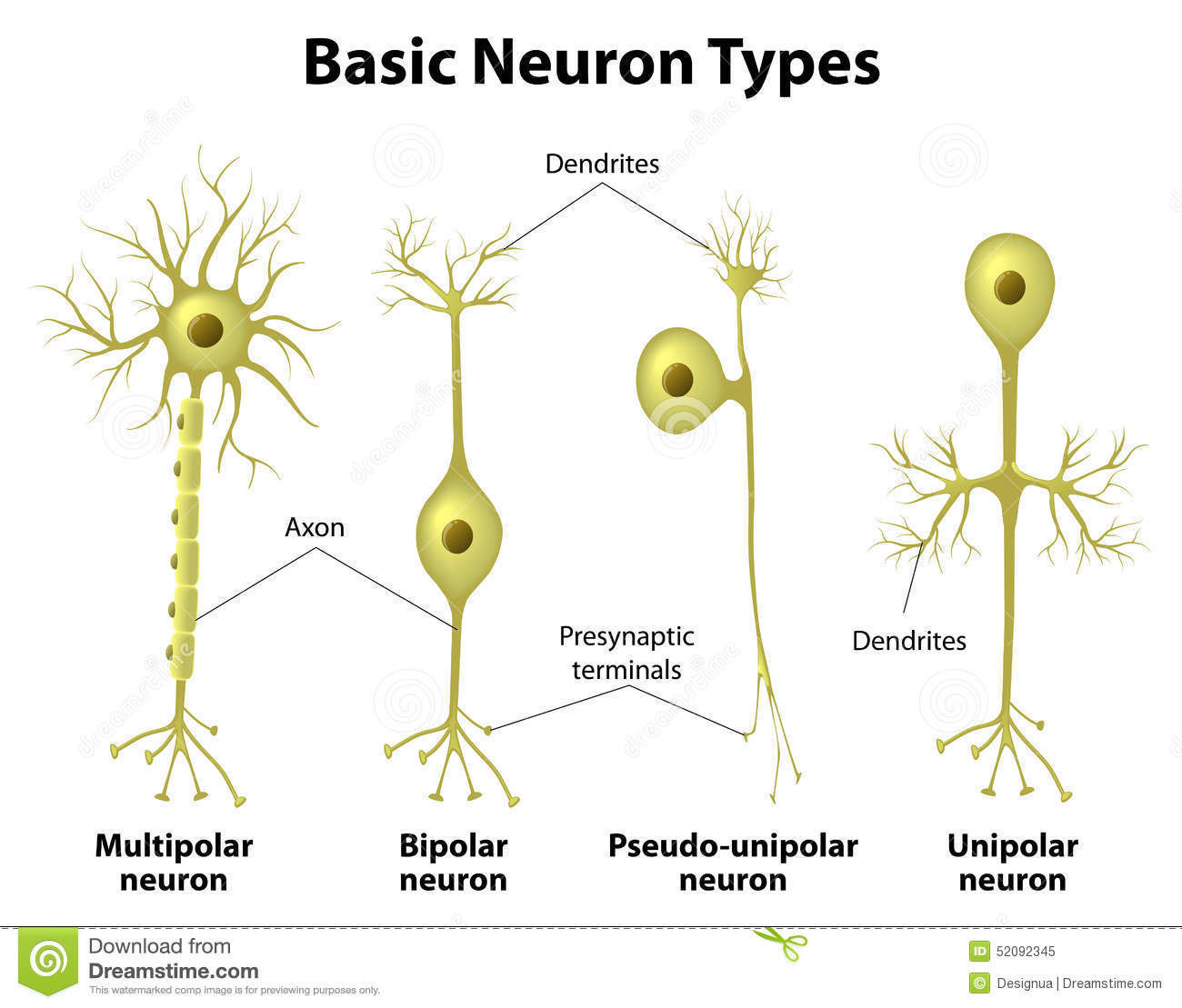
How are neurones classified? -give the different types ? (4)
according to shape: the no. of neurites arising from the soma -Unipolar (one neurite) e.g. peripheral autonomic neurone Pseudounipolar (one neurite that bifurcates) e.g. morals route gangloin Bipolar (two neurites) e.g.retinal bipolar neurone Multipolar (3 or more neurites) e.g. LMN
Functional regions of the neurone: name the 4 functional regions show where these are located on picture
Input Integrative Conductile Output
Action potential: describe how this occurs
depolarising stimulus depolarises membrane and brings the resting potential to threshold, If threshold is reached then voltage activate Na channels open and trigger explosive depolarisation the voltage activated K channels then open and the Na ones shut so get unopposed K conduction and rapid repolarisation and downstroke of the Action potential to dip below resting potential
Axon • function? • barrier to function? • what are the factors contributing to current spread?
• the Axon acts as a cable, transporting current. • the axon is leaky and so current will leak out over distance the leakage is greatest at the site of current injection and then lessens further from the site therefore the membrane potential change is a passive neuronal process and decays exponentially with distance • membrane resistance and axial resistance of the axoplasm
Passive conduction & AP velocity -How is passive conduction involved?
factor in AP propagation the longer the length constant the greater the local current spread and the greater the local current spread the increased AP conduction velocity. When depolarisation is sufficient the AP over on , there are inactive regions ahead and behind the AP as it moves along the neurone
how to increase passive current spread? -provided by what cells?
add insulating material i.e. myelin -Schwann cells in the PNS, many surround a single axon oligodendrocytes in the CNS, one surrounds many axons (both macroglia cells)
Saltatory conduction -describe what happens
action potential jumps from one node of Ranvier to the next (the node of Ranvier is the exposed axon between myelin sheaths, the village activated Na channels cluster at the nodes)
Types of synapse -how are the classified? (morphologically/functionally) -types? (3)
-morphologically by location of the presynaptic terminal upon the post synaptic cell functionally excitatory or inhibitory -Axodendritic (synapse at post synaptic cell dendrite ) Axiomatic (synapse at post synaptic cell soma) Axoaxonic (presynaptic terminal of one cell synapses on presynaptic membrane of another before synapse occurs on post synaptic cell)
Excitatory synapse • NT involved? • activates what?
• glutamate in CNS • postsynaptic cation selective, ionotropic, glutamate receptors generating a local, graded, excitatory (depolarising) response called the excitatory postsynaptic potential (e.p.s.p.)
Inhibitory synapse • NT involved? • activates what?
• GABA or glycine • postsynaptic anion selective ionotropic GABA or glycine receptors, generating a local, graded inhibitory (hyperpolarising) response called the inhibitory post synaptic potential
The chemical synapse • what is the synaptic cleft? • what holds the pre/post synaptic membranes together? • what stores NT? • what is different between the 2 membranes?
• the space that separates the pre and post synaptic membranes • a matrix of fibrous extracellular protein • vesicles in the presynaptic terminal • presynaptic: active zones around which vesicles cluster postsynaptic: contains NT receptors
Synaptic integration • what does this mean? • what are the two types?
-inhibitory and excitatory synapses are not separate, any neurone might receive hundreds of inhibitory and excitatory inputs at once Soma is an integrator and adds the signals together so the effects is either NET inhibitory or NET excitatory -Spatial summation many inputs converge upon a neurone to determine it’s output Temporal summation single input may modulate output by variation in action potential frequency of that input these both occur simultaneously and are complimentary
Give an overview of chemical neurotransmission? (9)
Uptake of precursor Synthesis of transmitter Storage of transmitter Depolarization by action potential Ca2+ influx through voltage-activated Ca2+ channels Ca2+- induced release of transmitter (exocytosis) Receptor activation Enzyme-mediated inactivation of transmitter OR Reuptake of transmitter
NT synthesis and storage amino acids and amines -where are GABA and amines synthesised? • where are the enzymes ended synthesised and what do they do after? • how are NTs concentrated?
• specifically synthesised in neurones that releases them, so require specific enzymes • in cell body and transported to the presynaptic terminal by axoplasmic transport along microtubules they then get to the terminal and mediate synthesis in the cytoplasm of NTs from precursors • the NT is then concentrated in the vesicle
NT synthesis and storage Peptides • where are precursor peptides synthesised? • How is NT activated? tranport to terminal how?
• by ribosomes assoc with RER • cleavage of the precursors in golgi apparatus yielding active NT • secretory granules bud off from the golgi apparatus and then are transported to the presynaptic terminal by fast axoplasmic transport via microtubules