ChemPath: Lipoprotein metabolism, CVD and obesity
No description yet. This curated deck is ready for daily study.
Card preview (24)
What are the features of an atherosclerotic lesion?
• Fibrous cap • Foam cells (macrophages full of cholesteryl ester) • Necrotic core (full of cholesterol crystals)
What is the biggest plasma lipoprotein?
Chylomicrons
During what time will chylomicrons be most abundant?
After eating (they are present in very small amounts in the fasted state)
Describe the uptake of cholesterol by the intestinal epithelium.
• Cholesterol entering the intestines will come from the diet and bile • Cholesterol will be solubilised in mixed micelles • It is then transported cross the intestinal epithelium by NPC1L1 (this is the main determinant of cholesterol transport)
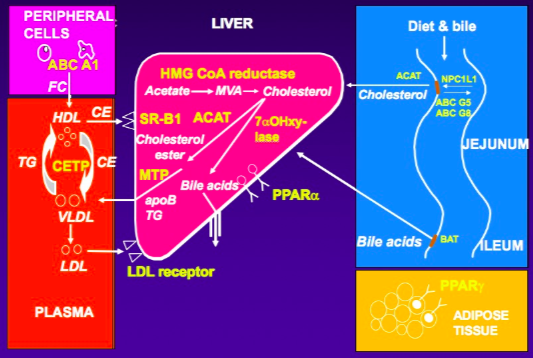
Name two transports that transport cholesterol back into the intestinal lumen.
ABC G5 ABC G8
Where are bile acids absorbed?
Terminal ileum
What happens when cholesterol arrives at the liver?
Downregulates the activity of HMG CoA reductase NOTE: HMG CoA reductase is responsible for the production of cholesterol from acetate and mevalonic acid
What are the two fates of cholesterol that is either produced by or transported to the liver?
• Hydroxylation by 7a-hydroxylase to produce bile acids • Esterification by ACAT to produce cholesterol ester which is incorporated into VLDLs along with triglycerids and ApoB
Which transfer protein is important in the packaging of VLDLs?
MTP
Which transfer protein is important in the packaging of HDLs?
ABCA1
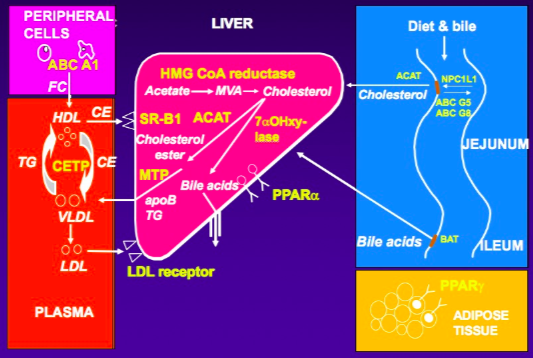
What are the effects of CETP on the movement of substances between lipoproteins?
• Moves cholesterol from HDL → VLDL • Moves triglycerids from VLDL → HDL
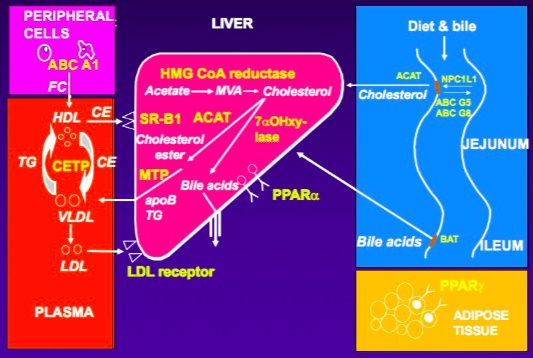
Which receptor is responsible for the uptake of some HDLs by the liver?
SR-B1
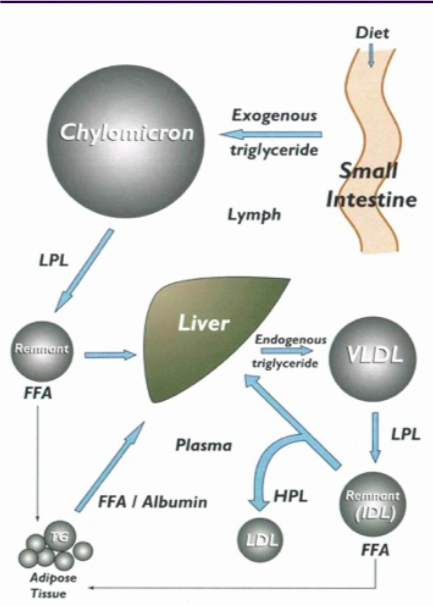
Describe the transport and metabolism of triglycerides.
• Triglycerides from fatty foods are hydrolysed to fatty acids, absorbed, and resynthesized into triglycerides which are transported by chylomicrons into the plasma • Chylomicrons are hydrolysed by lipoprotein lipase ino free fatty acids • Some free fatty acids are taken up by the liver, and some by adipose tissue • The liver resynthesizes fatty acids into triglycerides and packages them into VLDLs • VLDLs are acted upon by lipoprotein lipase to liberate free fatty acids
List the three causes of familial hypercholesterolaemia (type II).
• Caused by autosomal dominant gene mutations in: • LDL receptor • ApoB • PCSK9
List some mutations that are implicated in polygenic hypercholesterolaemia.
• NPC1L1 • HMGCR • CYP7A1
What is familial hyperalphalipoproteinaemia?
• Increase in HDL caused by deficiency of CETP • This is associated with longevity
What is phytosterolaemia?
• Increased plasma concentrations of plant sterols due to mutations in ABC G5 and ABC G8 NOTE: this condition is associated with premature atherosclerosis
Dsecribe the function of the LDL receptor.
• LDLs bind to LDLR in coated pits which then undergo endocytosis (thereby uptaking the LDL into the liver)
List some clinical features of familial hypercholesterolaemia.
• Xanthelasma • Corneal arcus • Tendon xanthomata
What is PCSK9?
• A protein that binds to LDL receptors and degrades them NOTE: gain of function mutations result in increased breakdown of LDLR and hence increased plasma LDL levels
List the key features of the following forms of familial hypertriglyceridaemia: • Familial Type I • Familial Type IV • Familial Type V
Familial Type I: • Caused by deficiency of lipoprotein lipase and ApoC II • NOTE: lipoprotein lipase degrades chylomicrons and ApoC II is an activator of lipoprotein lipase Familial Type IV: • Characterised by increased synthesis of triglycerides Familial Type V: • Characterised by deficiency of ApoA V • NOTE: these hypertriglyceridaemias show different patterns when the plasma is left overnight to separate
What is familial combined hyperlipidaemia?
Some people in the family have high cholesterol and others have high triglycerides
What is familial dysbetalipoproteinaemia (type III)?
• Due to aberrant form of ApoE (E2/2) • NOTE: normal form is ApoE (3/3) • A diagnostic clinical feature of yellowing of the palmar crease (palmar striae)
List some causes of secondary hyperlipidaemia.
• Pregnancy • Hypothyroidism • Obesity • Nephrotic syndrome