Protein Function: Catalysis
No description yet. This curated deck is ready for daily study.
Card preview (24)
What does a catalyst do?
Increases the rate of reaction by lowering the activation energy barrier in the absence of thermal activation
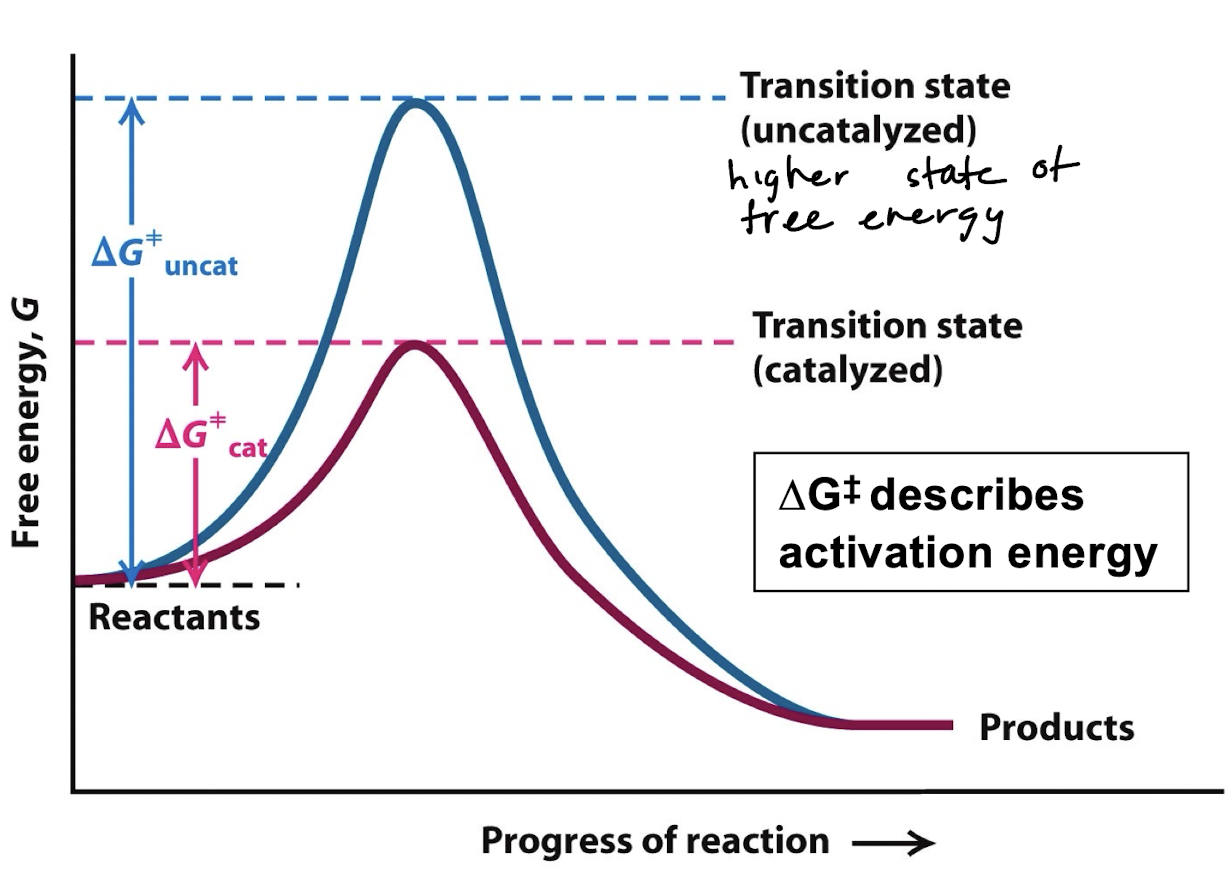
Why don’t reactions occur instantaneously?
Provides an opportunity for regulation; also, reactions in cells are steady state
Does a catalyst influence the rate of the reaction?
Yes
Does a catalyst influence the position of equilibrium of a reaction?
No.
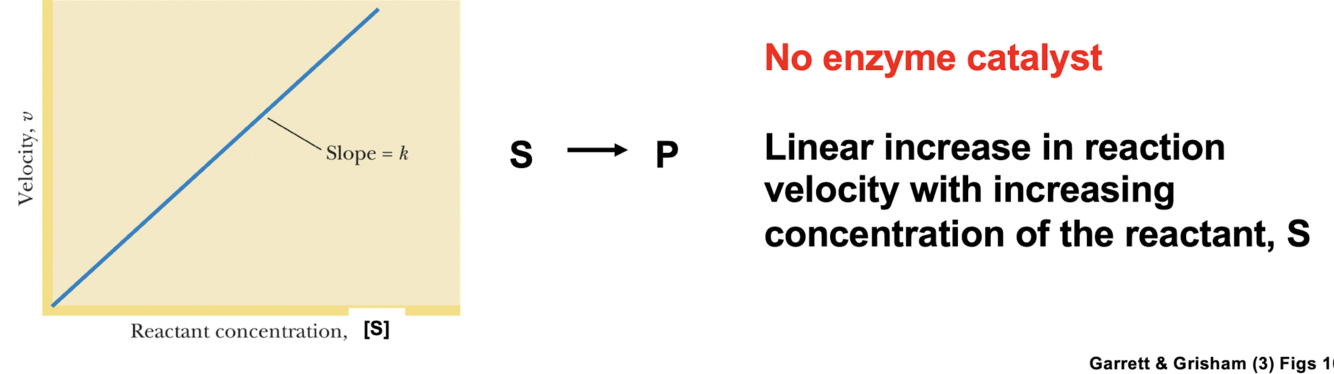
Describe the slope of the rate of a reaction and the concentration of a reagent without an enzyme catalyst.
Linear slope
Describe the slope of the rate of a reaction and the concentration of a reagent with an enzyme catalyst.
Hyperbolic slope, no longer linear
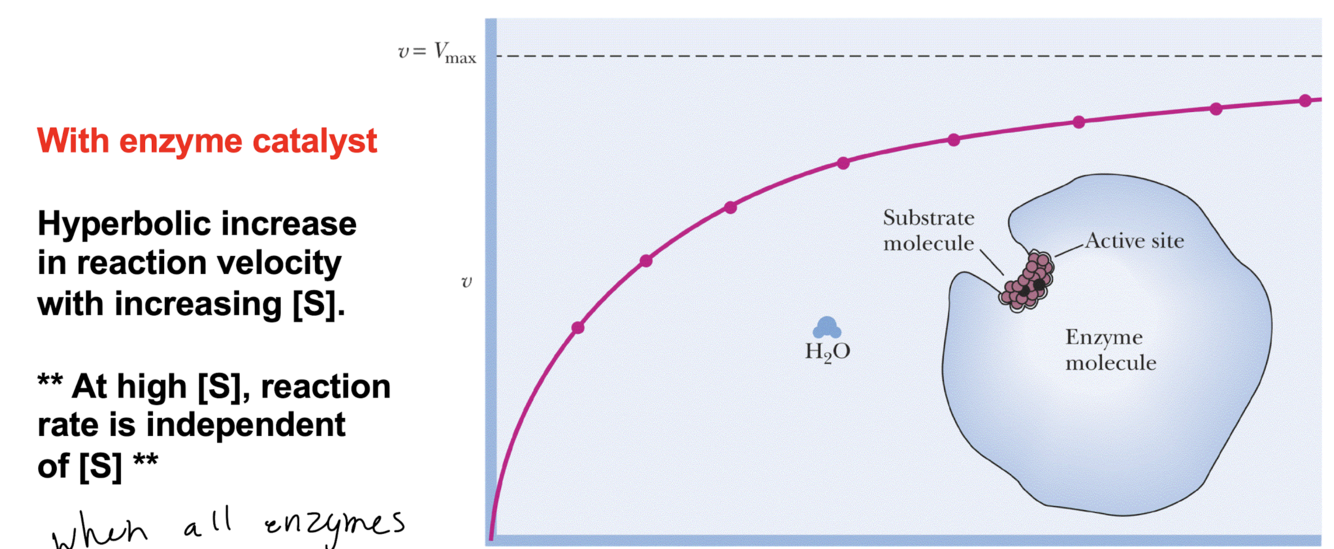
Why would a reaction’s rate plateau when using enzymes in vitro?
If the enzymes become saturated with substrates, then they’re all occupied and can not increase the rate any more.
What’s the first step of catalysis?
Substrate binding
How does a catalyst act?
Forms a reversible complex with a substrate, stabilizing a transition state
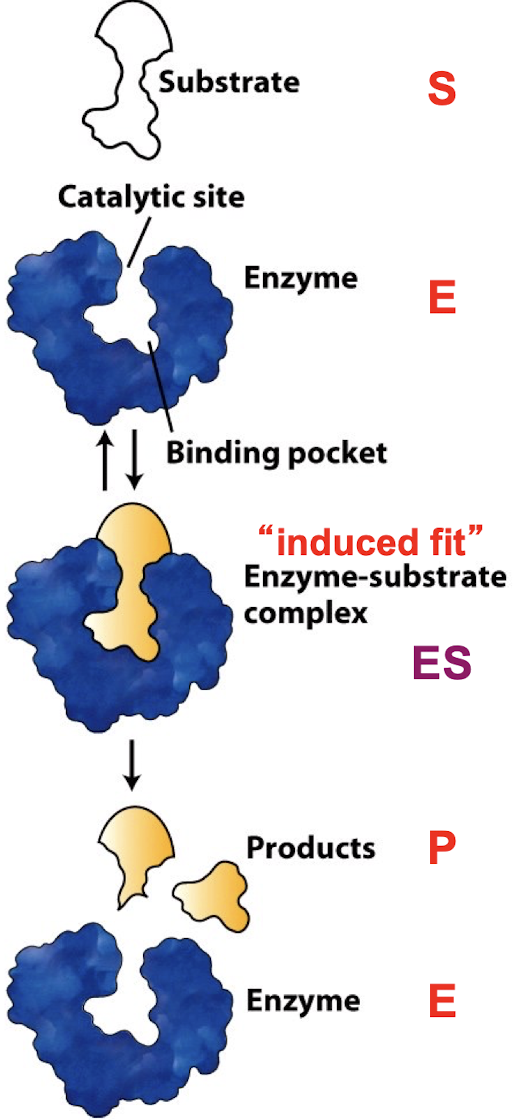
What does folding the catalyst do?
Creates a binding site where specific R groups are presented to each other; specific topology allows enzymes to have specificity.
Is Vmax ever reached?
No, it is only approached.
What is Vmax proportional to?
the concentration of enzymes
What is Vmax?
maximum velocity of a reaction, when 100% of the enzymes are bound to a substrate
What determines the initial rate of an enzyme catalyzed reaction?
Km, Vmax, and the initial substrate concentration
What does Vmax tell us?
• At high [S], reaction rates vary significantly among different enzymes. • Allows a calculation of kcat (the turnover number of a specific enzyme - measures how effective an enzyme is) • In vivo, few enzymes encounter saturating [S]; Vmax and kcat set upper bounds, enabling estimates of reaction rates in vivo.
What does Km (Michaelis Constant) tell us?
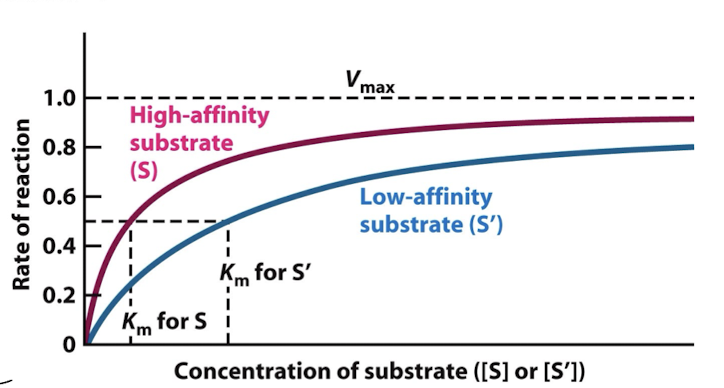
measure of affinity of enzyme for substrate
What does a high Km indicate?
low affinity for a substrate, may require higher substrate concentration for a reaction in vivo
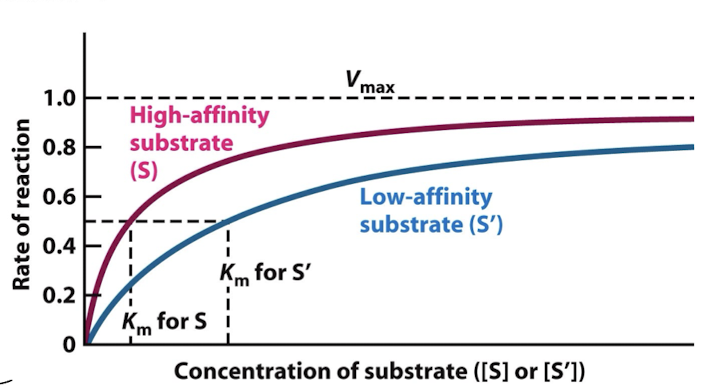
What does a low Km indicate?
high affinity for a substrate, may not require higher substrate concentration for a reaction in vivo
What are the four kinds of enzyme regulation?
• Substrate-Level • Covalent Modification (e.g. phosphorylation of Cdk) • Modulator Proteins • Allosteric
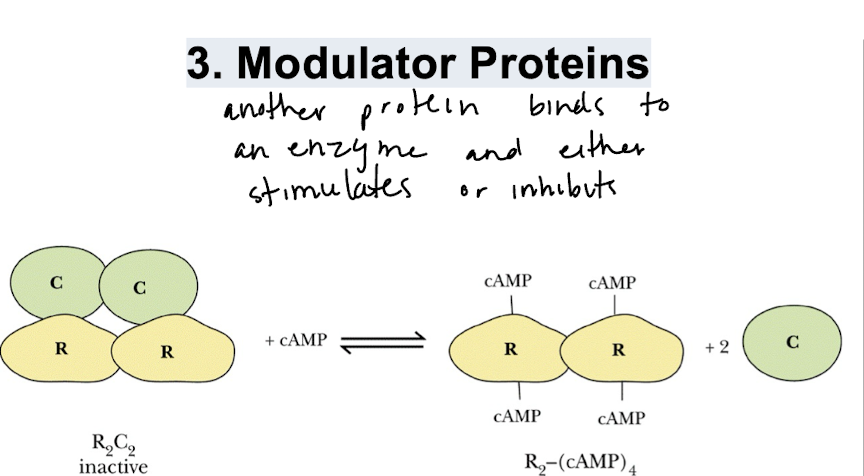
What do modulator proteins do?
Bind to enzymes and either stimulate or deactivate them
What is an allosteric effector?
a small molecule that regulates the activity of an enzyme for which it is neither substrate nor immediate product
Which kind of enzyme regulation does not obey Michaelis-Menten equation?
Allosteric
How does temperature relate to the rate of the reaction? What is the rule of thumb?
Increased temperature increases the rate. For every 10 degrees C increase, the rate doubles (until max activity).
Why are enzymes impacted by pH?
Many active sites have charged amino acid side chains and are ionizable.