periodic trends
No description yet. This curated deck is ready for daily study.
Card preview (24)
What is periodicity?
Periodicity is the recurring pattern in the physical and chemical properties of the elements, caused by repeating patterns in electron configuration, especially the arrangement of valence electrons.
How is the periodic table arranged?
The periodic table is arranged in order of increasing atomic number, which reflects increasing nuclear charge and repeating patterns in electron configuration.
What is a period?
A period is a horizontal row in the periodic table in which the elements show a progressive change in properties as the number of valence electrons and nuclear charge increase.
What is a group?
A group is a vertical column of elements with similar chemical properties because they have the same number of valence electrons.
What determines the block (s, p, d, f) an element belongs to?
The block is determined by which sublevel (s, p, d, or f) the highest-energy (last added) electron occupies in the ground-state electron configuration.
What characterises the s-block?
s-block elements (Groups 1 and 2 + He) have their highest-energy electron in an s orbital.
What characterises the p-block?
p-block elements (Groups 13–18) have their highest-energy electron in a p orbital.
What characterises the d-block?
The d-block contains elements in which the d sublevel is being filled (3d, 4d, or 5d), even if the final electron in the atom does not occupy a d orbital.
What characterises the f-block?
f-block elements (lanthanides and actinides) have their highest-energy electrons entering f orbitals.
Where are metals located on the periodic table?
Metals occupy the left side (s-block), the centre (d-block), and the f-block, with some metals also in the left side of the p-block (like Al, Pb).
Where are non-metals found?
Non-metals are primarily found in the upper right of the p-block.
What are metalloids?
Metalloids are elements that have metal-like physical properties but non-metal-like chemical properties.
Which elements are metalloids?
B, Si, Ge, As, Sb, Te, Po. They form the diagonal “staircase” between metals and non-metals.
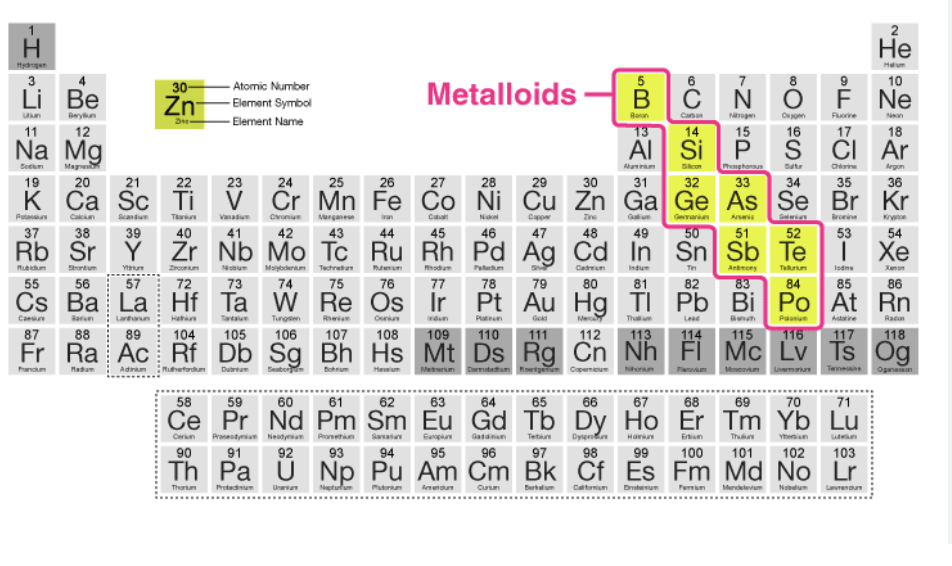
Why do elements in the same group have similar chemical properties?
They have the same number of valence electrons, which determines reactivity, bonding, oxidation states, and ion formation.
Why do properties change across a period?
Across a period, nuclear charge increases while electrons are added to the same energy level, increasing effective nuclear charge and altering properties such as atomic radius, ionisation energy, electronegativity, and metallic character.
What does the position of an element in the periodic table indicate?
It indicates: - its electron configuration - its valence electron count - its typical oxidation states - whether it is a metal, metalloid, or non-metal - This explains periodicity and similarities within groups.
Why is the periodic table useful for predicting chemical behaviour?
Because the arrangement by electron configuration gives predictable trends in: - reactivity - ion formation - bonding type - physical properties - acidity/basicity of oxides - metallic vs non-metallic character
What does the period number tell you?
The period number indicates the number of occupied principal energy levels (electron shells) in an atom.
What does the group number tell you?
The group number (1–18) indicates the number of valence electrons in the outer energy level.
What is meant by the s-, p-, d-, and f-blocks?
Blocks correspond to the sublevel in which the highest-energy electron is placed: - s-block: valence electrons in s subshell - p-block: valence electrons in p subshell - d-block: valence electrons in d subshell - f-block: valence electrons in f subshell
What groups belong to the s-block?
Groups 1 (alkali metals) and 2 (alkaline earth metals) + helium.
What groups belong to the p-block?
Groups 13–18, including halogens (17) and noble gases (18).
What elements belong to the d-block?
Groups 3–12, containing most transition elements.
What elements belong to the f-block?
Lanthanides and actinides, where electrons fill f orbitals.