Chapter 12
No description yet. This curated deck is ready for daily study.
Card preview (24)
Frequency of absorption decreases with
Increased atomic mass
Frequency of absorption increases with
Increased bond energy
A molecule is IR active if
Its movement in the electric field creates a change in dipole (must be polarizable)
A molecule is IR inactive if
There is no change in dipole moment, it is either symmetrical or non-polarizable.
IR active water molecules stretch in what way?
Asymmetrical stretching, or bending (towards one another)
Overtones
Occur with very strong vibrations (c=o) and appear as weak absorptions at double the fundamental frequency.
Why do conjugated carbonyl groups vibrate at lower frequencies than non-conjuated carbonyls?
Resonance reduces reduces dipole moment b/c electron density is spread out, which lowers stretch frequency.
Why do Nitriles exhibit stronger absorbency (longer spikes) than Alkynes?
C-N bond is more polarizable.
Functional Groups that vibrate at frequency of 3300cm^(-1) and appearance.
alcohol (O-H) - broad Amines/amide (N-H) - broad, sharp, or with spikes Alkyne (C-C)- always sharp, usually strong
Functional Groups that vibrate at frequency of 3000cm^(-1) and appearance.
Alkane (C-H) - just below 3000 Alkene (C=H) - just above 3000 Acid (O-H) - very broad
Functional Groups that vibrate at frequency of 2200cm^(-1)
Alkyne (C=-H) - just below 2200 Nitrile (C=-N) - just above 2200
Functional Groups that vibrate at frequency of 1710cm^(-1) (very strong)
Carbonyls: ketones and acids: 1710 aldehydes: 1725 + 2700,2800 esters: 1735 + 2500-3500
Functional Groups that vibrate at frequency of ~1685cm^(-1) and appearance.
conjugated carbonyls: ketones: 1685 aldehydes: 1690 acids: 1687
Functional Groups that vibrate at frequency of 1660cm^(-1)
conjugated alkenes inimes (C=N) - stronger than C=C amide (C=O group)
Functional Groups that vibrate at frequency of 1600cm^(-1)
Aromatic C=C bonds
Functional Groups that vibrate at frequency of 1000-1200cm^(-1)
C-O bonds of ethers, esters, and alcohols.
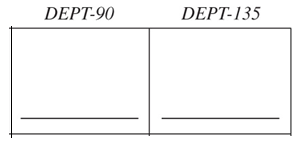
quaternary
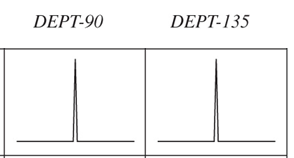
methine C-H
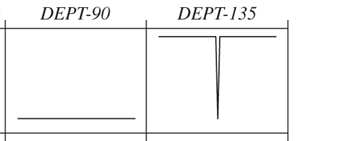
methylene CH2
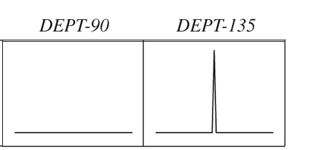
methyl CH3
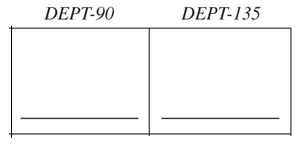
quaternary
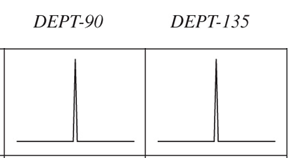
methine C-H
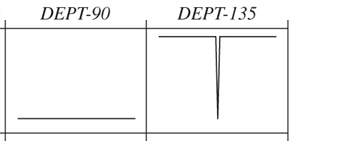
methylene CH2
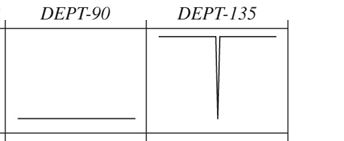
methylene CH2