Lecture 5 : Translation II (Mutations)
No description yet. This curated deck is ready for daily study.
Card preview (12)
When do mutations happen? Where? How?
When do mutations happen in genomic sequence?
• Most likely during DNA replication • Impacts base pairing with AT and GC • Distances between chains can alter which destabilises hydrogen bonds, takes up different spatial space in nucleus, strand slippage
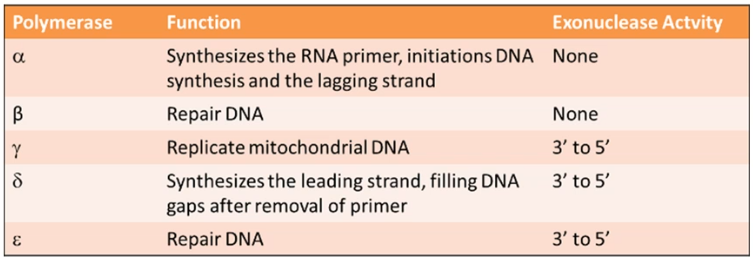
DNA polymerase and mutations
• Mistake 1 in every 100000 nucleotides • Mistakes corrected during proof reading (fixes 99% of errors) • Some corrected during mismatch repair • Incorrectly paired nucleotides that remain following mismatch repair become PERMANENT mutations after cell division.
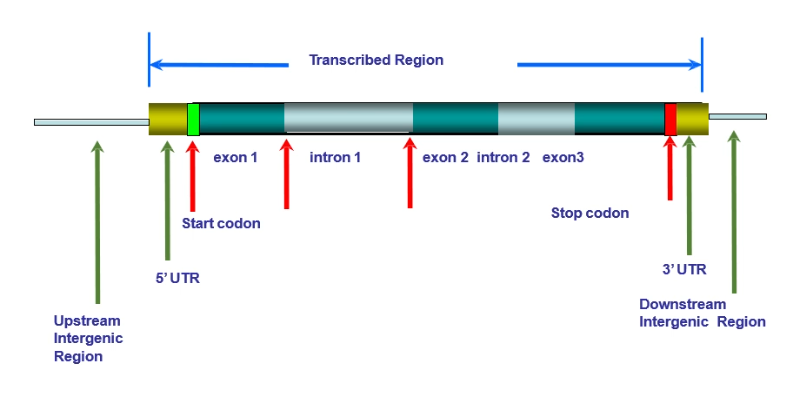
Where in the genome can these mutations happen
• If in UTR regions it doesnt really matter to this protein • If where the red arrows are, it may have a huge effect • If mutation in promoter, if between GC box or TATA box or CCAAT box then its ok, but if it happens at beginning of transcriptional start site then we’re cooked
How can genomic mutations happen
Induced - Environmental agents, UV rays, exposure to chemicals Spontaneous - Wobble-iduced, replication errors
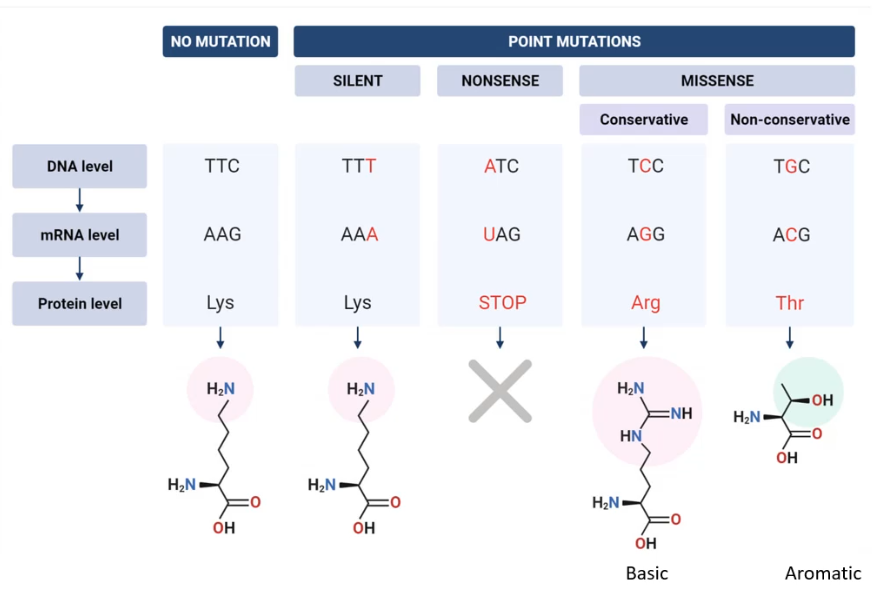
What are point mutations
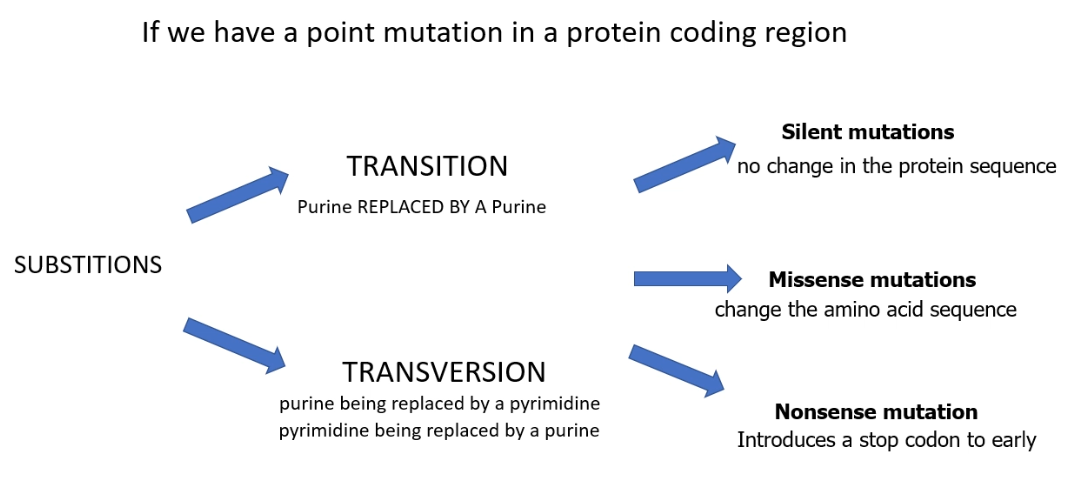
Point mutations - single base pair (can have no effect) Substitutions are a type of point mutation, which can be a transition or a transversion substitution
What are point deletions ( i guess same principle could apply for point additions)
• A point deletion is a FRAMESHIFT MISSENCE MUTATION • If a region of termination sequence (x stop codon) is deleted, a frameshift mutation occurs causing EXTENSIVE missence (next codon needs to be searched for)
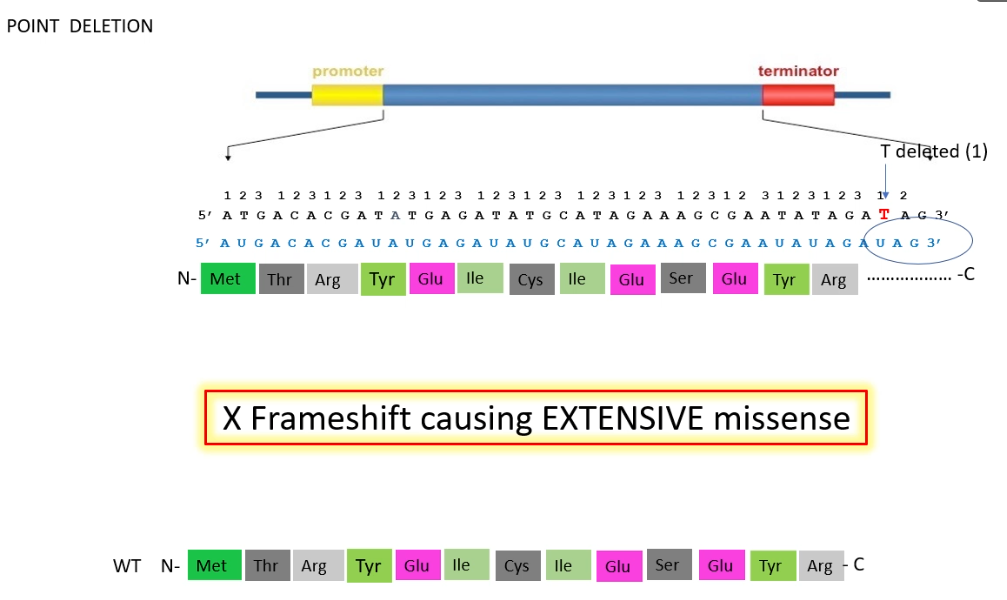
What is frameshift nonsense
• Stop codon introduced
What is extensive missence
When a stop codon is mutated and another stop codon needs to be searched for, extending amino acid sequence unwantedly
What happens if you add 3 bases after position 3
No frameshift, look if its multiple of 3 or not, but mutation still.
Summary
Remember, hydrophobic amino acids may be swapped for hydrophobic amino acids and so little biochemical properties may change
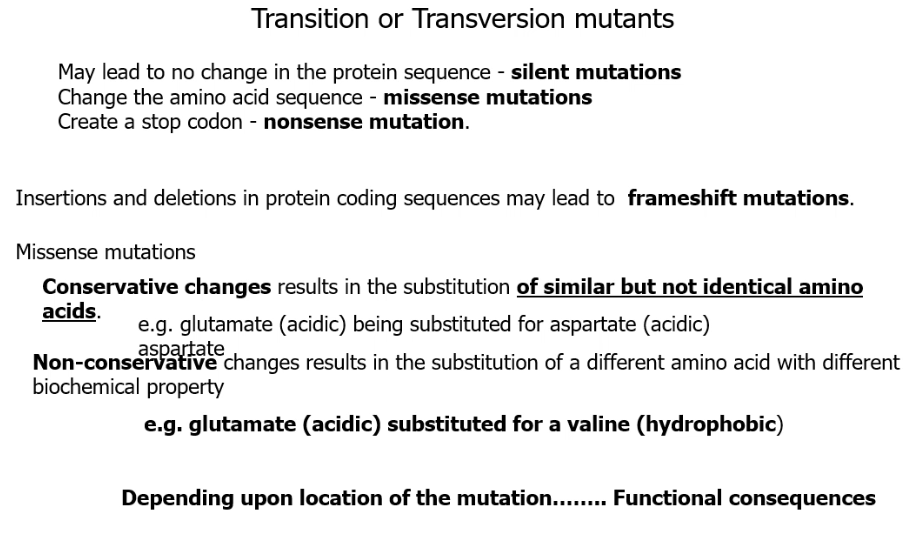
Summary 2
Degeneracy, silent mutations