Human nervous system
暂无描述。系统推荐的高质量记忆内容,适合每天坚持背诵学习。
卡片预览 (22 张)
How is the nervous system organized?
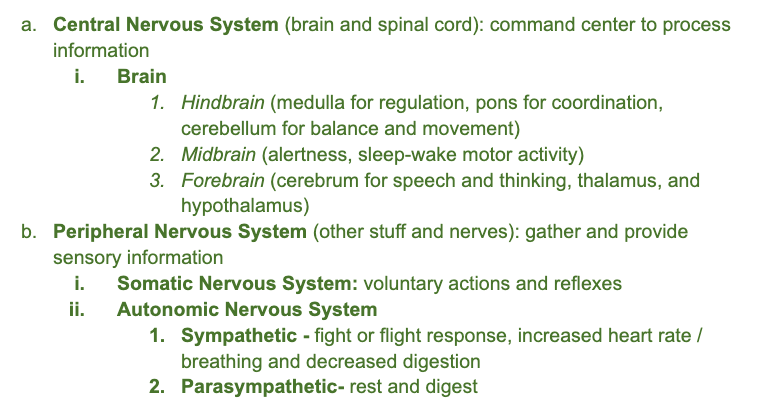
What cells are in the central and peripheral nervous systems?

What is the function of the sensory-somatic and autonomic nervous systems?

What do the sympathetic and parasympathetic systems do?

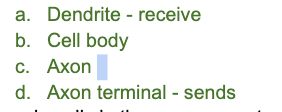
What is the structure of a neuron?
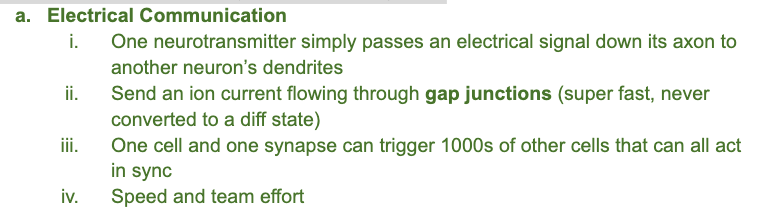
What is electrical communication
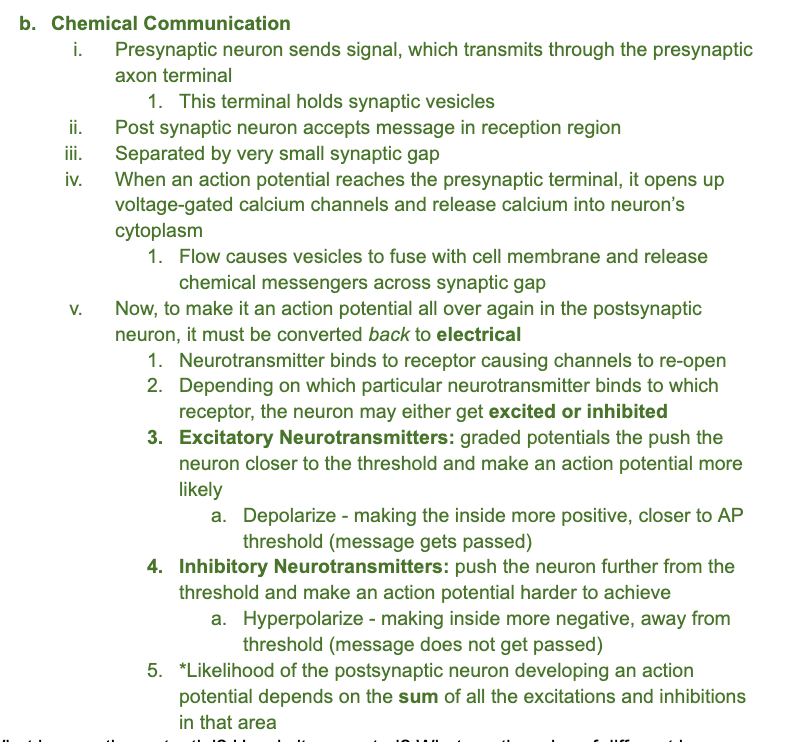
Chemical communication
What is an action potential? How is it generated? What are the roles of different ion channel proteins?
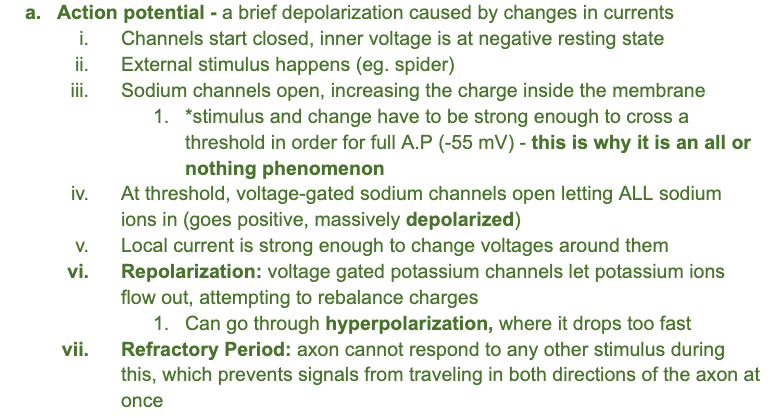
Why do action potentials move only in one direction?

What is myelin and what is the effect of saltatory conduction?

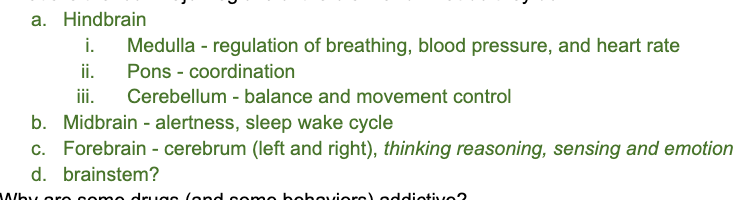
What are the four major regions of the brain and what do they do?
Why are some drugs (and some behaviors) addictive?

motor neurons
neuromuscular junction
spinal cord
bundle of nerve fibers within the spinal collumn, transmits signals between brain and body
steps of action potential
• A signal comes in • Stimulus depolorizes the membrane • Sodium rushes in (positive charge in neuron) • 30 plus MU sodium chanel inactivated, gates locked, but potassium opens (the voltage gate) • Inside of cell goes negative again – repolarization • hyper polarization, leak channels and sodium potassium bring it back to normal
how do neurons communicate
frequency, not height or speed
what is muscle memory
activating neural pathways, practice widens the path
competition/ survival of the fittest not really
the connections that are strongest survive
what is synaptic pruning
Synaptic pruning helps to refine and optimize the neural circuitry by eliminating unnecessary or weaker synapses while strengthening and preserving important connections.
how does lead interfere with synaptic pruning
Studies have shown that lead exposure can alter the levels of certain neurotransmitters, such as glutamate and gamma-aminobutyric acid (GABA), which are crucial for maintaining the proper balance between excitation and inhibition in the brain. This imbalance can disrupt the normal patterns of neural activity and interfere with the selective elimination of synapses during pruning. Furthermore, lead can interfere with the function of glial cells, which play important roles in synaptic pruning.
what is long term potentiation
Long-term potentiation (LTP) is a phenomenon that refers to the long-lasting strengthening of synapses between neurons. It is considered one of the primary cellular mechanisms underlying learning and memory formation in the brain.
What is AMPA and NMDA
AMPA receptors are involved in the transmission of signals between neurons by responding to the neurotransmitter glutamate. When glutamate binds to AMPA receptors, it causes the opening of ion channels, allowing the influx of sodium ions into the postsynaptic neuron. This influx of positive ions leads to depolarization of the postsynaptic membrane, promoting the generation of an action potential. Unlike NMDA receptors, AMPA receptors are not voltage-dependent. Their activation depends solely on the binding of glutamate. AMPA receptors are responsible for the initial fast excitatory response at the synapse, while NMDA receptors contribute to the later stages of synaptic potentiation, such as long-term potentiation (LTP). The combination of NMDA and AMPA receptors at synapses is crucial for synaptic plasticity.