3. Political preferences and voting behaviour
No description yet. This curated deck is ready for daily study.
Card preview (21)
What is the traditional view on how preferences are formed
Economic factors were seen as the dominant explanation for why and actor held the preferences they did
Describe Karl Marx’ theory on how preferences were formed
An individual’s understanding of the world was determined by their relationship to the “means of production” (physical objects needed to produce goods – land, factories, mines, tools) Basically, whether you were an owner of capital or a worker determines your political viewpoint
Describe Max Weber’s belief on how political preferences are formed
Also believed that economics was the primary determinant of political viewpoint but he believed it was wealth and not ownership of capital that was the determining factor So a well-paid worker may have more in common with an owner of capital than with other workers
What happened in the 1960s that challenged the viability of the traditional view of how political preferences are formed
• Embourgeoisment of society • New classes that blurred the liens between wealthy and poor (the middle class) • New liberal professions (doctors, lawuers, teachers, journalists)
What are the most commonly used left-right dimensions
Left • Progressives and social liberals Right • Conservatives and capitalists
Why do political scientists like the traditional right-left dimension
Appealing because it is nearly universal (present in almost every country) This enables comparisons between countreis and also over time
What were Dalton’s findings relating to the left-right scale
• Found that in most countries, over 50% of people were able to locate their political preferences on a left-right dimension • Broad nature limits the analytical use of the left-right dimensions • Left-right scale was comprised of different issues in different regions of the world • In advanced industrial societies the two strongest issues people associated with the left-right scale were economics and religion • Eastern Europe = economics and religion • Latin America = gender and religion • Asian democracies = gender and nationalism • Arab countries = mainly religion and also gender
Which 2 distinct dimensions do most political scientists use
Economic left-right dimension Left Right State should intervene State should not intervene • How far a state should intervene in the economic freedoms of its citizens • Welfare state, taxation, market regulation Social left-right dimension Left Right State should not intervene State should intervene • How far the state should intervene in the social freedoms of its citizens • Minority rights, lifestyle choices and post-material issues
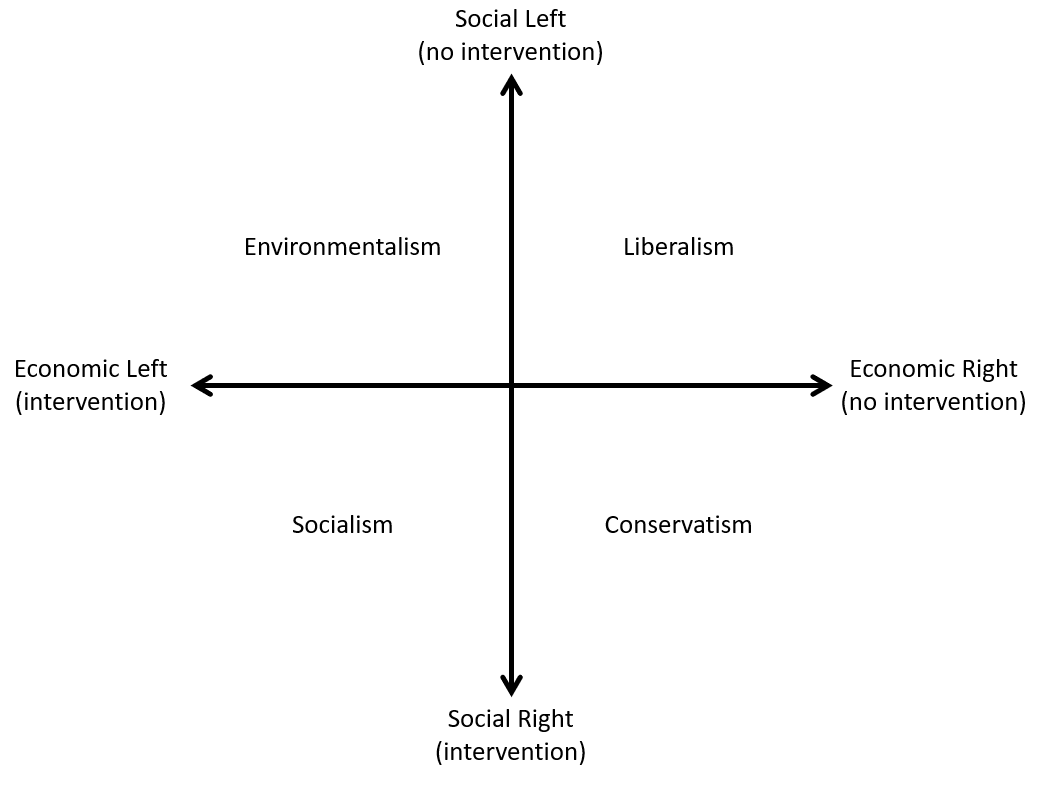
Describe Liberalism
• Emerged in 19th century • Economic and social freedoms
Describe Conservatism
• Evolved as a defense against liberalism and the threat to traditional authorities (church and aristocracy) • Greater intervention to social freedoms but still minimal intervention on economic freedom
Describe Socialism
• Late 19th century / early 20th century • Emerged with the extension of voting to working class men • In favor of both economic and social intervention
Describe Environmentalism
• Emerged in 1960s-70s • Non-intervention on social freedoms • Intervention on economic freedoms in order to protect the environment
What is the cleavages model
A theory for explaining voting behaviour Focussed on how social group membership (such as class) led to party identification and this rigidly influenced who they voted for
What is expressive voting
Related to the Cleavages model • Voting on the basis of party attachment, political ideology or social group membership • Preferences don’t matter, voting was a reflection of a person’s identification with a particular party • This identification was formed on the basis of an individual’s membership in a particular social group
What is a cleavage
A divide in society that provided the potential for political conflict
Provide 2 examples of cleavages
Industrial revolution * Upper and middle classes (conservative/liberal) vs Working class (socialist/social democrat) Democratic revolution (late 19th century) • Traditional elites and authority structures (church) vs Newly emerging liberal professionals (state)
Name 2 implications of the cleavages model
• Once a citizen identifies with a party, they don’t necessarily appraise the party’s policies or exercise reflective judgement prior to voting • Voting patterns shoudl be stable and slow to change
Describe the de-alignment of cleavages
1960s-70s - cleaves model was no longer able to explain voting behaviour • Increase in economic growth and prosperity led to embourgeoisment of working class • Reduced inter-class conflict • Introduction of public/private divide • Increase in education levels and media • Rise of post-material values
What is The Alford Index
A measure utilised with the cleavages model • Measure of class voting • Percentage of workign class voters who voted for their expected class-based parties minus the percentage of upperclass who voted for this party • Shows a marked decline in class voting since the 1960s
What is the Strategic Voting theory
Refers to voting to produce an election outcome which is as close as possible to one’s policy preferences May or may not mean voting for one’s preferred party Model assumes a voter can locate their preferred position on a one or two-dimensional scale and that they can estiamte the distance between theis point and the differnt policy proposals offered by each party
Provide 2 examples of Strategic Voting
Local • If a voter’s preferred candidate has no chance of winning, he ay vote for the next best thing National • Preferred party has no chance or will form a coalition with a party much further away from voter’s preferences • May vote for aparty that has a chance which is close to preferences