Unit 1-Rates Of Reactions
No description yet. This curated deck is ready for daily study.
Card preview (14)
What is meant by the rate of a chemical reaction?
How fast reactants are used up or how fast products are made
Name the four factors which speed up the rate of a reaction.
Higher temperature Higher concentration Smaller particle size (larger surface area) A suitable catalyst
Why does increasing temperature increase reaction rate?
Particles move faster, collide more often, and with more energy.
Why does increasing concentration increase reaction rate?
More particles in the same space leading to more collisions.
Why does decreasing particle size increase reaction rate?
More surface area exposed for collisions.
What is a catalyst?
A substance that speeds up a reaction without being used up.
What word describes a biological catalyst?
Enzyme
What quantities can be measured to find the rate?
Changes in mass Changes in volume Changes in concentration
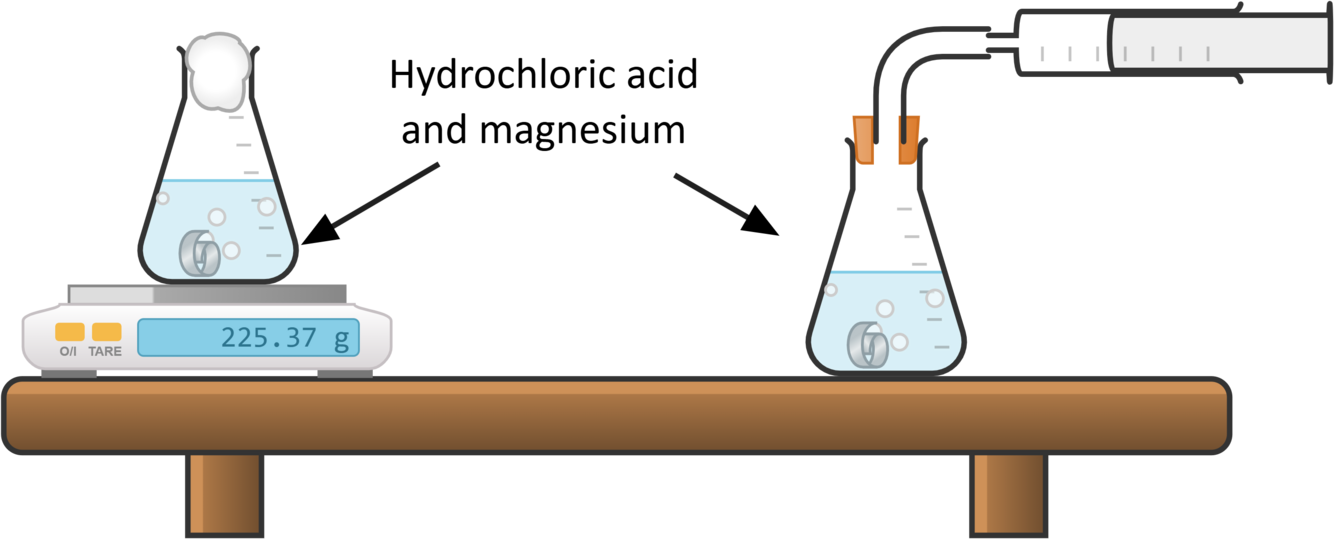
How can you measure the rate of the reaction between magnesium and dilute hydrochloric acid?
Use a balance to measure mass loss as hydrogen escapes. or collect the hydrogen gas in a gas syringe or over water.
How is the average rate of reaction calculated?
Average rate = change in quantity ÷ change in time Average rate = ∆quantity ÷ ∆t
State the units for rate when measuring: Volume in cm³ over seconds Mass in grams over seconds Concentration in mol l⁻¹ over minutes
cm³ s⁻¹ g s⁻¹ mol l⁻¹ min⁻¹
If a reaction produces 120cm³ of gas in 15 seconds, what is the average rate?
Average rate = ∆quantity ÷ ∆t = 120 ÷ 15 = 8 cm³ s⁻¹
What happens to the rate as a reaction progresses?
It slows down because reactants are used up, so collisions happen less often.
Which graph shows the faster reaction? How do you know when a reaction is finished?
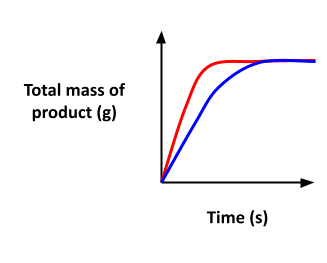
The steeper curve is the faster reaction. The reaction is finished when the graph levels off (no more product made).