Organic 4: Alkenes
No description yet. This curated deck is ready for daily study.
Card preview (24)
Why are alkenes more reactive than alkanes?
High electron density of the C=C double bond
Describe the structure of ethene.
Planar 120 degree bond angle
What is restricted rotation?
Double bonds cannot rotate due to the presence of the pi orbital in the double bond, which creates a region of high electron density that must be broken for rotation to occur
What are the CIP rules?
Compare the groups attached to each carbon on either side of a double bond The highest priority group will be the group with the highest Mr If the highest priority groups are on the same side of the double bond, it is a Z-isomer If they are on opposite sides, it is an E-isomer
Describe the physical properties of alkenes.
Similar to alkanes Alkenes are insoluble in water Higher bond enthalpy than alkanes
Give the equation for a complete combustion reaction of ethene.
Ethene + Oxygen –> Carbon Dioxide + Water
Explain the mechanism for producing a halogenoalkane from an alkene.
1) The delta positive hydrogen on H-Br is attracted to the double bond of the alkene due to its high electron density 2) A pair of electrons from the C=C bond moves to the hydrogen, forming a bond and creating a carbocation 3) The electrons in H-Br move towards the more electronegative Br, breaking the H-Br bond leaving a Br- ion 4) The Br- ion is then attracted to the C+ on the carbocation, forming a bond with one of its pairs of electrons
Describe the mechanism for producing a dihalogenoalkane from an alkene.
Electrophilic addition Reagents: Aqueous halogen solution, or chlorine gas Conditions: Room temperature Products: Dihalogenoalkanes
Describe the mechanism for producing a halogenoalkane from an alkene.
Electrophilic addition Reagents: Hydrogen halide Conditions: Room temperature Product: Halogenoalkane
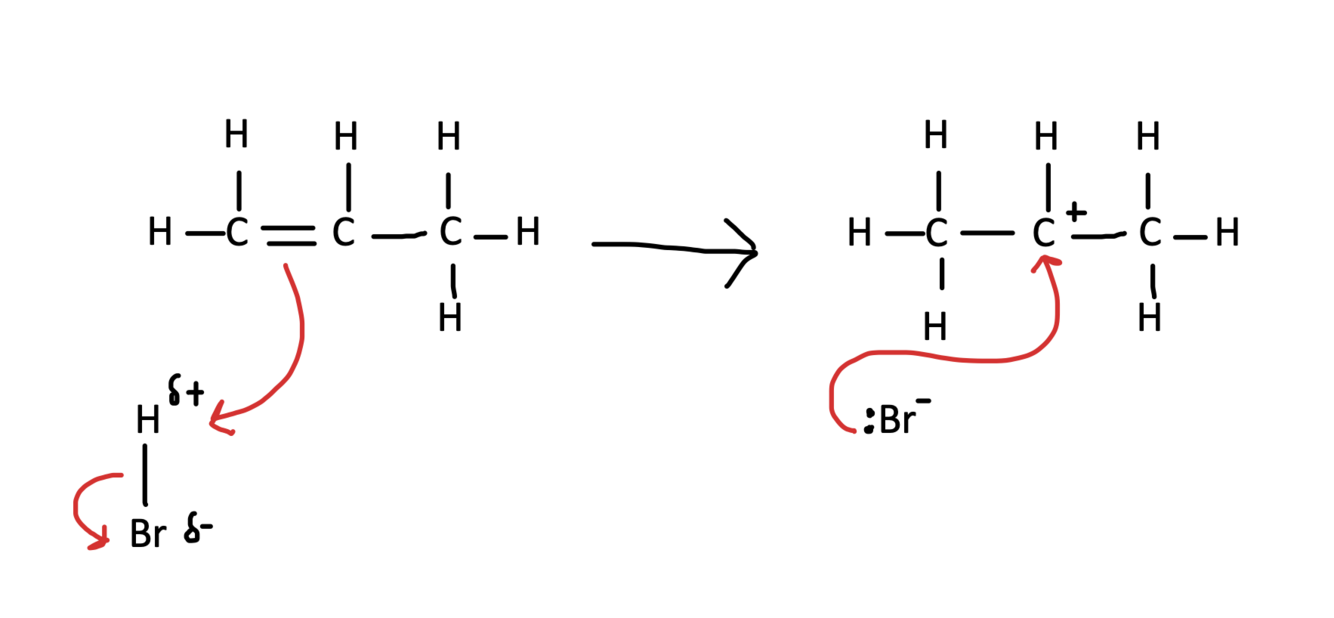
Why is the major product formed from a secondary or tertiary carbocation?
Because alkyl groups have a positive inductive effect, which stabilises the positive charge of the carbocation
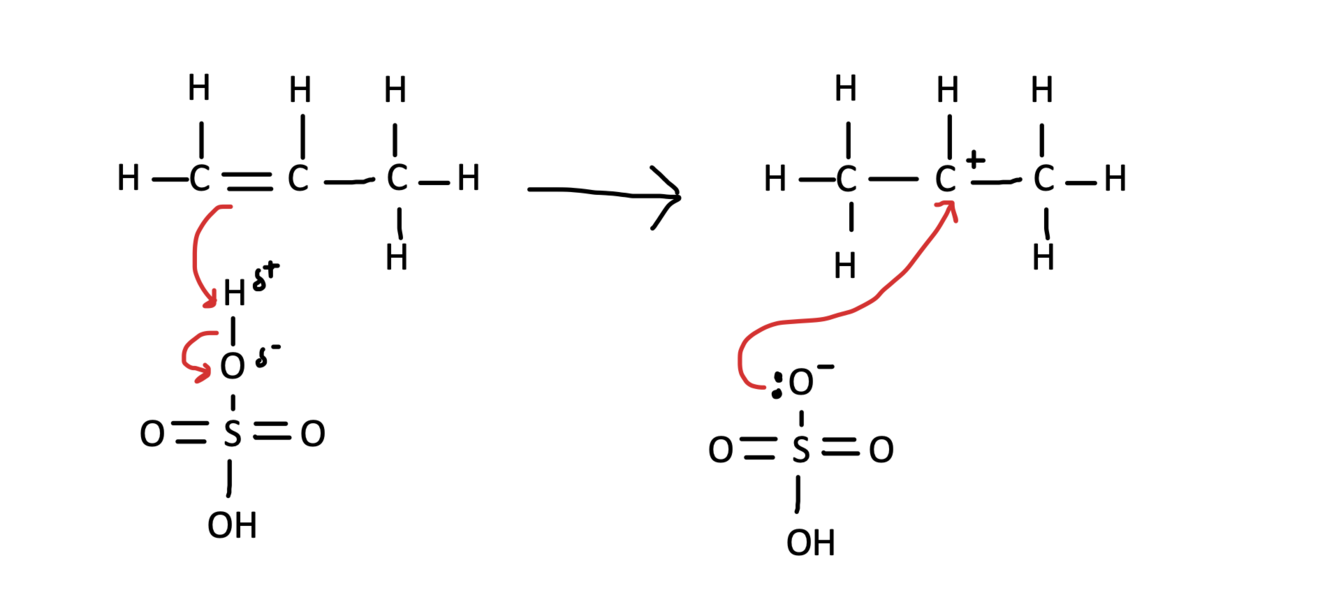
Describe the mechanism of forming an alkylhydrogensulfate from an alkene.
Electrophilic addition Reagents: Concentrated sulfuric acid Conditions: Room temperature Products: Alkylhydrogensulfate *Water can then be added to produce an alcohol and sulfuric acid
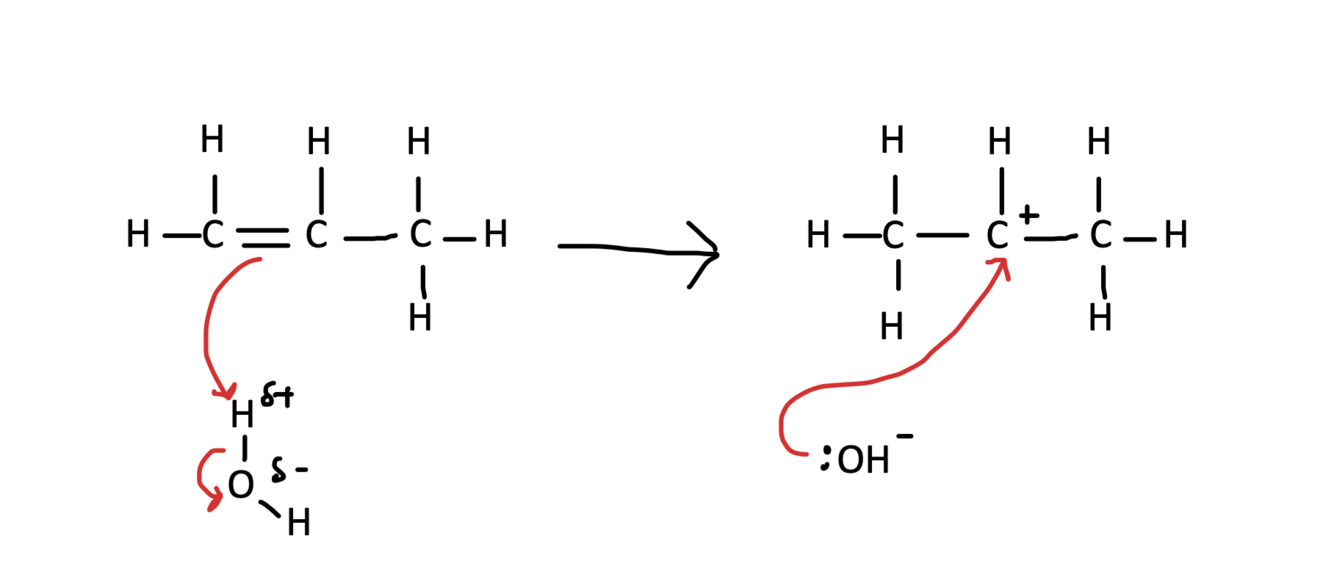
Describe the mechanism for producing an alcohol from an alkene using water.
Electrophilic addition (Direct industrial hydration) Reagents: Steam Conditions: Acid catalyst (e.g. H3PO4) High temperature, high pressure Products: Alcohols
What is a polymer?
A large molecule built up from monomers
What is an addition polymer?
A polymer made from alkene monomers based on ethene
What happens when monomers polymerise?
The double bond opens up, and monomers bond together to form a backbone of carbon atoms
Name the polymer formed by phenylethene.
Polyphenylethene
Why are addition polymers unreactive?
Because they form long, saturated alkane molecules with strong non-polar bonds
Why are addition polymers not biodegradable?
They cannot be attacked by biological agents like enzymes due to their strong non-polar bonds which makes them very unreactive
Describe mechanical recycling.
Separating plastics to be washed and sorted, ground into small pellets, and remoulded into new items
Describe feedstock recycling.
Plastics are heated to a temperature that will break the polymer bonds and produce monomers, which can then be used to make new polymers
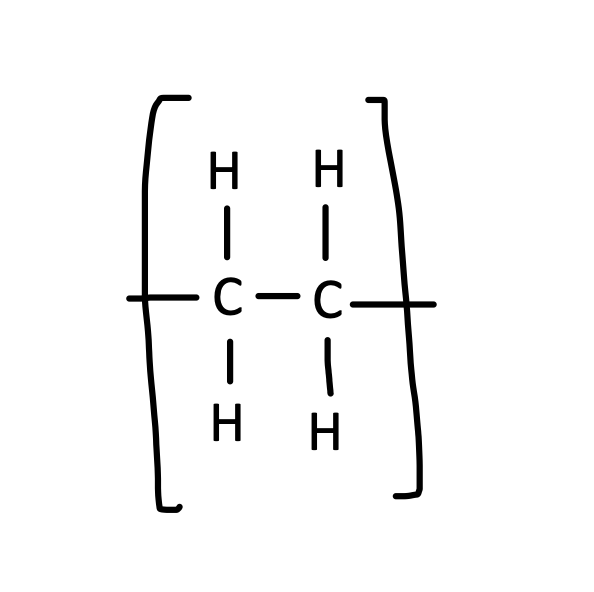
How do you draw a repeating unit of an alkene?
How do you test for alkenes?
Bromine water Will undergo an electrophilic addition reaction Positive result: Orange-brown –> colourless
What is polychloroethene?
Waterproof polymer Electrical insulator Doesn’t react with acids
What state is polychloroethene (PVC) in its pure form?
A rigid plastic Due to strong intermolecular bonding between polymer chains (i.e. dipole-dipole) Which prevents them from moving over each other