S4) Healthcare Economics
暂无描述。系统推荐的高质量记忆内容,适合每天坚持背诵学习。
卡片预览 (21 张)
Scarcity is a basic concept in healthcare economics. What does it mean?
- Scarcity is when the need outstrips resources • Prioritisation is inevitable
Efficiency is a basic concept in healthcare economics. What does it mean?
Efficiency means getting the most out of limited resources
Equity is a basic concept in health economics. What does it mean?
Equity is the extent to which distribution of resources is fair
Effectiveness is a basic concept in healthcare economics. What does it mean?
Effectiveness is the extent to which an intervention produces desired outcomes
Utility is a basic concept in healthcare economics. What does it mean?
Utility is the value an individual places on a health state
Opportunity cost is a basic concept in health economics. Explain what it means using an example
E.g. Resources spent on a new treatment, cannot now be used on other treatments The opportunity cost of the new treatment is the value of the next best alternative use of those resources
What is technical efficiency?
Technical efficiency is finding the most efficient way of meeting a need e.g. should antenatal care be community or hospital-based?
What is allocative efficiency?
Allocative efficiency involves choosing between the many needs to be met e.g. fund hip replacements or neonatal care?
What does an economic analysis involve?
An economic analysis compares the inputs (resources) and outputs (accompanying benefits and value) of alternative interventions
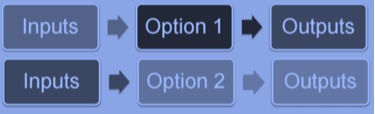
Identify 5 ways of measuring costs
• Costs of the healthcare services • Costs of the patient’s time • Costs associated with care-giving • Other costs associated with illness • Economic costs borne by the employers, etc
How do we measure benefits?
• Impact on health status • Savings in other healthcare resources if the patient’s health state is improved • Improved productivity if patient returns to work earlier
Identify 4 ways of comparing costs and benefits
• Cost minimisation analysis • Cost effectiveness analysis • Cost benefit analysis • Cost utility analysis
Outline cost minimisation analysis
• Outcomes assumed to be equivalent • Focus is on costs i.e. only the inputs • E.g. All prostheses for hip replacement improve mobility equally. Choose the cheapest one.*
Describe the use of cost effectiveness analysis
Used to compare drugs or interventions which have a common health outcome E.g. reduction in blood pressure - if costs are higher for one treatment, but benefits are too, calculate how much extra benefit is obtained for the extra cost
Describe the use of cost benefit analysis
• All inputs and outputs valued in monetary terms • Methodological difficulties e.g. putting monetary value on non-monetary benefits such as lives saved
Describe the use of cost utility analysis
• Focuses on quality of health outcomes produced or foregone • Most frequently used measure is quality adjusted life year (QALY) and interventions can be compared in cost per QALY terms
What are QALYs?
• QALYs adjust life expectancy for quality of life • 1 year of perfect health = 1 QALY
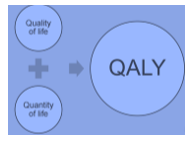
Provide 2 examples to illustrate the value of 1 QALY
Hence, 1 QALY = • 10 years with 0.10 perfect health • 6 months of 100% health for 2 people
A woman diagnosed at age 54 with peptic ulcer can expect to live 23 years. QoL without treatment is 0.7 of perfect health. How many QALYs does she have without treatment?
0.7 x 23 = 16.1 QALYs without treatment
This same woman, with 16.1 QALYs (23 years of 70% perfect health) can take treatment and live for 23 years with 0.95 perfect health. The treatment is 50 GBP per annum. What is the cost per QALY gained?
• QALYs with treatment = 21.85 (0.95 x 23) • QALYs gained = 5.75 (21.85 - 16.7) • Total cost of treatment = £1,150 (23 x 50) Cost per QALY gained = £200 (£1,150 / 5.75)
What are the main criticisms of QALYs?
• May disadvantage common conditions • QALYs may not embrace all dimensions of benefit • Values expressed by experimental subjects may not be representative • QALYs do not assess impact on carers/family