1.3.3
No description yet. This curated deck is ready for daily study.
Card preview (24)
network
A network is the name given to two or more computers connected together with the ability to transmit data between each other. There are two main types of networks: local area networks and wide area networks.
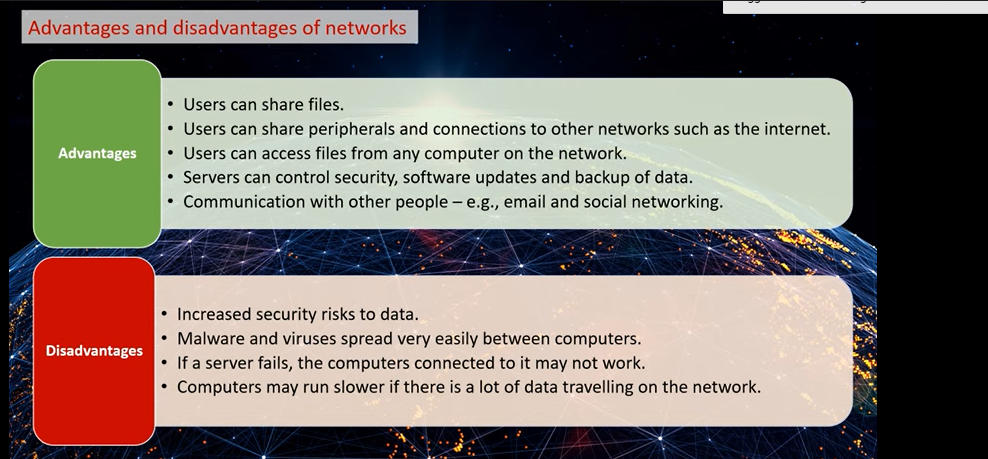
network adv and dis
WAN
Wide Area Network - Collection of connected computers/devices over a large geographical area Large corporations with offices in multiple locations will often have a WAN allowing them to communicate between different sites. Multiple LANs physically located in different areas form a WAN. Typically, connected by: telephone lines, fibre optic cables, satellite links Usually, a WAN will require extra telecommunication hardware.
LAN
Local area network (or LAN) is the name given to a network which is spread over a small geographical area or a single site, for example: a school. All hardware for LAN tends to be owned/controlled by organisation using it. Typically connected using: UTP cable, fibre optic, Wi-Fi
standards
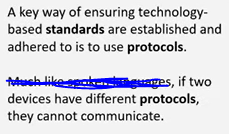
are a set of hardware and software specifications that allow manufactures to crate products and services that are compatible with each other.
protocols
Explain why protocols are important on a network
Allowing them to communicate - By ensuring all devices follow the same rules/standards - So they interpret data/signals in the same way
common protocols
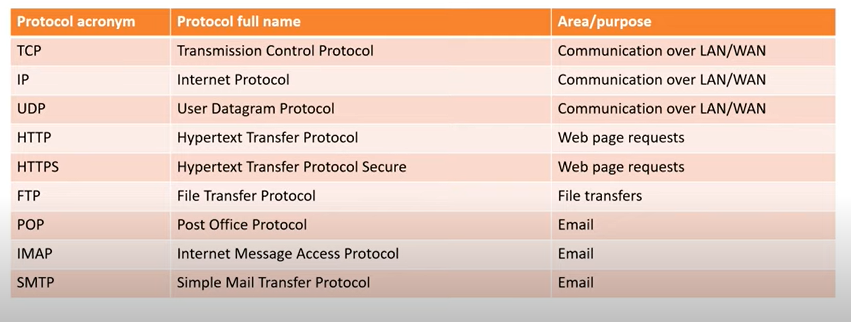
TCP/IP protocol stack
UDP
HTTP/HTTPS
FTP
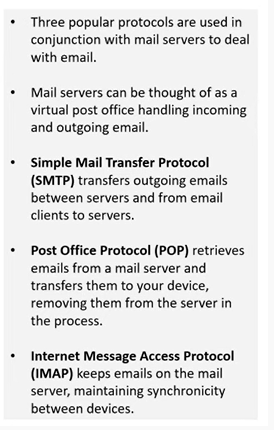
POP/IMAP/SMTP
purpose of layering
concept of layering is to divide complex task of networking into smaller simpler tasks that work in tandem with each other. The hardware/software for each layer had defined responsibility, and each one provides a service for the layer above it. ADV: reducing complex program into smaller sub problems makes it easier to understand. Devices can be manufactured to operate a particular layer. Products from different vendors will work together.
four layers of the TCP/IP stack
-Application -Transport -Internet - Link
application
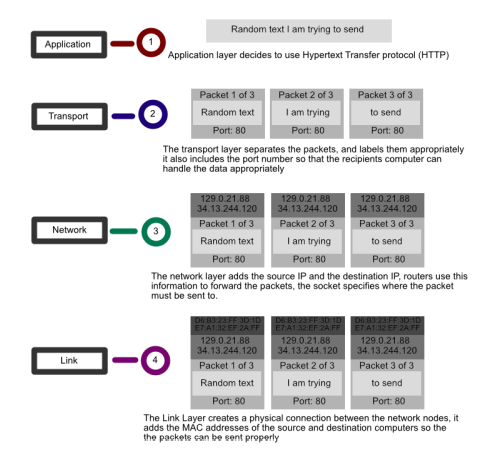
Based at the top of the stack, this uses an appropriate protocol relating to whatever application is being used to transmit data. It specifies what protocol needs to be used to relate the application that’s being sent. E.g. a message being sent via a web browser, protocols would be HTTP, HTTPS, FTP.
transport
Uses TCP part of the stack as well as other conversation protocols like UDP, to establish an end-to-end connection between the source and recipient computer. These protocols use port numbers to track sessions and add this information to the header. Once the connection is made, the transport layer splits the data into packets, adding to each one: - Its number/sequence (they are numbered so they can be reassembled in the correct order). - Total number of packets - Port number that the packet should use If any packets get lost, the transport layer requests retransmissions of these lost packets.
internet
Uses IP part of the stack. Adds to each packet: - Source IP address - Destination IP address The combination of the IP address and the port number is called a socket address. All routers operate at this layer, they use the IP address to find out where the packets are heading. ○ Routers operate on the network layer and the router is what uses the IP addresses to forward the packets. ○ The sockets are then used to specify which device the packets must be sent to and the application being used on that device. We know now: - The device the packet is being sent to (IP address). - The application on that device that needs the packet (port).
link layer
Represents the actual physical connection between network devices. Responsible for adding the unique media access control (MAC) address of the: - Source device - Destination device When transmitting data between routers over a wide area network (WAN) , the MAC address is changed at each hop on the route.
example of TCP/IP
modem
router
cables
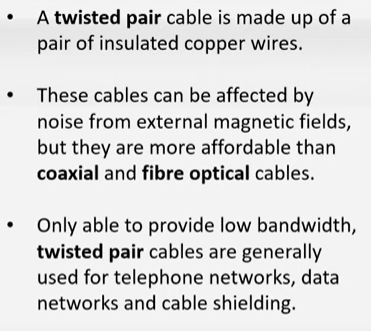
cables twisted