Science A (Core): Physics - The Basics
No description yet. This curated deck is ready for daily study.
Card preview (24)
How is heat energy (infrared radiation) given out by objects?
All objects emit and absorb heat (hot objects emit more than they absorb and cold objects absorb more than they emit)

What colours absorb and emit more heat than others?
Dark, matt colours are good absorbers and emitters Light, shiny colours are bad absorbers and emitters
What are the 3 states of matter and how are the particles arranged?
Solids: particles close together and fixed Liquids: particles quite close but can move around Gases: particles spread apart and move freely around
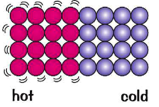
What is conduction and where does it occur best in?
Conduction is the transfer of energy by particles vibrating (mainly in solids and especially in metals)
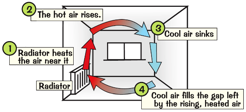
What is convection and where does it occur best in?
Convection is the transfer of energy by particles moving around (in gases and liquids)
What is the difference between evaporation and condensation?
Evaporation is when a liquid changes into a gas Condensation is when a gas changes into a liquid
What can affect the rate of heat transfer?
Heat transfer is affected by: surface area; material type (conductor / insulator); the temperature difference (a big temperature difference means a faster energy transfer)
How can heat transfer be reduced?
Conduction, convection and radiation can all be reduced
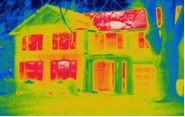
How is heat loss reduced in the home?
Insulation (cavity wall; loft; double glazing etc…)
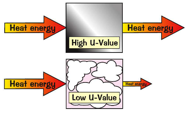
What is a U-value?
A U-value is a measure of how well heat can pass through a material High U-value = lots of heat loss
How can insulation save you money?
Payback time = initial cost ÷ annual saving Payback time is the time it takes to save the amount of money spent on the insulation
What is specific heat capacity?
How much energy something can store (the amount of energy needed to raise 1kg of material by 1oC)
How can you calculate how much energy is stored in a material?
E = m x c x Ѳ Energy (J) = Mass (kg) x specific heat capacity (J/kgoC) x temperature change (oC)
What is the rule with energy?
Energy cannot be created or destroyed, only transferred Electrical > light + sound Chemical > kinetic > gravitational
What is efficiency?
All machines waste energy (usually as heat) Efficiency is how much energy is transferred usefully Efficiency = useful energy out ÷ total energy in
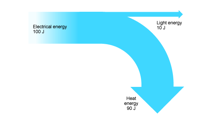
What is a sankey diagram and what does it show?
A sankey diagram shows how much energy of the input is changed into different types of energy – the wider the arrow the more energy it shows
How can you work out how much electrical energy is transferred by an appliance
E = P x t Energy transferred = power of the appliance x time it is used for
What is electricity measured in?
Kilowatt-hours (kWh)
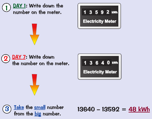
How is the cost of electricity calculated?
Cost = energy transferred (kWh) x price per kWh This is often shown on an electricity meter
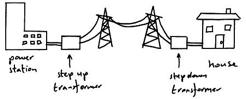
How is electricity transferred across the UK?
The National Grid
What is a non-renewable energy resource?
An energy resource that will run out one day (e.g. coal, oil, gas and nuclear fuel)
How are energy sources used to generate electricity?
Fuel is burnt / reacted releasing heat which turns water to steam turning turbines and generators which generate the electricity
How does the start-up time for power stations vary?
Gas – quickest Oil Coal Nuclear – longest
What is a renewable energy resource?
An energy resource which will never run out (wind, wave, tide, hydroelectric, solar, biofuel etc…)