Rate Equations
No description yet. This curated deck is ready for daily study.
Card preview (24)
Define the term rate of reaction
Change in concentration of the reactant or product per unit time
At a given instant how do you calculate rate if reaction
Change in Conc/ Change in time Gradient of a concentration-time graph Y value of a rate-concentration graph
How would you measure rate if reaction experimentally? (include different methods) 3
Use a calibrated colourimeter at suitable intervals, if there is a notable colour change- to test for the concentration of a specific ion If a gas is expelled use a gas syringe to measure the volume of gas at intervals Measure the mass of the reactants at suitable intervals
How can you determine the rate constant and rate expression for a reaction
Can only be done experimentally, theoretical data cannot be calculate prior
What affects the value of rate constant for a given reaction
Only Temeprature
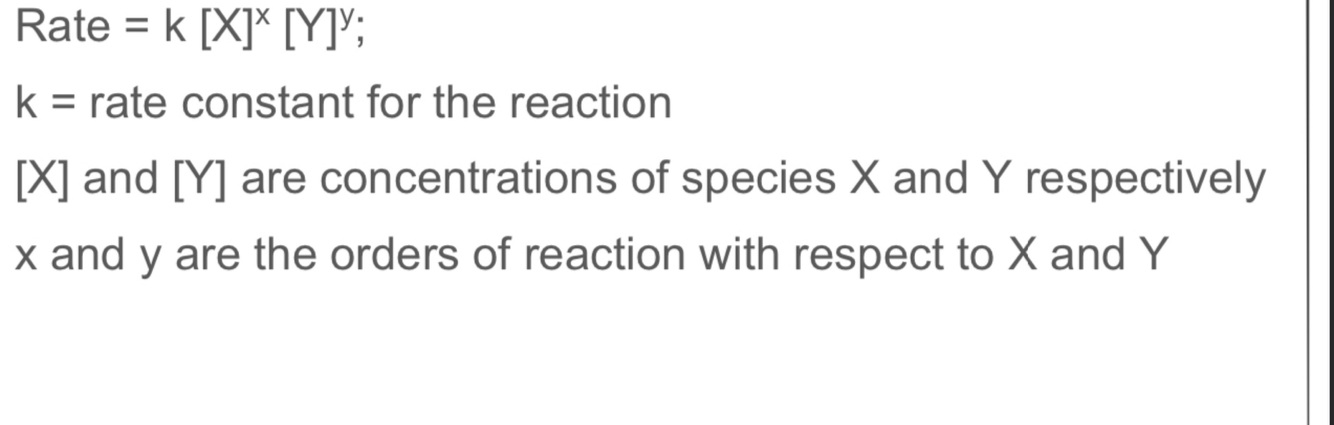
Write a generic rate expression and state what each term means
Why are some chemicals in the chemical equation but not the rate equation
Rate Equation includes any species’ that affect rate Chemicals included after the rate determining step may not be included Catalysts may be included as they affect the rate of reaction
Define the term : “Order of a reaction with Respect to a given product”
The power to which a specific concentration is raised to in the rate equation
Define the term: “Overall order of reaction”
The Sum of the orders of reaction of all species in the rate expression ie (X+Y) where a^x b^y = rate
How do you calculate the units of the rate constant
Rate units = moldm^-3 s^-1 Conc units = moldm^-3 rearrange rate equation to get k sub in units and cancel out
How would you calculate the order of a reaction with only concentration and time data
Plot [A] against time , draw tangents at different values Draw a secondary graph of rate against concentration [A] gradient of 0 = Zero order y= mx + c = 1st order X^2 = 2nd rder
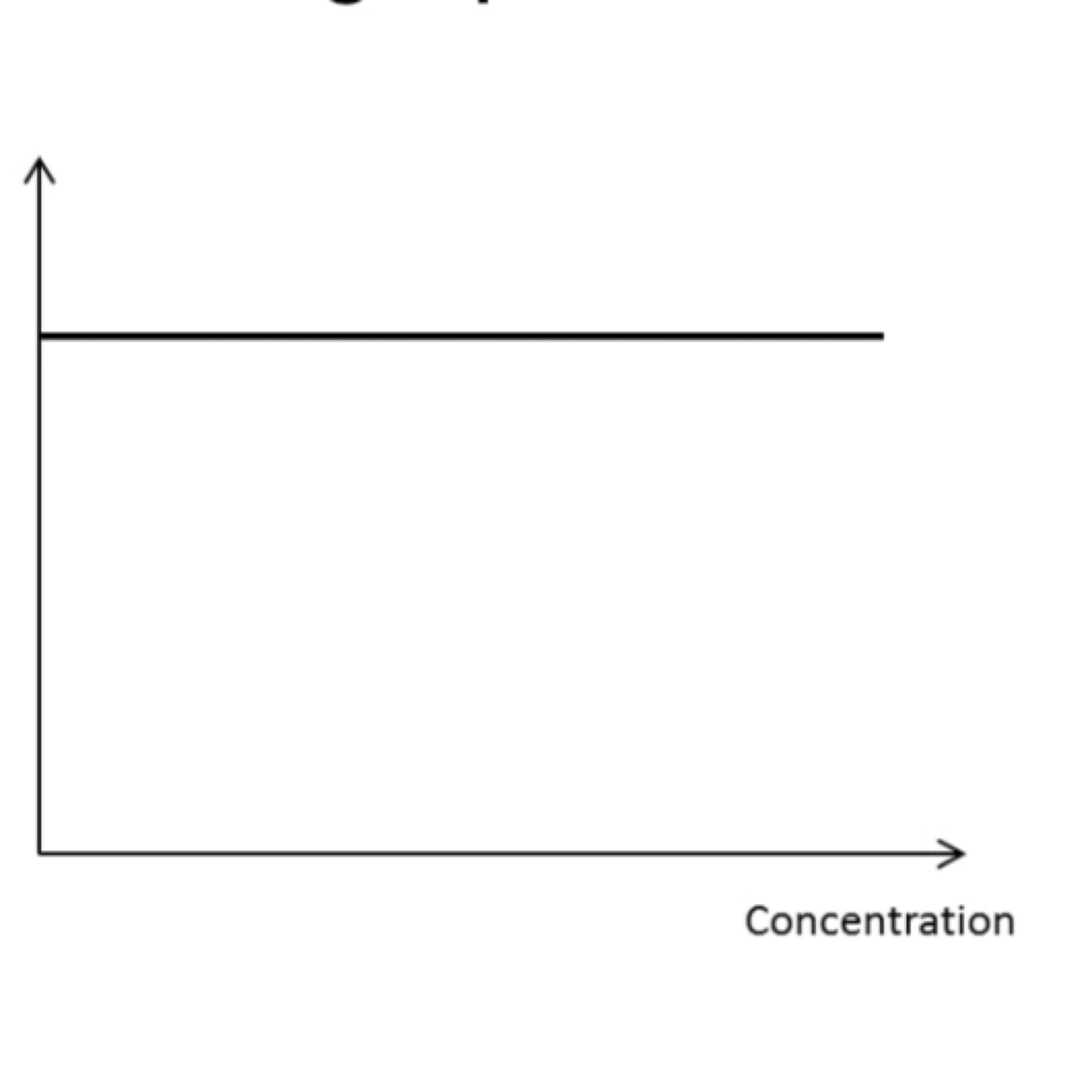
Draw a rate-concentration for a zero order reactant
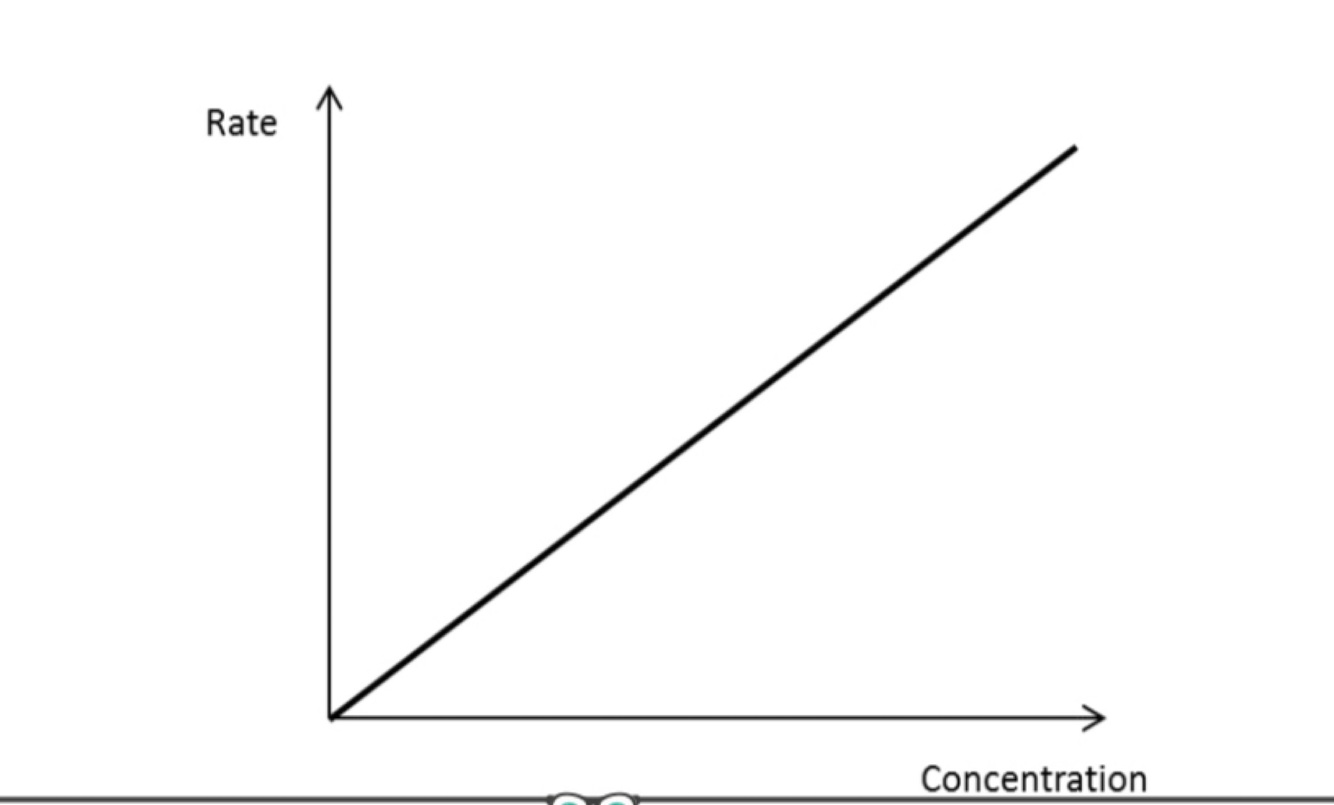
Draw a rate-concentration for a 1st order reactant
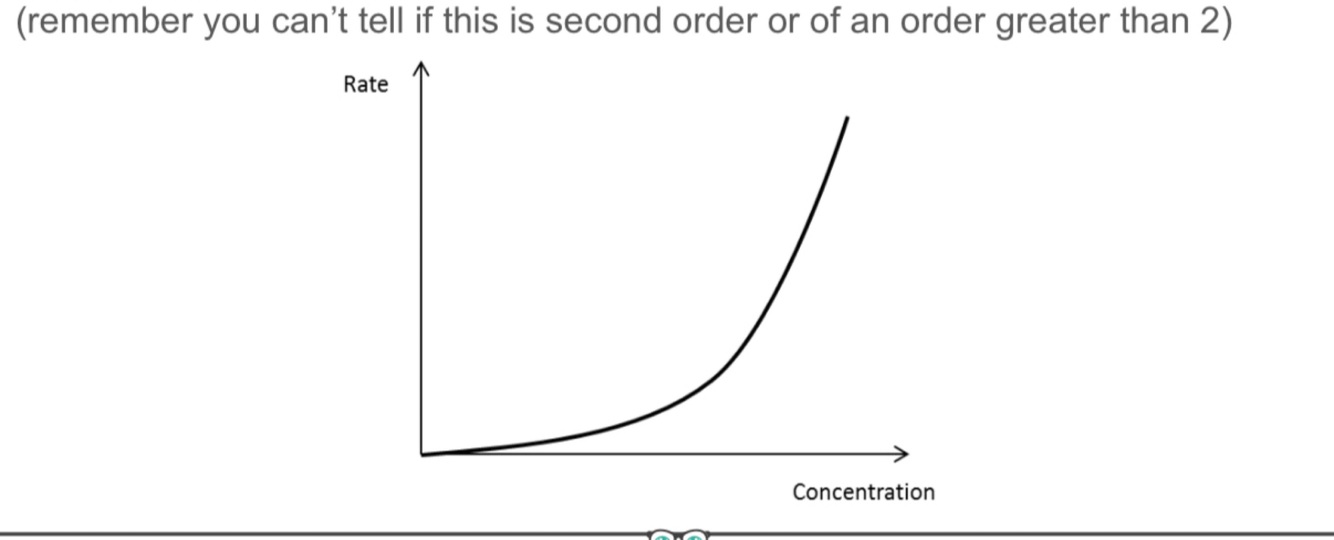
Draw a rate-concentration for a 2nd order reactant
How would you confirm an order of reaction greater then 2
Rate against conc^x graph would be a straight line through the origin when the order of reaction is x
Explain how you would find the rate expression using the initial rates method
Do a series of experiments during - vary the concentrations - the concentration of just one reactant changes over time Plot a graph of concentration against time for each reactant Draw a tangent at t=0 to find the initial rate of reaction Compare rates and concentrations between each experiment to find order of reactants and the overall rate equation
Write the ionic equation for the iodine clock reaction What are the reactants Explain what happens
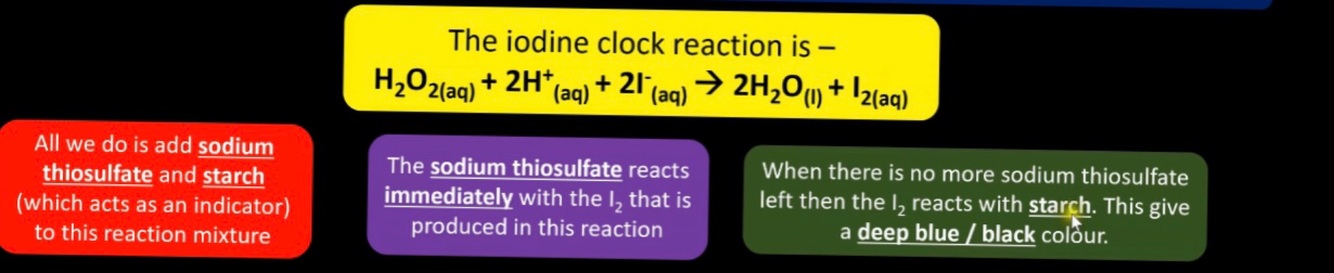
When does the starch tuen a blue-black colour in an iodine clock reaction and why?
When all of the Sodium thiosulphate has been used up so I2 is produced I2 reacts with the starch leading to Blue-Black Colour
How do you calculate the rate of reaction from the data from an iodine clock reaction
Record time taken for colour change to occur Initial rate is roughly equal to 1/ the time taken
What temheprature increase roughly doubles the rate of reaction
10K
Explain what each of the Components from the Arrhenius equation mean
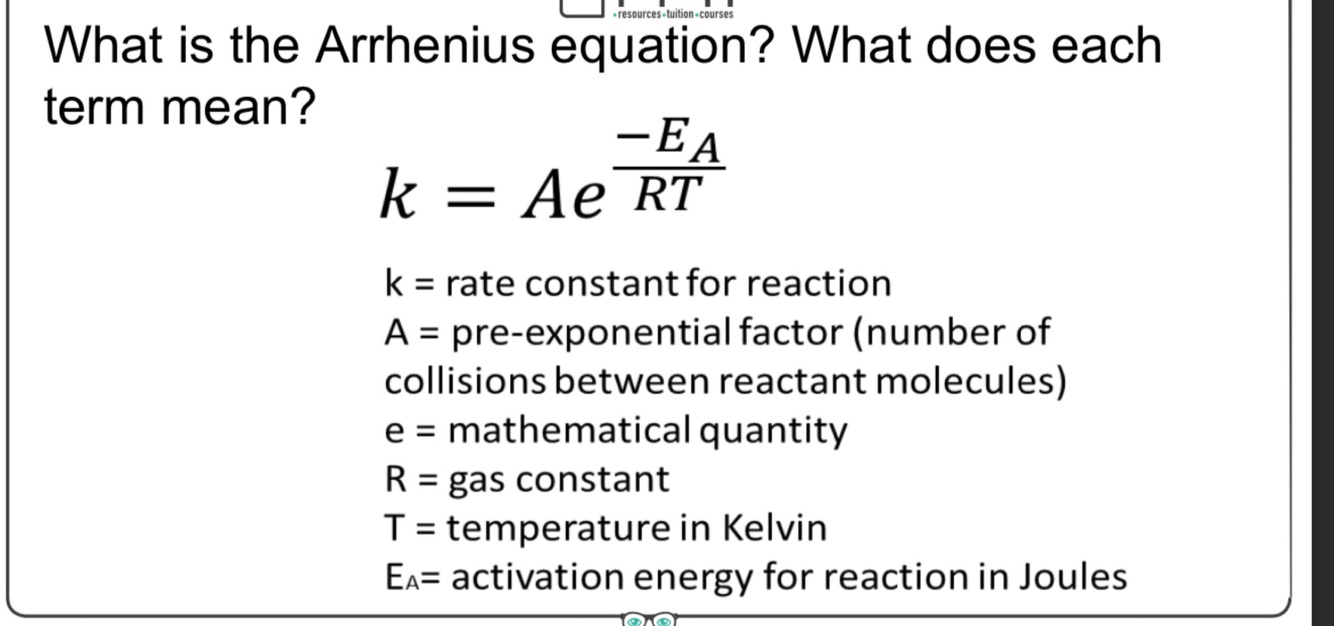
How can you convert the Arrhenius equation into y= mx + c format
ln(k) = -Ea/RT + ln(A) for a graph of ln(k) against 1/T Gradient = -Ea/R and the y intercept is ln(A)
What is the rate determining step?
The slowest step in a reaction mechanism which determines the overall rate of reaction
How does the Rate determining step link to the species involved in the rate expression.
Any Species involved in the rate determining step appear in the rate expression Species only involved after, do not appear in the rate expression.