Computer Architecture
No description yet. This curated deck is ready for daily study.
Card preview (24)
What is Von Neumann architecture?
A computer whose programs and data it uses is stored in the same memory
Describe the fetch-execute cycle
An instruction is brought from the RAM. It is then decoded by the CU to find out what to do with the instruction The instruction is then carried out
What is the purpose of the CPU? Central Processing Unit
To continuously process instructions and data that are inputted by repeatedly carrying-out the FE cycle
What is the function of the ALU?
Carries out the mathematical and logical operations (e.g. AND, OR, NOT) and compares values held in registers
What is the function of the CU?
• Coordinates all of the CPU’s actions in the FE cycle • Decodes all instructions • Sends and receives control signals to fetch and write data
What is the function of the clock?
It regulates the speed and timing of all signals and computer functions
What are the registers in the CPU?
PC MAR MDR ACC CIR
What is the purpose of the registers?
They are very small, fast memory locations that temporarily store memory addresses, instructions and data
What does the CIR do?
Holds the instruction currently being executed
What does the MDR do?
Holds data or a program instruction after it is stored/fetched from memory
What does the ACC do?
Where the ALU stores its results (from its operations)
What is the PC?
Holds the memory address of the next instruction to be executed
What are the seven steps in the FE cycle?
• The memory address held in the PC is copied into the MAR • The PC is incremented. It now holds the address of the next instruction • The processor sends a signal across the address bus to the memory address held in the MAR • The instruction/data held in that memory address is sent along the data bus to the MDR • The instruction/data in the MDR is copied into the CIR • The instruction/date held in the CIR is decoded and then executed (results held in ACC) • The process repeats
What three factors affect CPU performance?
Clock speed Cache size Number of cores
How does clock speed affect CPU performance?
One tick of the clock counts as one FE cycle. So the faster the clock, the more ticks there are, the more FE cycles there are
How does the number of cores affect CPU performance?
• A CPU can contain multiple cores, with each core processing one operation per clock cycle • A dual/quad-core can perform two/four operations simultaneously therefore more clock cycles
Why might a computer with a dual-core not necessarily be faster than a single-cored computer?
If the software used is only written for one core, additional cores may be redundant
What is cache memory?
It is a small amount of very fast memory that can be accessed faster than RAM RAM is further away from the processor than cache
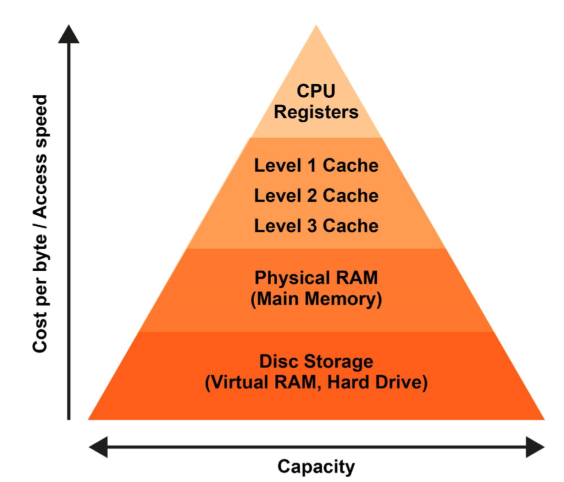
What are the benefits of cache?
Makes the CPU more efficient as less time is spent waiting for data to be transferred
Which is (theoretically) faster? 1) A dual-core processor running at 3.2GHz with 4MB of cache memory 2) A dual-core processor running at 2.7GHz with 4MB of cache memory 3) A single-core processor running at 3.2GHz with 2MB of cache memory 4) A quad-core processor running at 1.5GHz with 8MB of cache memory
1) 2 x 3.2 GHz = 6.4 GHz + 4MB 2) 2 x 2.7 = 5.4GHz + 4MB 3) 1 x 3.2 GHZ = 3.2GHZ + 2MB 4) 4 x 1.5GHZ = 6GHz + 8MB Therefore 1 is fastest But 4 is slightly slower with more cache/cores so it could be faster
What is an embedded system?
Used to control the function of electronic devices that don’t need a full OS since they perform specific tasks. Their input is also frequently controlled by a switch/button
What are some examples of embedded systems?
Air conditioning, microwaves, vending machines, lighting systems
What is an NIC?
Hardware required to be able to access any network Can be wireless or use an Ethernet cable to connect
What is a MAC address?
A unique, hexadecimal, static ID number assigned to every NIC used in network devices Static = It does not change