Carboxylic Acids And Derivatives
No description yet. This curated deck is ready for daily study.
Card preview (24)
• Where must the numbering of carbon atoms always start at in a carboxylic acid?
• The numbering always starts from the carboxylic acid end
• If there are carboxylic acids on both ends of the chain, what do we call the acid?
• - dioic acid • eg ethanedioic acid
• Describe the acidity of carboxylic acids
• Carboxylic acids are only weak acids in water and only slightly dissociate, but they are strong enough to displace carbon dioxide from carbonates.
• Describe the solubility of carboxylic acids in water
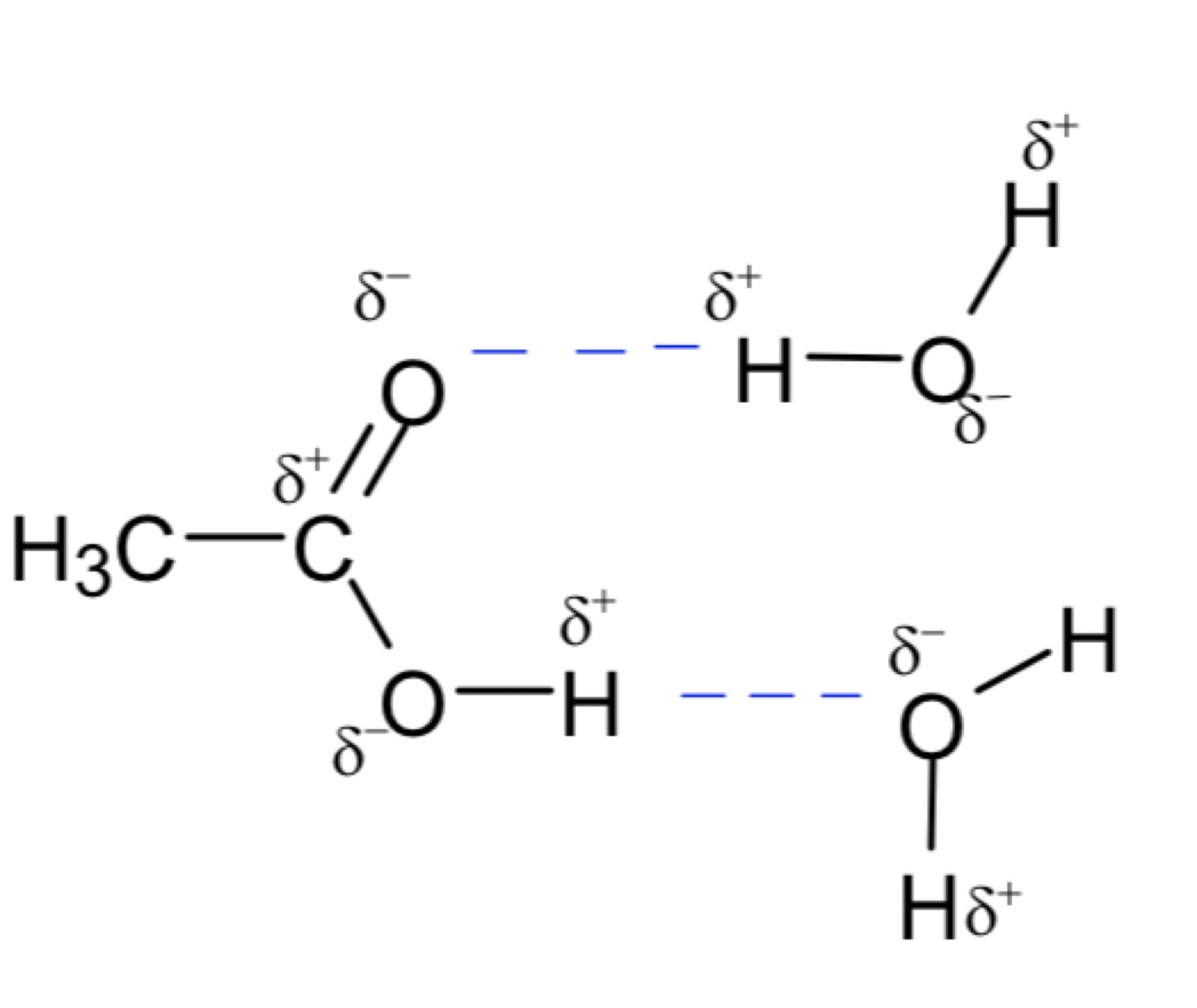
• The smaller carboxylic acids (up to C4) dissolve in water in all proportions but after this the solubility rapidly reduces. • They dissolve because they can hydrogen bond to water molecules
• Draw hydrogen bonding of ethanoic acid in water
• What can be used as a test for carboxylic acids?
• The effervescence caused by production of CO2 with carboxylic acids • with solid Na2CO3 or aqueous NaHCO3 can be used as a functional group test for carboxylic acids
• Why can mechanoic acid be oxidised?
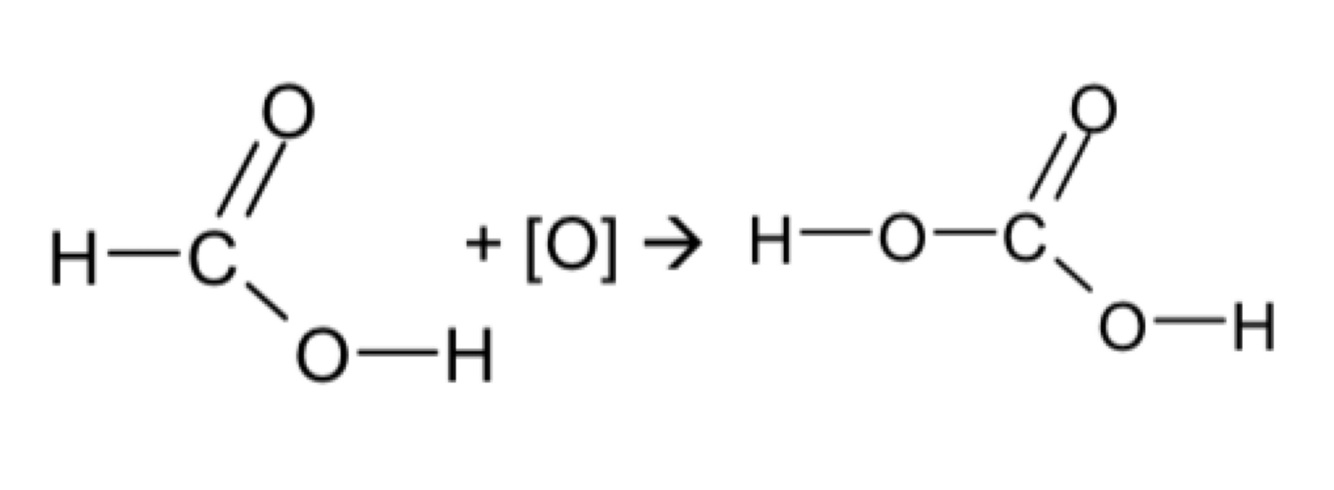
• Carboxylic acids cannot be oxidised by using oxidised agents, but methanoic acid is an exception as its structure has effectively an aldehyde group
• What does the oxidation of methanoic acid form?
• It forms carbonic acid (H2CO3) which can decompose to give CO2
• Write an equation for the oxidation of methanoic acid
• How are esters formed from the reaction of carboxylic acids with alcohols?
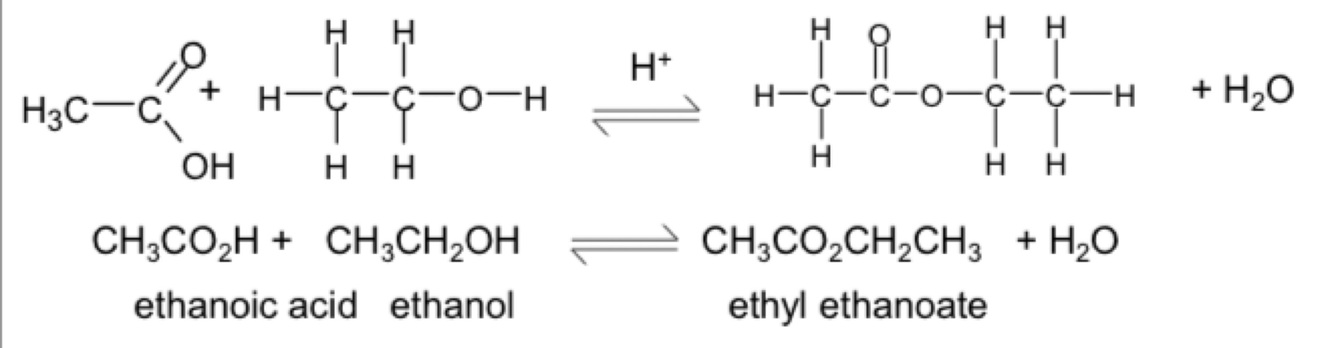
• Carboxylic acids react with alcohols, in the presence of a strong acid catalyst, to form esters and water • Strong acid catalyst = concentrated H2SO4 catalyst

• Write an equation for the formation of ethyl ethanoate from ethanoic acid and ethanol?
• The reaction is reversible. The reaction is quite slow and needs heating under reflux (often for several hours or days). Low yields (50% ish) are achieved. An acid catalyst (H2SO4 is needed)
• What are the uses of esters?
• Esters are sweet smelling compounds that can be used in perfumes and flavourings • Esters can be used as solvents for polar organic substances. Ethyl ethanoate is used as a solvent in glues and printing inks • Esters can be used as plasticisers for polymers
• What can esters have?
• Esters can have pleasant smells
• What do esters need to be for use in perfumes?
• For use in perfumes they need to be non toxic, soluble in solvent such as ethanol, volatile (turns into gas easily) and not react with water
• Why do esters not form hydrogen bonds?
• Although polar, esters do not form hydrogen bonds because there is no hydrogen bonded to a highly electronegative atom • They have a lower boiling point than the hydrogen-bonded carboxylic acids they came from. They are almost insoluble in water
• Why do pure polymers often have limited flexibility?
• Often pure polymers have limited flexibility because the polymer chains cannot move over each other • Incorporating some plasticiser into the polymer allows the chains to move more easily and the polymer can become more flexible
• What are the 2 ways that esters can be hydrolysed?
• Esters can be hydrolysed by either: • Heating with acid • or with sodium hydroxide
What are the reagents and conditions for hydrolysis by heating with acid?
• Reagents: dilute acid (HCl) • Conditions: heat under reflux • This reaction is the reverse reaction of ester formation • When an ester is hydrolysed a carboxylic acid and an alcohol are formed • This reaction is reversible and does not give a good yield of the products

• What are the reagents and conditions for hydrolysis by heating with NaOH?
• Reagents: dilute sodium hydroxide • Conditions: heat under reflux • This reaction goes to completion. Using excess sodium hydroxide will ensure the ester is completely hydrolysed • The carboxylic acid salt product is the anion of the carboxylic acid • The anion is resistant to attack by weak nucleophiles such as alcohols, so the reaction is not reversible

• How can the carboxylic acid salt produced by hydrolysis (heating with NaOH) be converted back into a carboxylic acid?
• Addition of a strong acid such as HCl to the carboxylic acid salt will convert the salt to the carboxylic acid form

• What are fats and oils?
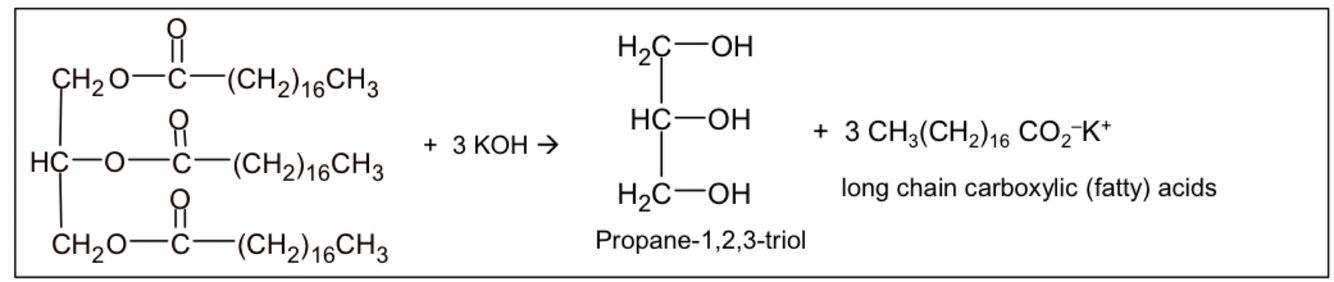
• Fats and oils are esters of glycerol and long chain carboxylic acids (fatty acids)
• What can vegetable oils and animal fats be hydrolysed to give?
• Vegetable oils and animal fats can be hydrolysed to give soap, glycerol and long chain carboxylic (fatty) acids
• What is glycerol?
• Glycerol (propane-1,2,3-triol) forms hydrogen bonds very easily and is readily soluble in water. It is used in cosmetics, food and in glues.
• What is soap?
• Soaps are the sodium or potassium salts of long chain carboxylic acids, produced by the alkaline hydrolysis of fats or oils • The carboxylate ion (COO-) end is hydrophilic and mixes with water. The long non-polar hydrocarbon chain is hydrophobic and mixes with grease • So this allows the grease and water to mix and be washed away