Periodicity and Bonding
No description yet. This curated deck is ready for daily study.
Card preview (24)
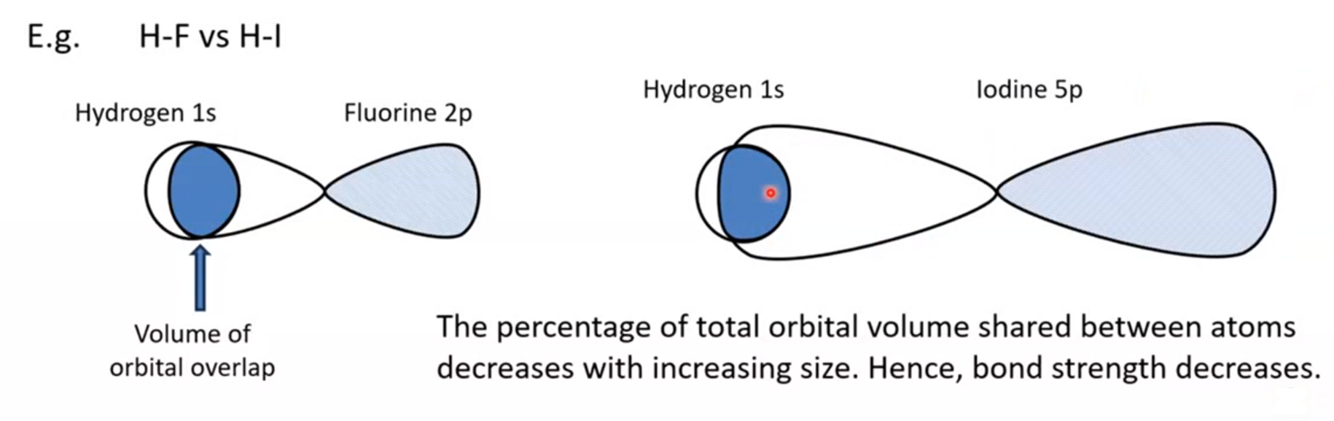
Generally what happens to bonds as we go down a group?
• Generally, the bonds become weaker and longer down a group • This is due to less of the valence orbital volume overlaps and thus sharing of e- density is less effective
What happens to orbital charge density going down a group?
Larger valence orbital volume but only ever 2e- per orbital, so more diffuse orbitals with lower charge density going down a group
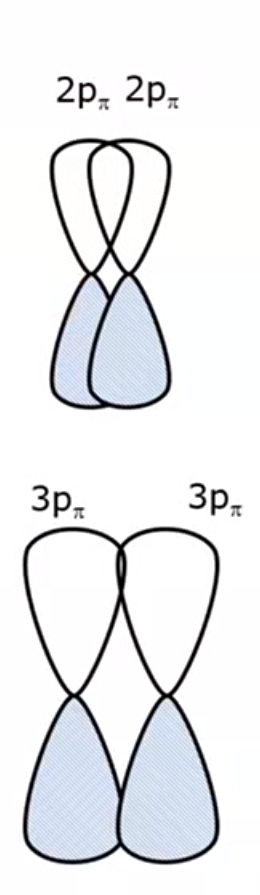
Why are multiple bonds formed predominately for first period elements e.g. C=C or C=N
• 2p-π orbitals (used in multiple bonding) where there is good overlap - due to small covalent radius of E • 3p-π orbitals used with larger covalent radius of E - poor p-π overlap and single bonds favoured - too big essentially to form multiple bonds
Why is the C-O bond not as strong as the Si-O bond
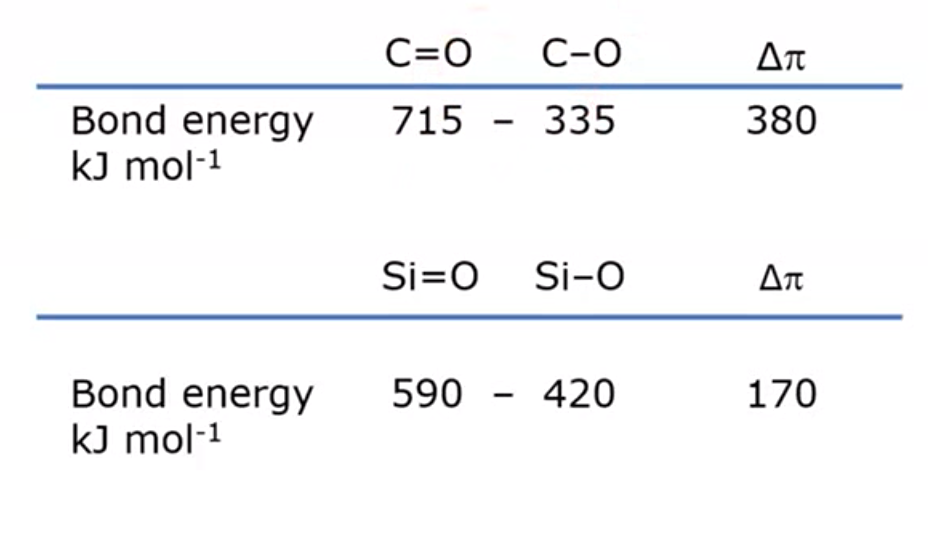
• Si is a larger atom, hence has larger valance orbitals BUT there is also a bigger difference in electronegativity • Silicon is not very electronegative compared to carbon • So there is a stronger electrostatic interaction between silicon and oxygen • This means that σ-bonds are favoured for silicon compounds over π
What is the name of the interaction which stabilises multiple bonds?
pπ-pπ overlap
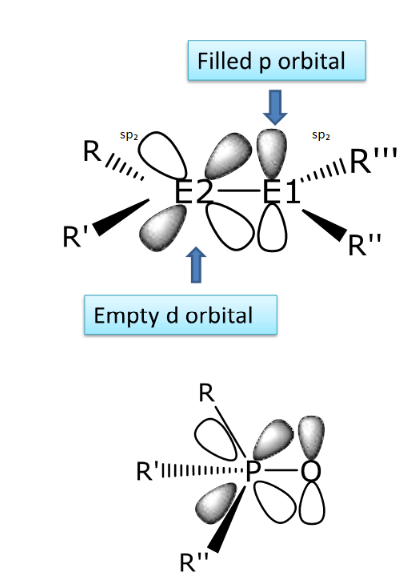
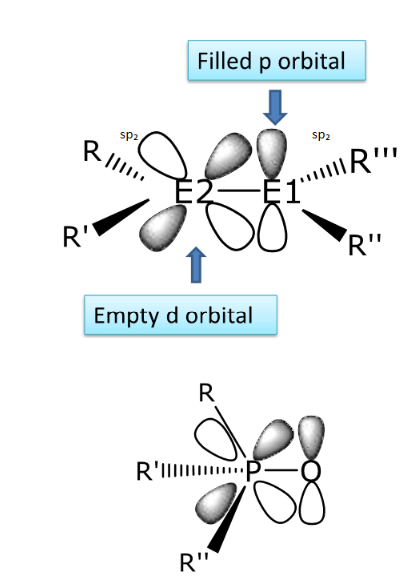
Explain the bonding interactions for a P=O double bond?
• Electron donation from a filled p-orbtial on the oxygen, to an vacant d-orbtial on the phosphrous • The phosphorus already has 4 bonds but can expand it octet using the d-orbitals • Resulting in pπ-dπ bonding
When comparing NMe₃ to N(SiH₃)₃ VSEPR theory predict pyramidal geometry (C₃v) However, the Si-containing molecule is planar (D₃h) Why?
• Generally believed that planarity of N(SiH₃)₃ comes from a pπ-dπ interaction • Due to overlap of N p-orbtials with d/σ’ orbitals on Si + enhanced steric factors = trigonal planar • (NMe₃ cannot do the same due to no d-orbitals)
Define valance
This is the number of valence electrons used by an atom to form bonds to other things
Group 17 halogens form how many bonds to give a full valance ocetet
Halogens have 7 valence e- Hence will form 1 bond to give a full valance ocetet Heavier elements can expand their ocetet however
Group 16 will form how many bonds to give a full valance ocetet
Will form two bonds to give a full valence octet Heavier elements can expand their ocetet
Group 15 will form how many bonds to give a full valance octet
3 bond gives the valance octet (3 bond pairs and 1 lone pair - lewis bases) Heaier elements again can expand their octet
Group 14 will form how many bonds to give a full valance octet
4 bonds gives full valance octet Multiple bonding common for C (can be π or σ, so many geometries possible) Pi-bonding less common down the group
Group 13 will form how many bonds to give a full valance octet
• only 3 valance electrons, so can only have a valance of 3 bonded pairs giving only 6 electrons • So the triel compounds are electron deficient (Lewis acids)
Generally, bonds get weaker down a group due to larger valance orbitals, less effective overlap/sharing of e- density Why is period 2 an exception?
The second period is an exception due to greater electrostatic repulsion Which is pushing the atoms apart, hence making the end weaker For smaller atoms, N to F, with more charge-dense orbitals
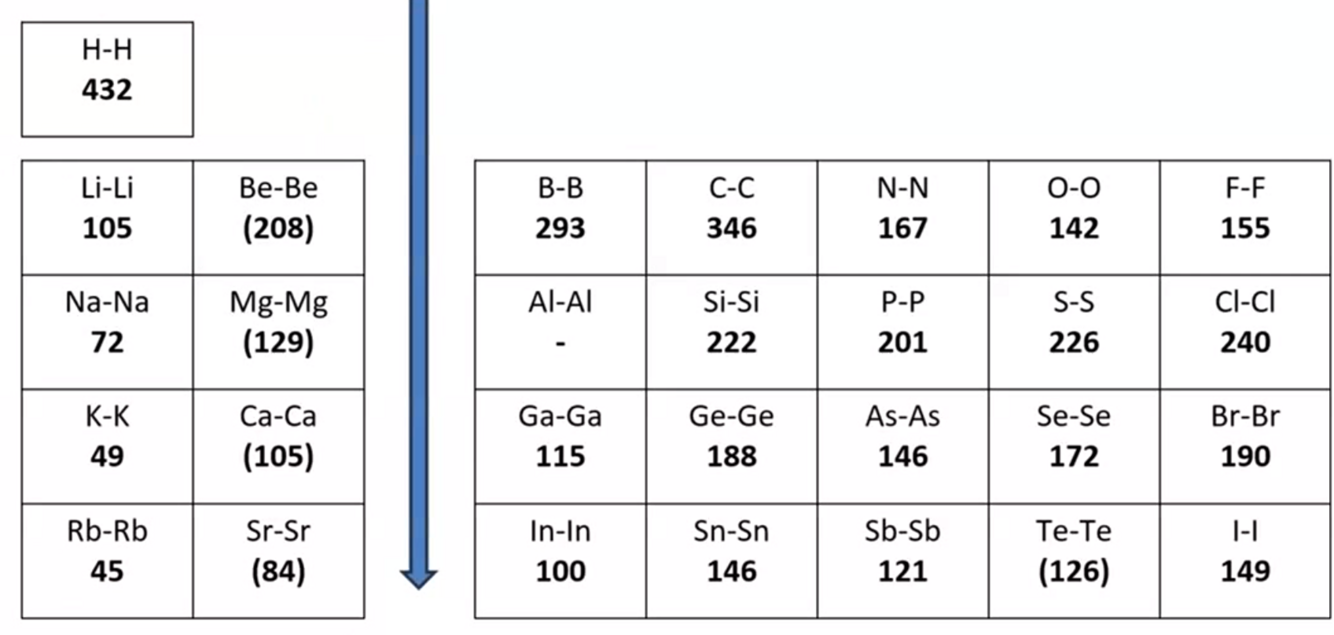
Why is the H-H bond so strong?
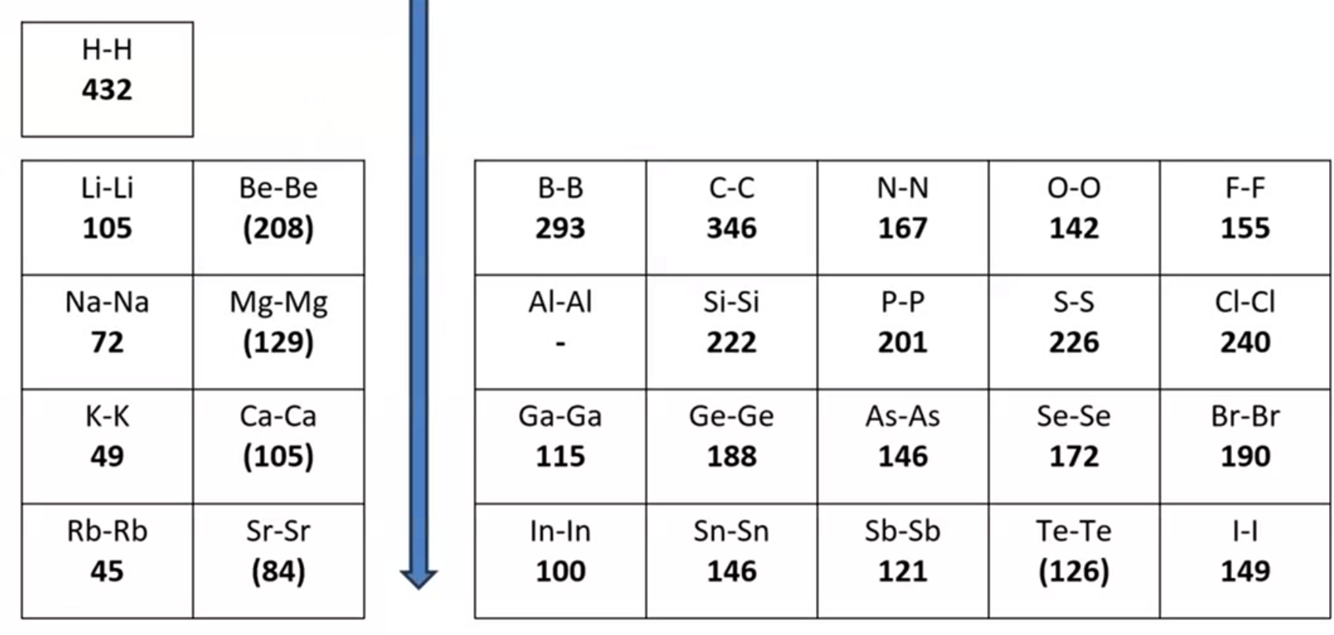
H-H is an exception despiting having high electronegativity Smaller orbitals, good overlap, and effective sharing of electron density There is no electrostatic repulsion (only 2e- present) = very strong bond
Why does bond strength increase from left to right going across a period
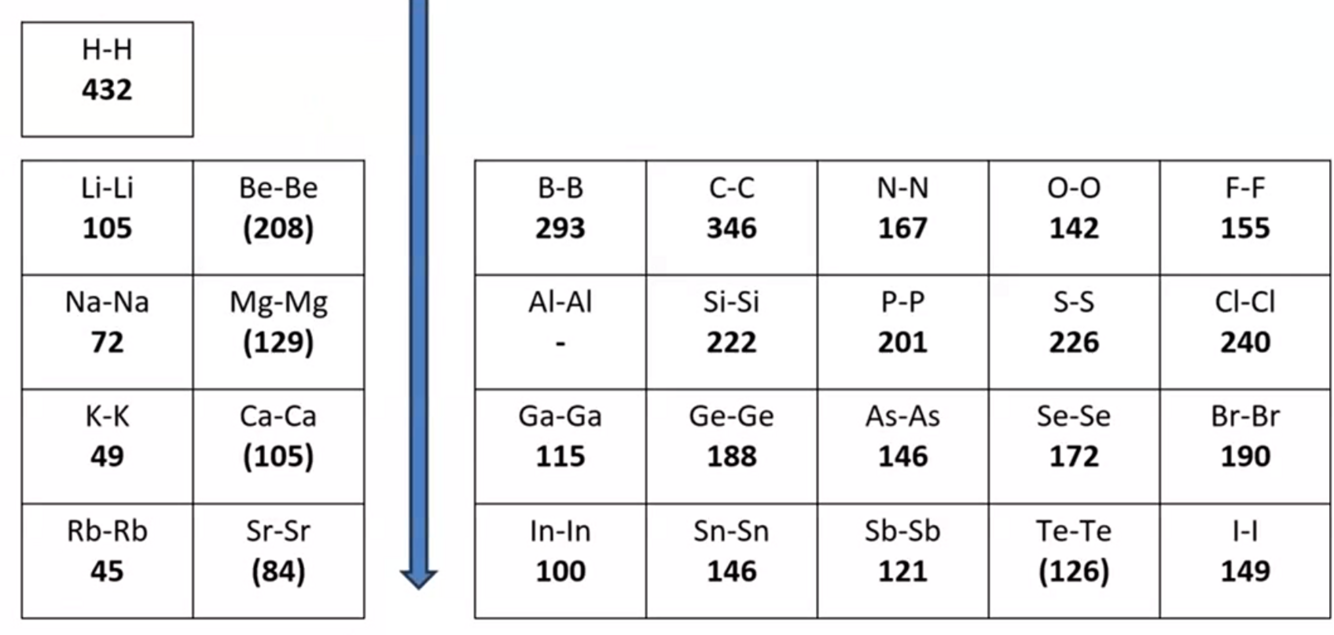
Going from left to right, the atom gets smaller and more electronegative (from 1-14) Leading to more effective orbital overlap and sharing of electron density, hence stronger bonds
Why is the B-F bond so strong?
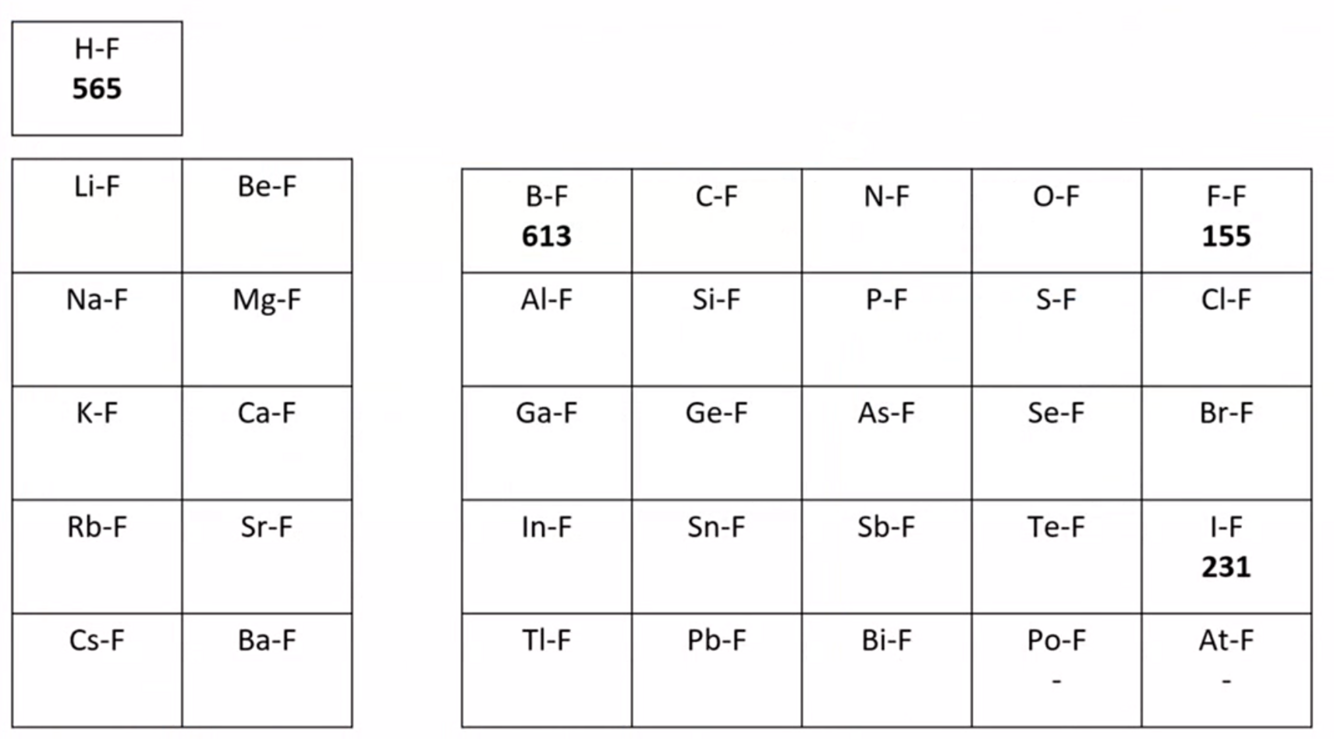
• Small orbtials and effective overlap meaning good sharing of electron density • The bond is also polar covalent so there is additional electrostatic attraction • There is also pi, donation from lone pairs of F to empty p-orbitals on B is possible
Why is the Al-F bond weaker than the B-F bond?
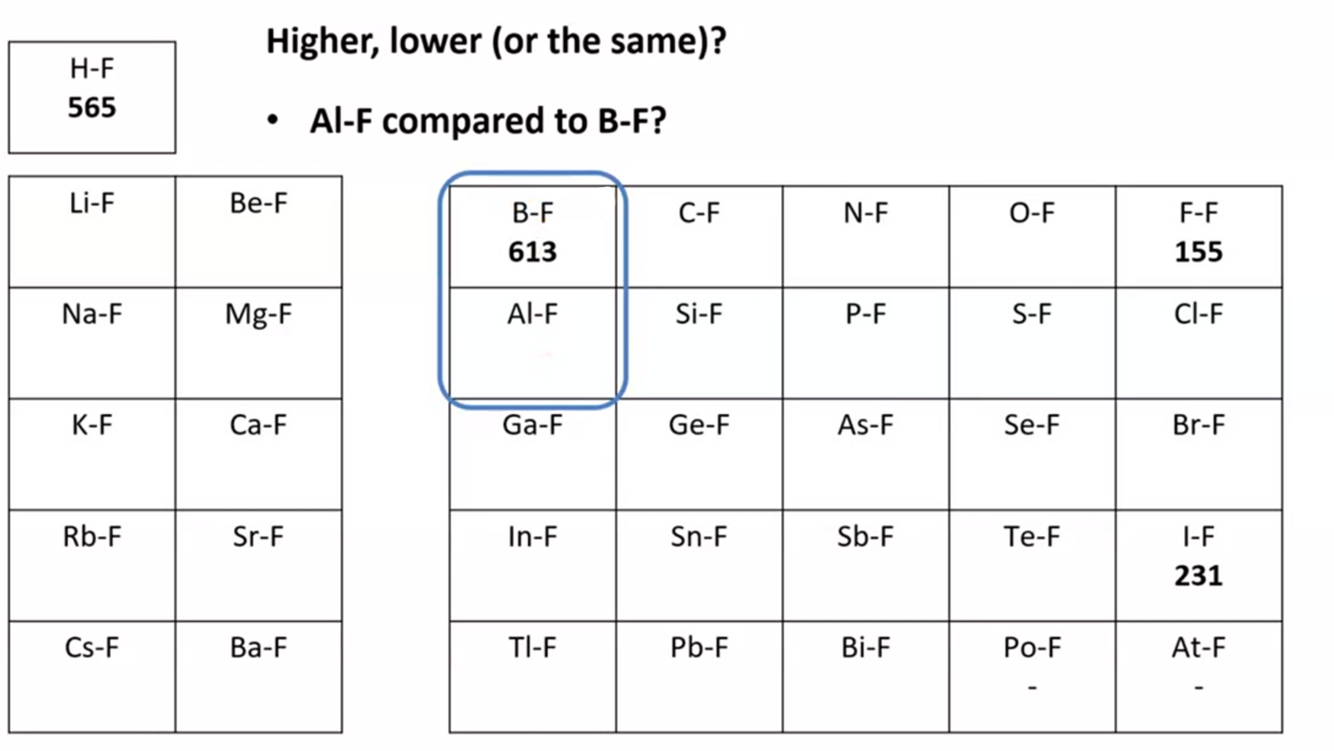
• Al is a larger atom, hence the valence orbitals will be more diffuse • Therefore will have poorer sharing of electron density
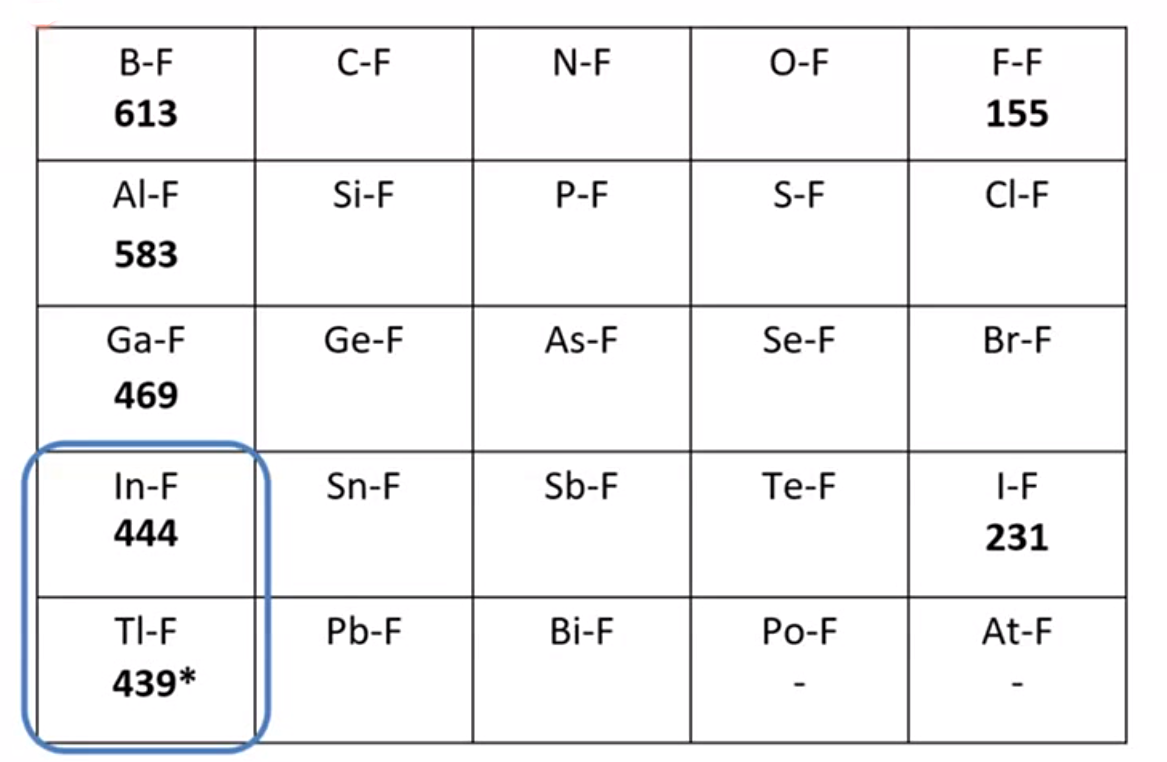
The heteronuclear bond energies for In-F and Tl-F are relatively the same However, the main difference is that the oxidation state of the metals is different, why?
• In-F has an O.S. of (iii) • While Tl-F has an O.S of (i) • Due to the inert pair effect • BUT due to the big difference in electronegativity between Tl and F, the bonding will be more ionic which weakens the strength of the bond (hence not really a fair comparision)
The heteronuclear bond energies for B-F is stronger than the C-F bond (485) Why?
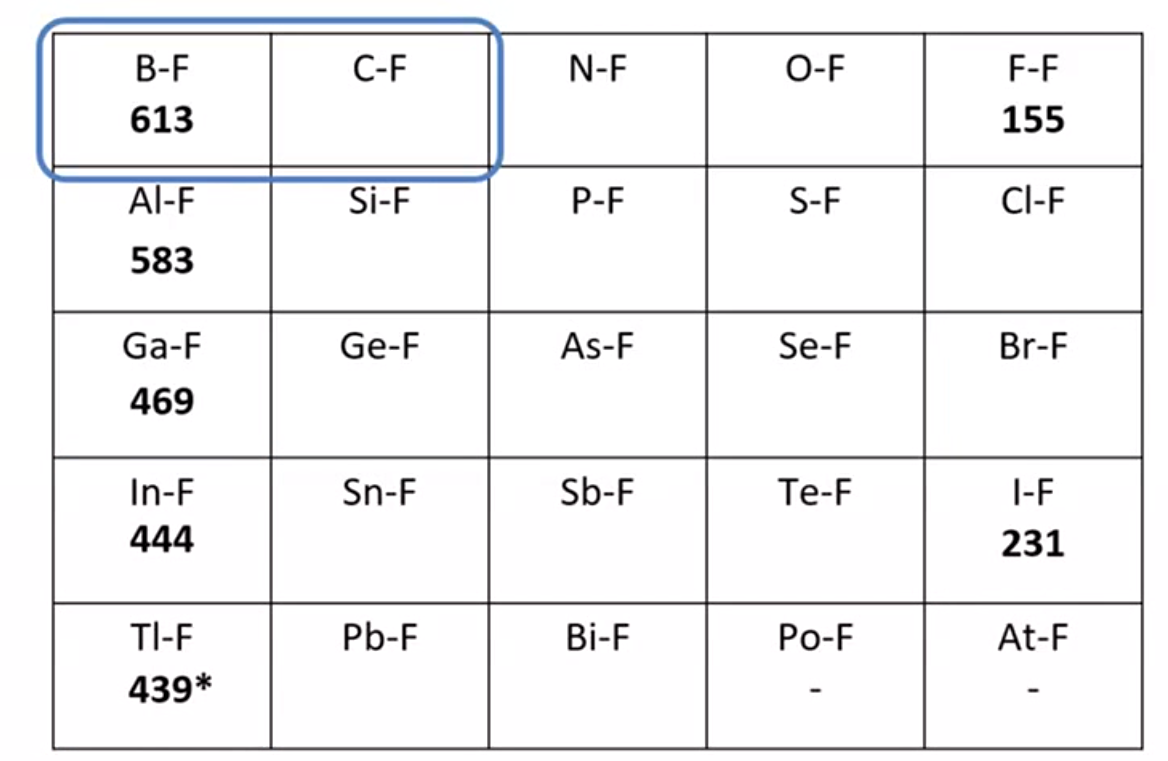
• C-F bond is weaker than the B-F bond • There is a smaller difference in electronegativity going left to right (lower ΔΧ) • Hence reduced electrostatic interaction • (no pi-donation can occur for these period 2 elements as all C orbitals are filled)
The Heteronuclear bond energies for C-F is weaker than for Si-F Why?
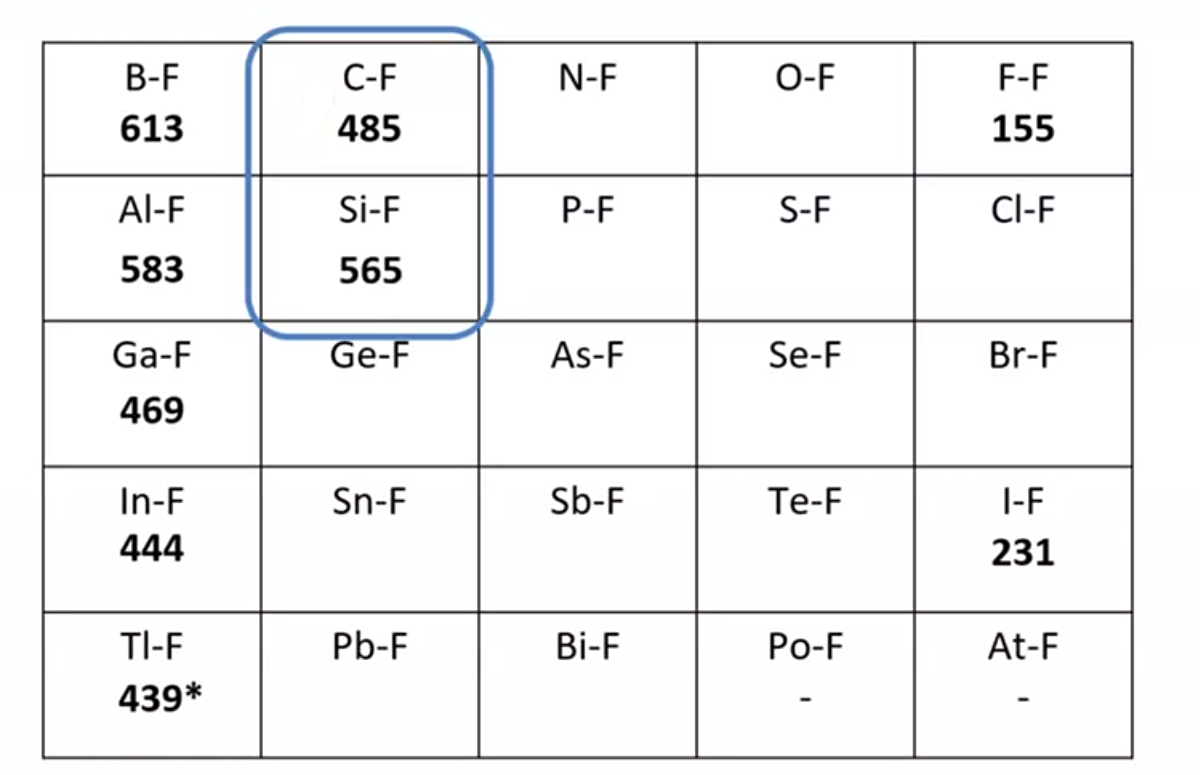
• Si-F stronger than C-F • Larger difference in electronegativity for Si-F (higher ΔΧ) meaning increased electrostatic interaction • Silicon has the ability of expanding it’s ocetet due to having d-orbitals, so can undertake pπ-dπ bonding (from F LPs)
The Heteronuclear bond energies for N-F is weaker than for P-F Why?
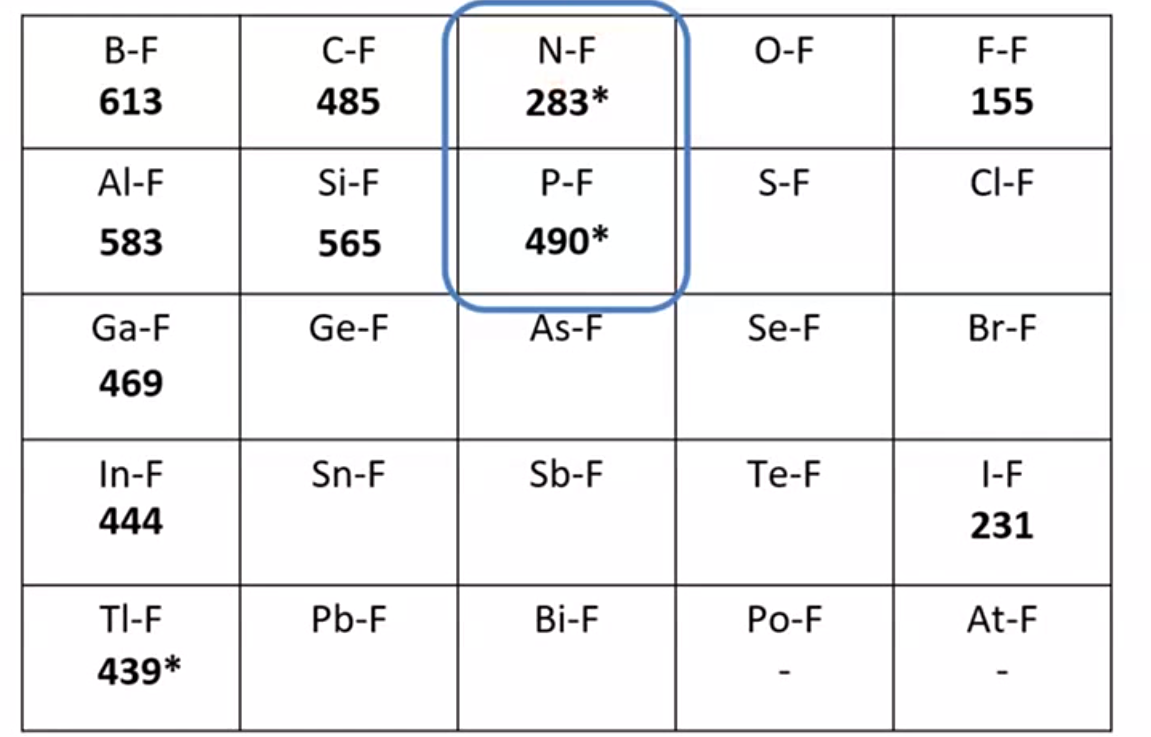
• P-F stronger than N-F • N is highly electronegative, meaning the difference in electronegativity is lower (smaller ΔΧ) and decreased electrostatic interaction • N and F have LPs and are smaller so there will also be increased electrostatic repulsion • AND phosphorus has d-orbitals available for pπ-dπ bonding
The Heteronuclear bond energies for P-F is stronger than for S-F Why?
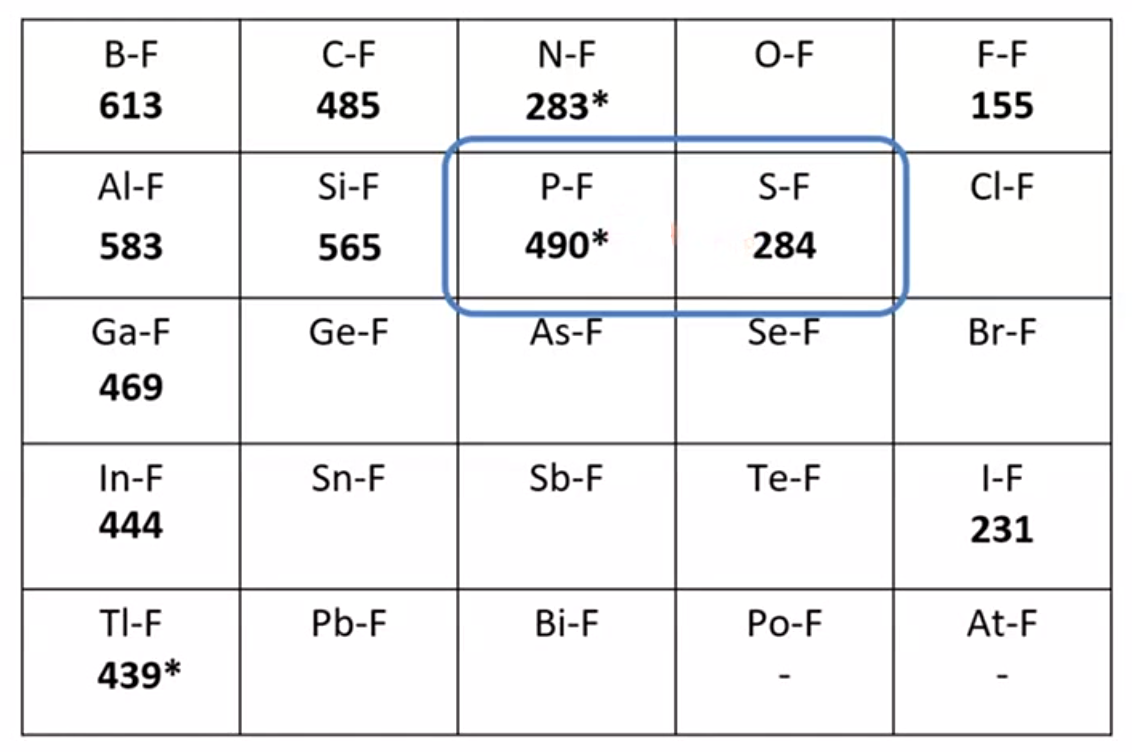
• P-F is stronger than S-F • There is a lower difference is electronegativity for S-F (lower ΔΧ), meaning decreased electrostatic interactions • S and F both have multiple LPs and are small = increased electrostatic repulsion greater than for P
The following graph shows group 14 chlorides The top row is the ethanlpy of formation The Bottom row is M-Cl bond strength Explain the trends

• Enthalpy of formation is negative because energy is released through forming bonds • Generally there is a decreases as we go down the group = less exothermic as the bonds get weaker • This is due to larger valance orbitals and hence weaker bonds • Apart from C-Cl as carbon is weakest due to smaller difference in electronegativity - less electrostatic interactions