Organic 1st yr
No description yet. This curated deck is ready for daily study.
Card preview (24)
Functional group
is an atom or group of atoms which when present in different molecules causes them to have similar chemical properties
Homologous series
Homologous series are families of organic compounds with the same functional group and the same general formula. • They show a gradual change in physical properties (e.g. boiling point). • Each member differs by CH2 from the last. • same chemical properties
Order of priority highest first: CA, ALD, KET,halo, alke,alc
Carboxylic acids >aldehydes>ketones>alcohols>alkenes>halogenoalkanes
HOMOLYTIC FISSION
each atom gets one electron from the covalent bond When a bond breaks by homolytic fission it forms two Free Radicals. Free Radicals do not have a charge and are represented by a A Free Radical is a reactive species which possess an unpaired electron
HETEROLYTIC FISSION
one atom gets both electrons
Structural isomers
same molecular formula different structures (or structural formulae)
Chain isomers
Compounds with the same molecular formula but different structures of the carbon skeleton
position isomers
Compounds with the same molecular formula but different structures due to different positions of the same functional group on the same carbon skeleton
Functional group isomers
Compounds with the same molecular formula but with atoms arranged to give different functional groups
Stereoisomerism
Stereoisomers have the same structural formulae but have a different spatial arrangement of atoms
E-Z stereoisomers arise when: ab
(a) There is restricted rotation around the C=C double bond. (b) There are two different groups/atoms attached both ends of the double bond
Cahn–Ingold–Prelog (CIP) priority rules
• Compare the atomic number of the atoms directly attached to each side of the double bond; the atom of higher atomic number is given priority • If the atoms are the same, consider the atoms at distance 2 from the double bond. Make a list of each atom bonded to the one directly attached to the double bond. Arrange list in order of decreasing atomic number. Compare the lists atom by atom; at the earliest difference, the group containing the atom of higher atomic number is given priority
Priority Group:
The atom with the bigger atomic number is classed as the priority atom
Petroleum fraction
mixture of hydrocarbons with a similar chain length and boiling point range
Draw fractional destillation mechanism
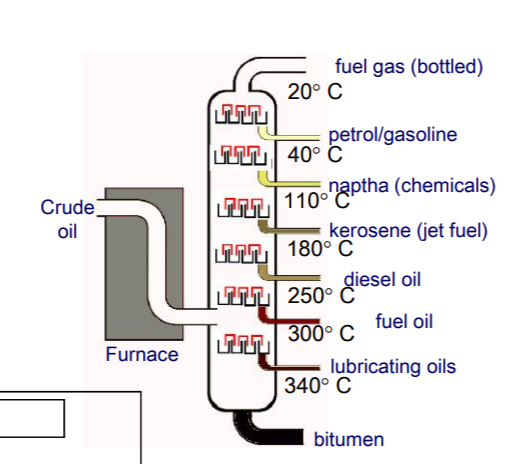
Key points to learn about fractional distillation
• Oil is pre-heated • then passed into the column. • The fractions condense at different heights • The temperature of the column decreases upwards • The separation depends on the boiling point. • Boiling point depends on the size of molecules. • The larger the molecule the larger the van der Waals forces • Similar molecules (size, bp, mass) condense together • Small molecules condense at the top at lower temperatures • and big molecules condense at the bottom at higher temperatures
Vacuum distillation unit
• Heavy residues from the fractionating column are distilled again under a vacuum. • Lowering the pressure over a liquid will lower its boiling point.
Fractional Distillation: In the laboratory
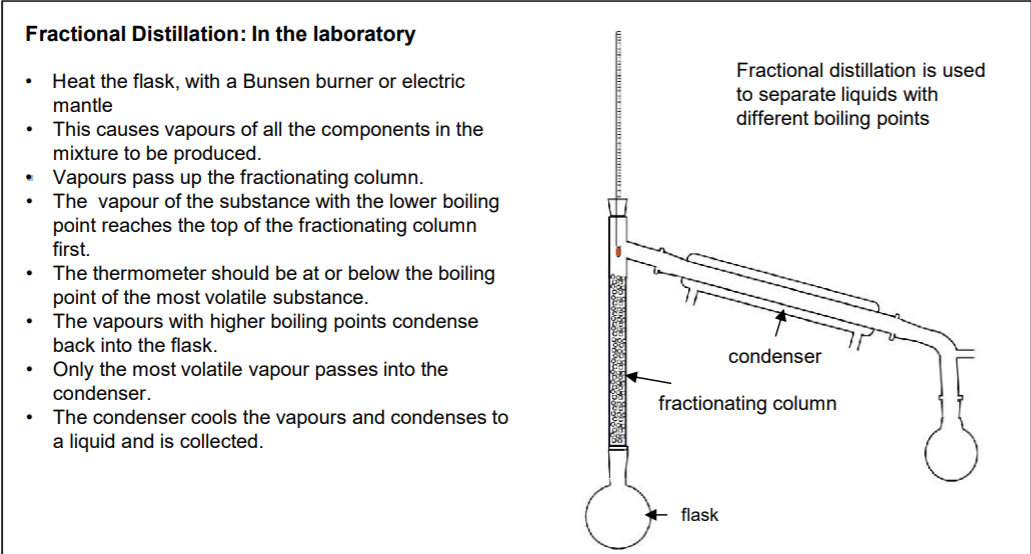
Cracking:
conversion of large hydrocarbons to smaller hydrocarbon molecules by breakage of C-C bonds
Economic reasons for cracking
• The petroleum fractions with shorter C chains (e.g. petrol and naphtha) are in more demand than larger fractions. • To make use of excess larger hydrocarbons and to supply demand for shorter ones, longer hydrocarbons are cracked. • The products of cracking are more valuable than the starting materials (e.g. ethene used to make poly(ethene), branched alkanes for motor fuels, etc.
There are two main types of cracking:
thermal and catalytic
Thermal Cracking
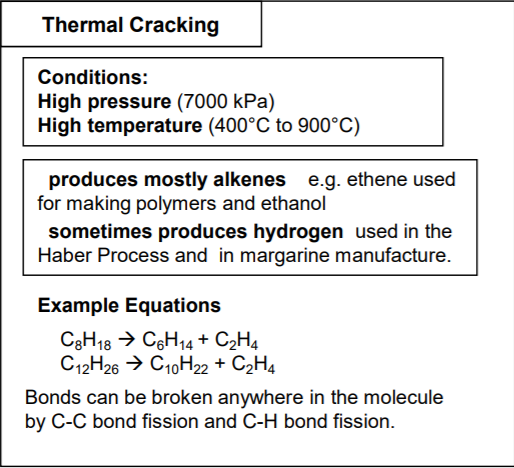
Catalytic Cracking
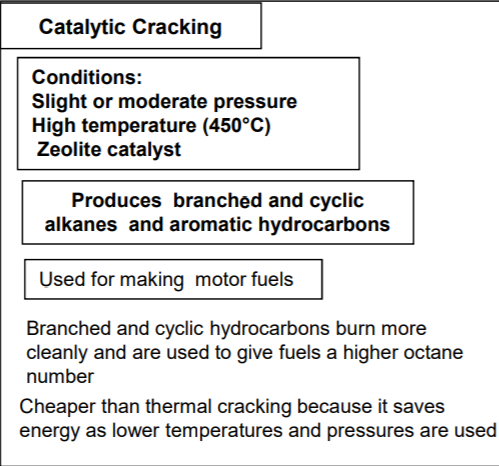
Fuel :
releases heat energy when burnt