Kinetics 5: Complex reactions: composite Arrhenius parameters; chain reactions
No description yet. This curated deck is ready for daily study.
Card preview (10)
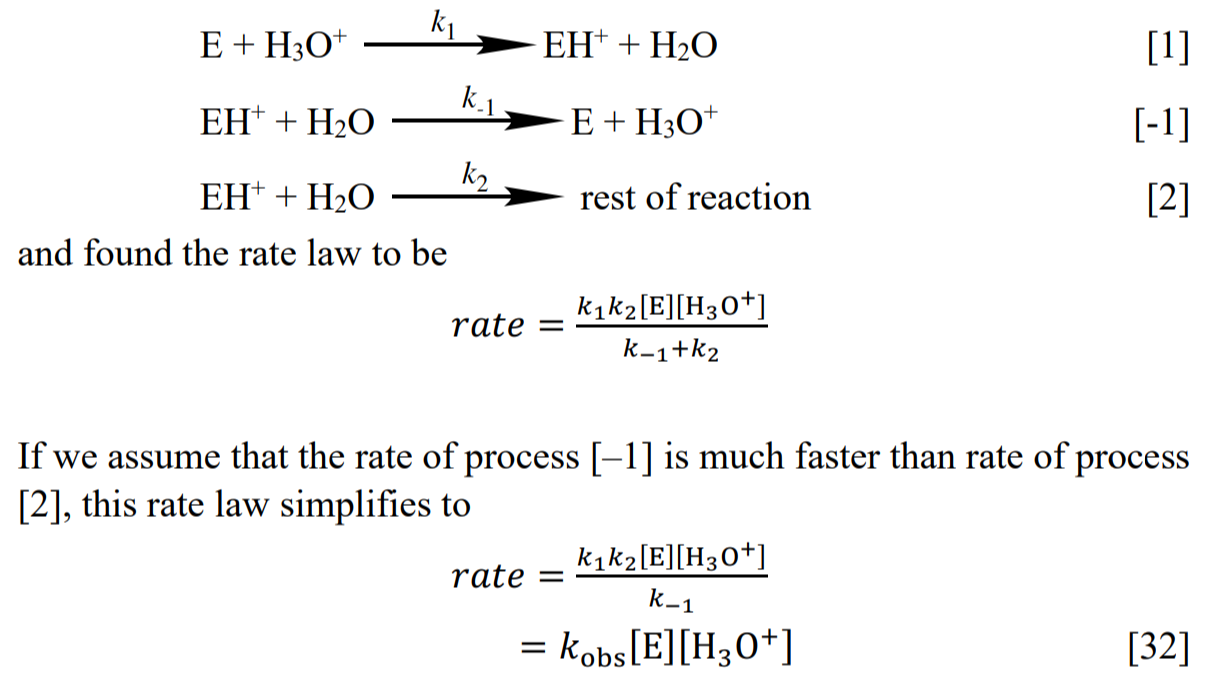
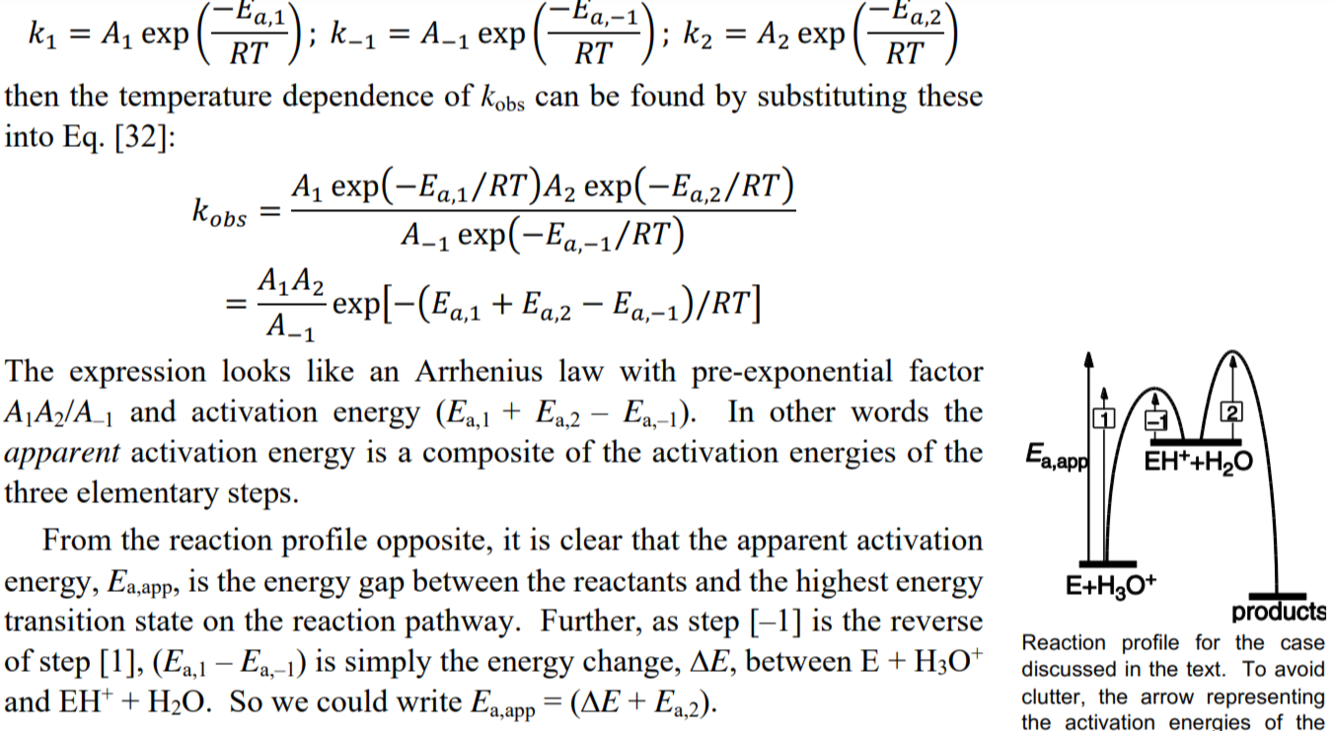
Composite Arhenius parameters Study the image. Assuming each elementary rate constant obeys an Arhenius law, with individual values of A and Ea, derive a composite expression for kobs. Use a reaction profile to illustrate what the apparent Ea represents.
What is a chain reaction?
A reaction comprised of non-linear elementary steps, which form chains in which the output of one step may be the input of an earlier step.
What is a chain carrier?
An intermediate formed during a chain reaction, which is an input into earlier steps, and thus propogates the reaction.
What are the general stages of a chain reaction?
• Initiation generates chain carriers • Propogation maintains chain carriers • Inhibition reduces reaction rate by destroying product (but not chain carriers) • Termination destroys chain carriers • Chain branching (sometimes): one chain carrier reacts to give 2+ carriers (results in explosion, eg combustion)
The thermal chain reaction H2 + Br2 –> 2HBr is well-characterised. Illustrate the stages of this reaction.
Initiation Br2 + M –> 2Br + M where M is a molecule Or photodissociation: Br2 + hv –> 2Br Propogation Br + H2 –> HBr + H H + Br2 –> HBr + Br Inhibition HBr + H –> H2 + Br Termination 2Br + M –> Br2 + M (M absorbs excess energy from new Br2 molecule, such that the Br2 doesn’t immediately fall apart)
The thermal chain reaction H2 + Br2 –> 2HBr is well-characterised. Which species would you expect to follow the steady state approximation?
Br and H, i.e. the chain carriers, since they are intermediates. Propogation • Br + H2 –> HBr + H* • H + Br2 –> HBr + Br*
The rate law for the thermal chain reaction H2 + Br2 –> 2HBr was found to be: d[HBr]/dt = (ka[H2][Br2]3/2)/([Br2] + kb[HBr]) What does this indicate about the mechanism?
• Complex • Fractional power indicates radicals are involved • [HBr] on denominator indicates HBr inhibits the reaction, ie it goes slower as [HBr] increases — but when [HBr] is small in the initial phase, it can be omitted from the denominator and inhibition doesn’t occur
Assuming the thermal chain reaction H2 + Br2 –> 2HBr has the following steps, use the ss approximation to derive an expression for the rate of formation of HBr. Initiation Br2 + M –> 2Br + M (k1) [1] Propogation Br + H2 –> HBr + H (k2) [2] H + Br2 –> HBr + Br (k3) [3] Termination 2Br + M –> Br2 + M (k4) [4] note other reactions could be involved, but the question is whether they compete effectively enough to alter the rate law
Assume chain carriers Br and H are in the steady state Expression for [H] d[H]/dt = k2[Br][H2] - k3[H][Br2] = 0 [H] = (k2[Br][H2]) / (k3[Br2]) Expression for [Br] d[Br]/dt = 2k1[M][Br2] - (k2[Br][H2] - k3[H][Br2]) - 2k4[M][Br]2 = 0 but the quantity in brackets is just d[H]/dt = 0 = 2k1[M][Br2] - (d[H/dt) - 2k4[M][Br]2 = 0 = 2k1[M][Br2] - 2k4[M][Br]2 = 0 [Br] = (k1[Br2]/k4)1/2 Note the 2-coefficients are from the fact that there are 2Br in the reagents/products, so the rate of change of Br is doubled. Also the squared term for k4 is due to the stoichoimetric coefficient = 2 Plug [Br] into [H] expression [H] = (k2[Br][H2]) / (k3[Br2]) = (k2[H2]/k3[Br2]) x (k1[Br2]/k4)1/2 = (k2/k3) x (k1/k4)1/2 x ([H2]/[Br2]1/2) Expression for HBr, then plug in [H] and [Br] d[HBr]initial/dt = k2[Br][H2] + k3[H][Br2] = k2[H2] x (k1[Br2]/k4)1/2 + k3[Br2] x (k2/k3) x (k1/k4)1/2 x ([H2]/[Br2]1/2) = 2k2 x (k1/k4)1/2 x [H2] x [Br2]1/2
Define chain length. Give its expression.
The average number of times that the closed cycle of steps producing products is repeated per chain carrier. chain length, l = (overall reaction rate)/(rate of initiation)
Expansion of the H2 + Br2 –> 2HBr reaction scheme to include [5], an inhibition step, gives the overall rate equation shown. Derive an expression for the chain length in the limit of low [HBr].
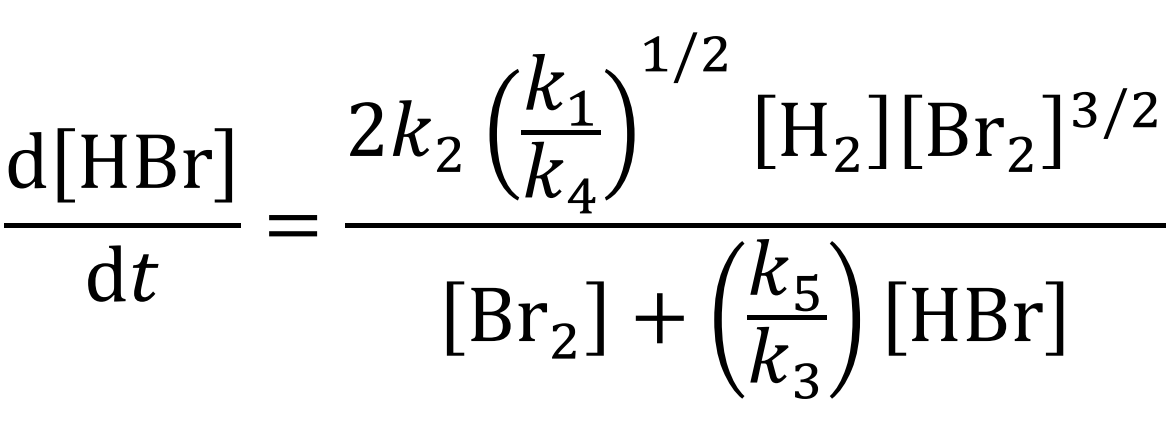
Overall reaction rate, A [HBr] low so can be removed from denominator, so: d[HBr]/dt = 2k2 x (k1/k4)1/2 x [H2] x [Br2]1/2 Rate of initiation, B refer back to scheme = 2k1[M][Br2] Chain length = A/B l = (2k2 x (k1/k4)1/2 x [H2] x [Br2]1/2) / (2k1[M][Br2]) = (k2 / (k4k1)1/2) x ([H2] / ([Br2]1/2[M])) under typical conditions of pressure, chain length is order 10^13, indicating one Br produces many HBr before being terminated