PMMA
No description yet. This curated deck is ready for daily study.
Card preview (8)
What ideal mechanical properties should a denture have?
High Young’s modulus High transverse strength High hardness and abrasion resistance
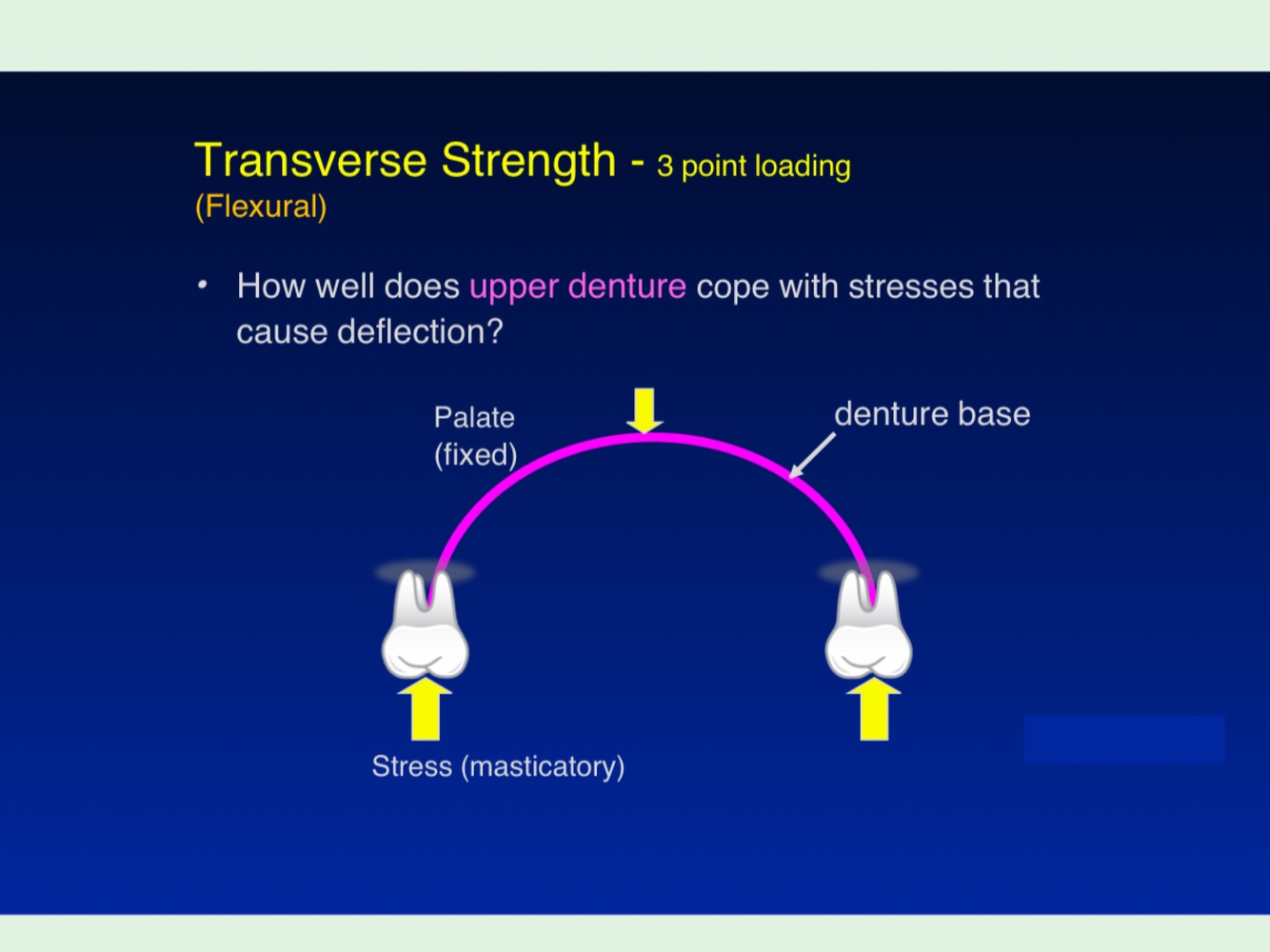
Why is transverse strength important?
3 point loading of a denture. Pivot point is on the palate and there is masticatory stress on the teeth. Transverse strength is needed to stop the denture from fracturing.
How is acrylic formed?
Free radical addition polymerisation Joining of two of the same chemicals or one larger without the removal of one atom. Requires C=C bonds.
What 4 stages of acrylic polymerisation are there?
Activation - of initiator to provide free radicals Initiation - c=c bond broken and free radical transferred Propagation - growing of chain Termination - of polymerisation
Give some properties of acrylic
Fairly resistant fatigue / impact strength, but can be cause of failure High hardness and abrasion resistance Thermal expansion the same if acrylic teeth used but different if porcelain teeth Poor thermal conductivity Low density High softening temp = 75 degrees so don’t clean in boiling water
Why self cure acrylic > heat cure?
Lower temperature used so less thermal contraction resulting in better dimensional stability
Issue with self cure acrylic?
Chemical activation is less efficient (more monomer = softer and more risk of being irritant to tissues), hence lower molecular weight and poorer mechanical properties
What acrylic is used in GDH, why is it useful?
Ultra-Hi • exceptional felxural strength and high ductility So slight bending before cracking or breaking