3.3- Halogenoalkanes
No description yet. This curated deck is ready for daily study.
Card preview (24)
What is electronegativity?
Electronegativity is a measure of the power of an atom to attract the shared pair of electrons in a covalent bond.
Substances with high electronegativity values …
attract electrons strongly.
What do mechanism arrows show?
Where electrons go.
What is hydrolysis?
Splitting a molecule by using water. (Breaking C-X bonds by adding water).
What type of bond do halogenoalkanes have?
C-X
How are halogenoalkanes formed?
When a halogen takes the place of hydrogen in an alkane.
What is the general formula of halogenoalkanes?
CnH2n+1X
How do we name halogenoalkanes?
1) Prefixes are used to show which halogen is present: Fluoro- Chloro- Bromo- Iodo- 2) Numbers show to which carbon the halogen is attached. 3) We use prefixes to show many atoms of each halogen are present: Di- Tri- Tetra- 4) When a compound contains multiple halogens they are listed in alphabetical order.
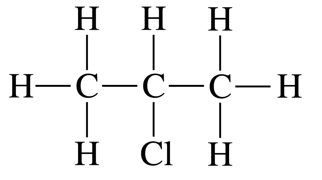
Draw 2-chloropropane.
What is bond polarity?
It is the unequal sharing of electrons between atoms that are covalently bonded.
How does bond polarity occur?
From covalent bonds between atoms with different electronegativity.
Is the C-X bond in halogenoalkanes polar or non-polar?
Polar
How do we show the polar C-X bond?

Place these elements in order of ascending electronegativity: C, F, Cl, Br, I.
C I Br Cl F
What are the different types of halogenoalkanes?
Primary, secondary, tertiary.
What type of halogenoalkane is this?
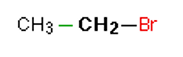
Primary
What type of halogenoalkane is this?
Secondary
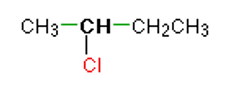
What type of halogenoalkane is this?
Tertiary
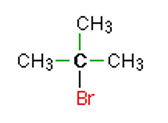
What happens when halogenoalkanes react?
C-X bond is broken.
What does the reactivity of halogenoalkanes depend on?
How easy the different C-X bond is to break.
What are the factors that determine how easy a C- bond is to break?
. The C-X bond enthalpy . The C-X bond polarity
What does the MORE electronegative halogen do to the carbon it’s bonded to?
It removes the charge from the carbon it’s bonded to. (Pulls electrons towards the halogen.)
What happens to the carbon that has its charge removed by a halogen?
It becomes an electron-deficient carbon.
What is the electron-deficient carbon vulnerable to?
Attack by electron-rich reagents (nucleophiles).