Organic Chemistry
暂无描述。系统推荐的高质量记忆内容,适合每天坚持背诵学习。
卡片预览 (24 张)
Homologous series
Compounds that have a similar chemical structure and chemical properties
Organic compounds
Compounds consisting of carbon atoms most commonly covalently bonded to hydrogen, nitrogen, phosphorus or oxygen atoms
Functional group
Specific groups of atoms within a compound that affect the properties of the compound.
Alkanes
Saturated molecules - all carbons to carbon single bonds
Alkenes
Unsaturated molecules - contains at least one carbon-to-carbon double bond
Alkane General Formula
CnH2n+2
Alkene General Formula
CnH2n
Haloalkane General Formula
CnH2n+1 X
Isomers
Molecules that have the same molecular formula but a different structural formula.
Fractional Distillation
Fractional distillation separates a mixture into a number of different parts, calledfractions. A tall fractionating column is fitted above the mixture. The column is hot at the bottom and cool at the top.
Why do the longer hydrocarbon chains take more heat energy to change state from solid to liquid or liquid to gas?
The longer the chain, the stronger the dispersion forces there are between the molecules thus requiring more energy to break.
Viscosity
Viscosityis a measure of a fluid’s resistance to flow.
When the hydrocarbon goes through a state change of liquid to gas, which bonds are broke?
Weak intermolecular forces (dispersion) are broken when the hydrocarbon reaches its boiling point and transitions from liquid to a gas. The covalent bonds between the atoms do not beak. This would required a higher amount of energy.
Difference in boiling point of small and larger hydrocarbons
Smaller the molecule the lower the boiling point because there are lesson intermolecular forces between the molecules. And therefore, less energy required to break them.
Cracking
Large hydrocarbon molecules can be broken down into smaller molecules using a catalyst.
Cracking Method
The hydrocarbon molecules are heated until they turn into vapour, and then mixed with a catalyst.
Combustion (complete and incomplete)
Complete combustion hydrocarbon is burned in excess oxygen hydrocarbon + oxygen → carbon dioxide + water Incomplete combustion hydrocarbon is burned in limited oxygen hydrocarbon + oxygen → carbon monoxide + water or hydrocarbon + oxygen → carbon + water
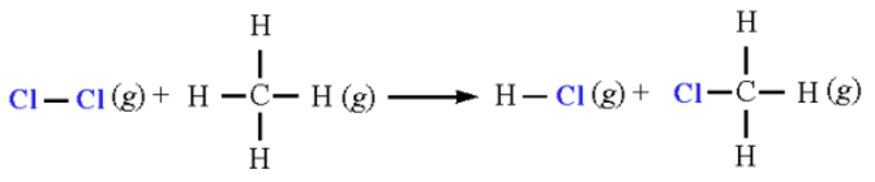
Substitution reaction (with drawn example)
Oneatomis swapped with another atom. Alkanesundergo asubstitution reactionwithhalogensin the presence of light.
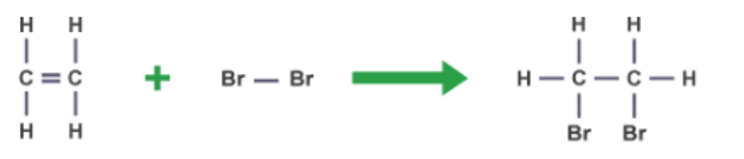
Addition reaction (with halides, including conditions)
Double bond breaks and addition atoms are added.
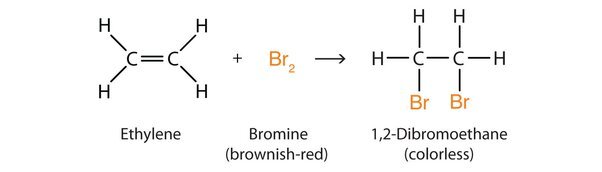
Bromine water test (including equation, including conditions)
(type of addition reaction). A test to determine whether a solution contains alkanes or alkenes. There is no change when bromine water is mixed with an alkane. The bromine water goes from orange to colourless when it is mixed with an alkene.
Hydrogenation (addition reaction with H2, including conditions)
Alkene + hydrogen (150degreesC and Ni catalyst)→ alkane
Hydration (addition reaction with H2O, including conditions)
Alkene + water (steam) (catalyst + 300degrees C) → alcohol
Ethanol production (including advantages and disadvantages) Fermentation of glucose
Fermentation of glucose: C6H12O6 (yeast catalyst) → C2H5OH + CO2 Advantages: Simple method and Uses renewable resources Disadvantages: Not a continuous process, slow reaction and produces low purity ethanol
Ethanol production (including advantages and disadvantages) Hydration
Ethene + steam C2H4 + H2O (g) → C2H5OH Advantages: Small-scale equipment, continuous process, reaction is fast and produces high purity ethanol Disadvantages: Uses non-renewable resources