AN213: Biodiversity and Conservation
No description yet. This curated deck is ready for daily study.
Card preview (24)
There are more than ____________ species of ants, __________ species of beetles, __________ species of fishes and nearly _________ species of orchids
20 000 300 000 28000 20 000
Biodiversity is the term popularised by the sociobiologist _______________ to describe the combined diversity at all the levels of biological organisms.
Edward Wilson
In Biodiversity most important levels of diversities are :- 1. Genetic diversity 2. Species diversity 3. _____________ diversity
Ecological diversity
The Genetic diversity shown by the medicinal plant ___________________ growing in different Himalayan ranges might be in terms of the potency and concentration of the active chemical (___________) that the plant produces.
Rauwolfia vomitoria reserpine
India has more than _____________ genetically different strains of Rice and ______ varieties of mango.
50000 1000
Example of the diversity at the species level is , the Western Ghats have a greater __________ species diversity than the Eastern Ghats
Amphibian
**At the ecosystem level , India has a greater ecosystem diversity than a Scandinavian country like _____________.
Norway Note:- Scandinavia is a subregion of Northern Europe consisting of Denmark, Norway, and Sweden
According to the _________________________ (IUCN) (2004) , the total number of plant and animal species described so far is slightly more than 1.5 million.
International Union for Conservation of Nature and Natural Recourses (IUCN) (2004)
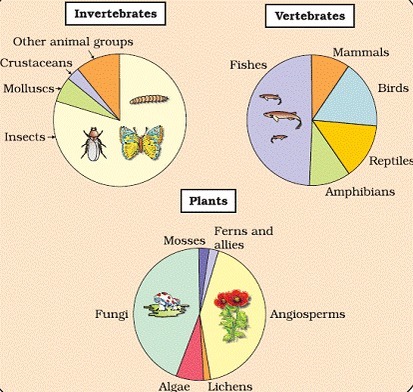
More than _________ per cent of all the species recorded are animals , while plants (including algae, fundi, bryophytes, gymnosperms and angiosperms) comprise no more than _____ percent of the total.
70 % 22 %
Among animals, ___________ are the most species-rich taxonomic group, making up more than 70 % of the total.
Insects Note:- watch the picture carefully.
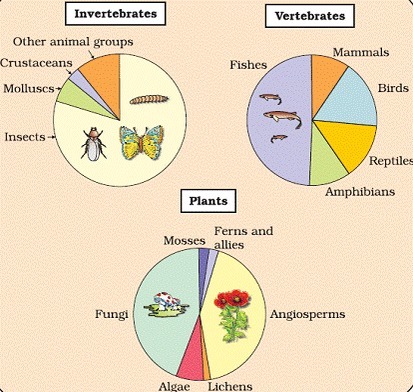
Out of every 10 animals on this planet, _____ are insects.
7 Note:- watch the picture carefully.
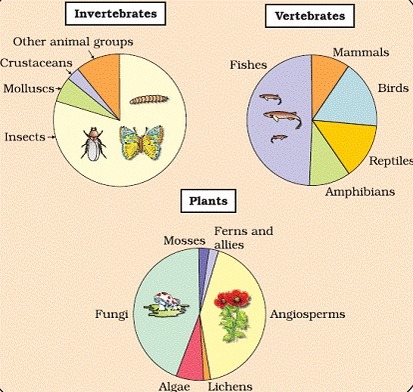
The number of _________ species in the world is more than the combined total of the species of fishes, amphibians, reptiles and mammals.
fungi Note:- watch the picture carefully.
India has only 2.4 % of the world’s land area, it share of the global species diversity is an impressive _______ %. That is what makes our country one of the ________ mega diversity countries of the world.
8.1 12
Nearly ___________ species of plants and twice as many of animals have been recorded from India.
45,000
species diversity decreases as we move away from the equator towards the poles. with very few exceptions, tropics (latitudinal range of 23.5oN to 23.5oS) harbor more species than temperate or poles. This is known as _______________ gradients.
Latitudinal gradients
Colombia located near the equator has nearly ___________ species of birds while New York at 41oN has _______ species and Greenland at 71oN only _____ species.
1400 species 105 species 56 species.
India, with much of its land area in the **tropical latitudes, has more than __________ species of birds
1200 species.
The largely tropical Amazonian rain forest in South America has the greatest biodiversity on earth- it is home to more than _________species of plants, _________ of fishes, _________ of birds _________ of mammals _________ of amphibians _________ of reptiles and of more than ______________ invertebrates
40000 species of plants, 3000 of fishes, 1300 of birds 427 of mammals 427 of amphibians 378 of reptiles and of more than 1,25,000 of invertebrates
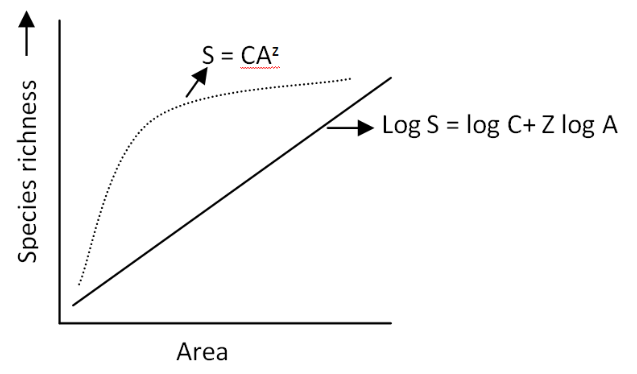
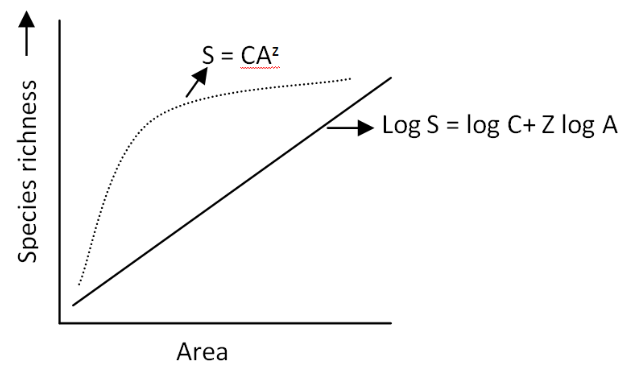
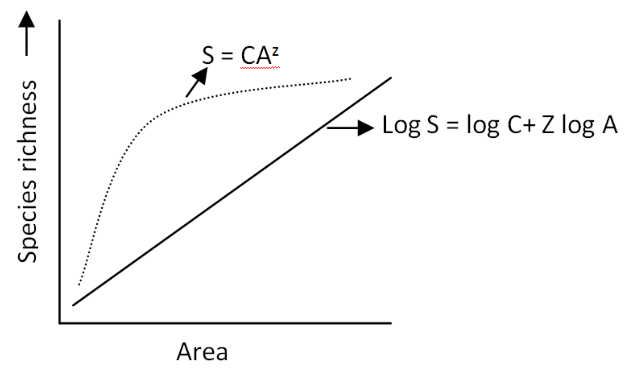
The relation between species richness and area for a wide variety of taxa turns out to be a _________________ hyperbola.
rectangular hyperbola
The relationship between species richness and area is a straight line described by the equation ___________________
log S = log C + Z log A where S = species richness A = Area Z = slope of the line (regression coefficient) C = Y-intercept Note:- Ecologists have discovered that the value of Z lies in the range of 0.1 to 0.2
_____________ are called fruit-eating animals.
frugivorous
The species- area relationships among very large areas like the entire continents, you will find that the slope of the line to be much steeper (Z value in the range of _______________)
0.6 to 1.2
For frugivorous birds and mammals in the tropical forests of different continents, the slope is found to be __________
1.15
David ___________ long-term ecosystem experiments using outdoor plots found that plots with more species showed less year-to-year variation in total _____________
David Tilman’s biomass. Note:- David Tilman’s showed that in his experiments, increased diversity contributed to higher productivity.