6.2 Blood System
No description yet. This curated deck is ready for daily study.
Card preview (6)
Circulation
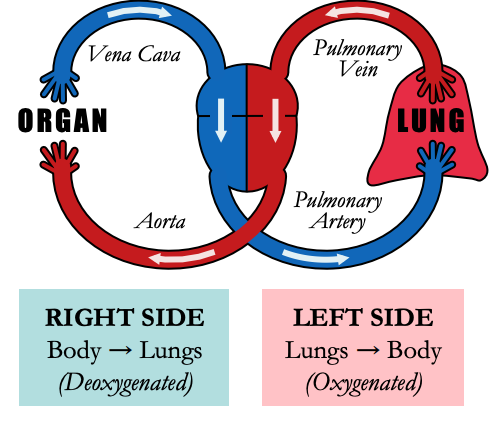
William Harvey proposed the modern understanding of the circulatory system According to Harvey: * The major blood vessels (arteries & veins) are connected by a single network * Blood flow is unidirectional (due to the presence of one-way valves) * The heart is a central pump (arteries = from heart ; veins = to heart) * Blood flows continuously and is not consumed by the body It has further been discovered that: * Arteries and veins are connected by capillaries (via arterioles & venules) * There is a separate circulation for the lungs (pulmonary versus systemic)
Blood Vessels: Arteries
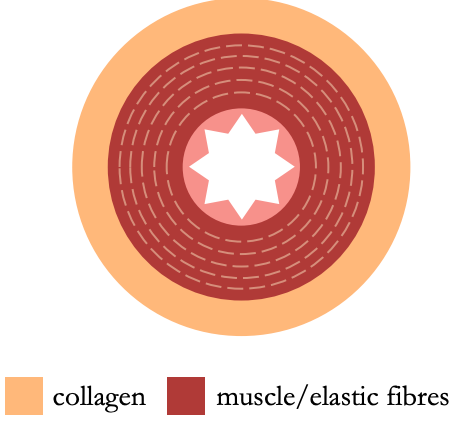
Arteries * Transport blood from the heart * Blood at high pressure (80-120 mmHg) * Walls are thick (muscle and elastin) * Walls stretch or contract with pulse
Blood Vessels: Veins
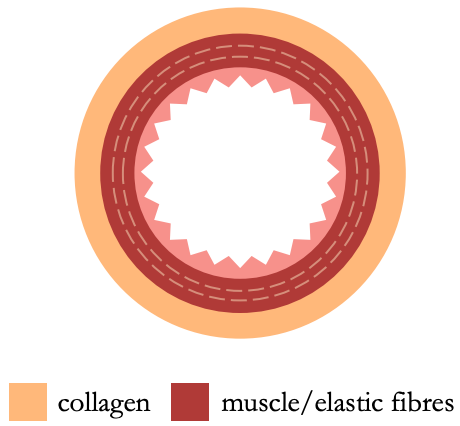
Veins * Transport blood to the heart * Blood at low pressure (<15 mmHg) * Walls are thin (with wider lumen) * Have valves to prevent pooling
Blood Vessels: Capillaries
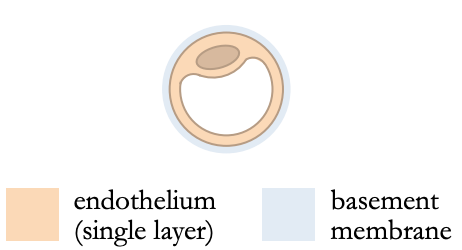
Capillaries * Facilitate material exchange * Blood at low pressure (~10 mmHg) * Walls made of single layer of cells * Extremely narrow lumen (~10 µm) Capillaries may be categorised as: * Continuous (intact basement membrane) * Fenestrated (have endothelial pores) * Sinusoidal (discontinuous membrane)
Blood
Blood contains three main elements: * Red blood cells (transport oxygen) * White blood cells (fight infections) * Platelets (responsible for clotting) The blood fluid (plasma) transports: * Nutrients (e.g. glucose) * Antibodies * Carbon dioxide * Hormones * Oxygen * Urea * Heat
Blood Flow
A heart pumps blood around the body via two distinct circulatory pathways Right Side (of heart): * Deoxygenated blood (from tissues) enters right atrium via the vena cava * Blood in the right ventricle is pumped to lungs via the pulmonary artery * Gas exchange at the lungs (capillaries ⟷ alveoli) oxygenates the blood Left Side (of heart): * Oxygenated blood (from lungs) enters left atrium via the pulmonary vein * Blood in the left ventricle is pumped to the body tissues via the aorta * Material exchange occurs at the respiring tissue (deoxygenates the blood) Valves in veins ensure proper circulation by preventing backflow of blood Contraction of skeletal muscles may compress veins to aid blood flow