7C - Muscles and bones
暂无描述。系统推荐的高质量记忆内容,适合每天坚持背诵学习。
卡片预览 (24 张)
Are bones organs?
Yes, they are organs
What are the three functions of the skeleton?
• Protect organs - Supports body - Allows you to move
Why are bones hard?
To withstand knocks and pressure.
Why are bones light?
So they are easy to move.
What does the hollow centre of bones contain?
Bone marrow, where blood cells are made.
Can muscles push?
No. They can only pull.
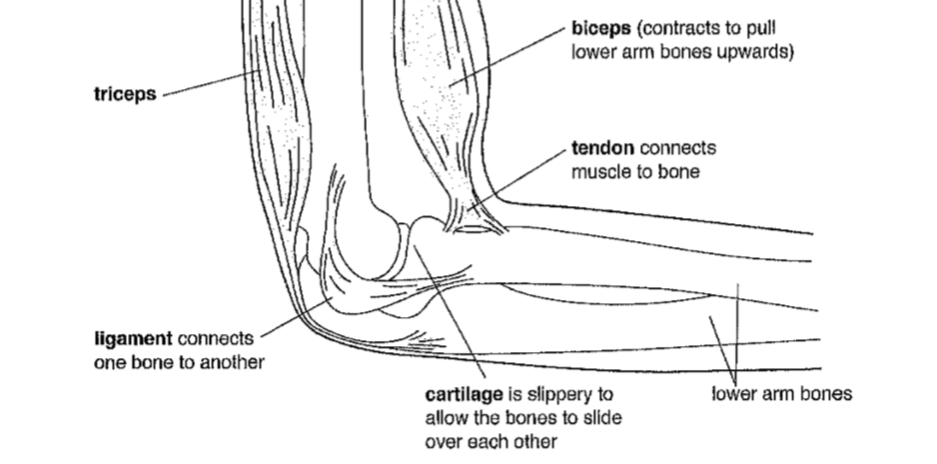
How do antgonistic pairs of muscles work?
One muscle contracts (gets shorter and fatter) to pull a bone. The other muscle pair relaxes. i.e. biceps and triceps
Hoe are muscles controlled?
By the nervous system. Impulses from the brain travel down the spinal chord and along nerves to muscles.
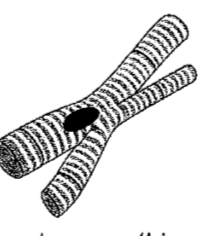
How are muscle cells adapted to their function?
contain strands that can shorten to produce a pulling force.
Does muscle contraction require energy?
Yes
From which process is the energy required for muscle contraction obtained?
Respiration
How are the nutrients and oxygen needed for respiration carried to the muscles?
in the blood: oxygen is carried on red blood cells and nutrients, in the plasma.
Which system allows air to enter and leave the lungs, so that oxygen can get into the blood and carbon dioxide can leave the blood?
Gas exchange / breathing system
What is carbon dioxide?
A waste product from respiration
Carbon dioxide is …. when you exhale
excreted
What is breathing?
The movement of the muscles in your diaphragm and between the ribs, which cause changes in the volume of the lungs.
What is ventilation?
The movement of air into and out of the lungs as breathing occurs.
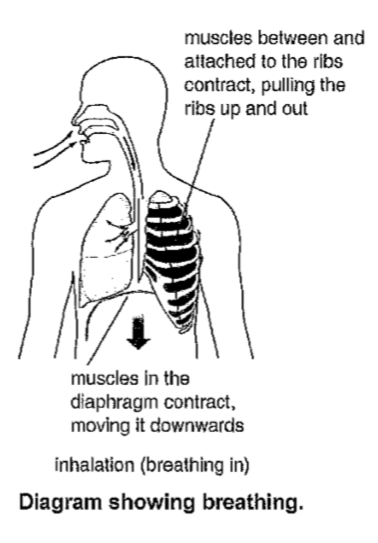
What happens when you breathe in (inhalation)?
Muscles in the diaphragm contract, moving it downwards. Muscles between and attached to the ribs contract, pulling the ribs up and out.
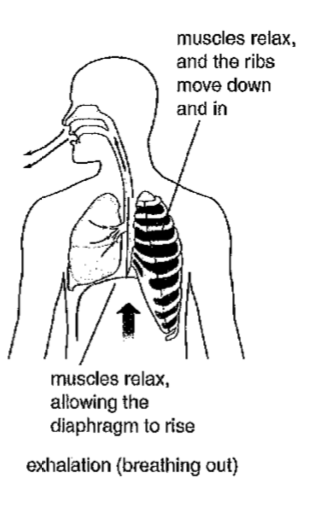
What happens when you breathe out (exhalation)?
Muscles in the diaphragm relax, allowing the diaphragm to rise. Muscles in between the ribs relax, and the ribs move down and in.
Which blood vessel carries blood to the heart?
Veins
Which blood vessel carries blood away from the heart?
Arteries
What are capillaries?
Blood vessels conecting arteries and veins. Have thin walls to allow oxygen and nutrients to leave the blood and get into the tissue. (Co2 moves from the tissue into the capillary).
What is the pulse?
When the pumping of the heart can be felt in arteries.
What are drugs?
Chemicals that affect how the body works.