Topic 4 Inorganic Chemistry and the Periodic Table
No description yet. This curated deck is ready for daily study.
Card preview (24)
Group 2: Trend in ionisation energy
First and second ionisation energy decreases going down the group: -Nuclear charge increases, so does force of attractions for the electron being removed (this causes an increase going down). -As each quantum shell is added, energy of the outermost electron increases. -As the number of filled electrons increases, the force of repulsion on electron being removed increases. The two decrease down the group outweighs the one increase meaning an overall decrease.,
Group 2: Reactions with oxygen
Similar reactions then when magnesium burns in air (very bright flame and the formation of a white solid). However calcium, strontium and barium react with more vigour (barium is the most reactive-often stored in oil to stop reactions with air). –>2M(s) + O2(g) –> 2MO(s) –> The element needs to be heated for the reaction to start (Reacts with increasing vigour going down the group).
Group 2: Reactions with chlorides
Reacts with increasing vigour going down the group –> M(s) + Cl2(g) –> MCl2(s)
Group 2: Reactions with water
-The reaction between magnesium and water is very slow and does not proceed completely. -Calcium, strontium and barium react with increasing vigour (which can be see by the increase of effervescence) –> M(s) + 2H2O(l) –> M(OH)2(aq) + H2(g) -Calcium hydroxide is only slightly soluble in water, so the liquid in this experiment goes cloudy as a precipitate of calcium hydroxide forms
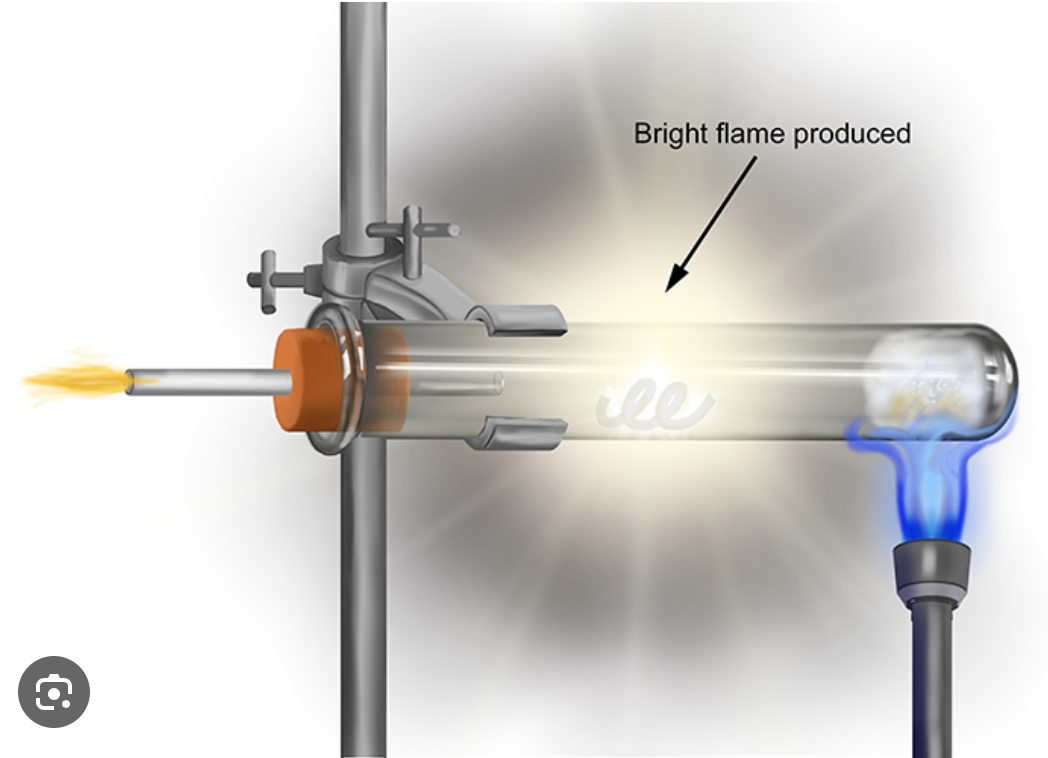
Group 2: Magnesium and steam
Magnesium reacts differently when heated with steam- it rapidly forms magnesium oxide (a white solid) and hydrogen gas is a vigorous reaction. (The hydrogen formed is burned as it leaves the tube. This is for safety reasons, to prevent highly flammable gas into the lab).
Group 2: Reactions of beryllium and radium
(Don’t need to know specific reactions) Trend is increasing reactivity down the group: -So beryllium is less reactive than magnesium -And radium is more reactive than barium
Group 2: Reactions of the oxides with water
-They react with water to form alkalis (form colourless solution) –> MO(s) + H2O(l) –> M(OH)2(aq)
Group 2: Trends in solubility of the hydroxides
Solubility of hydroxides increases going down group 2.
Group 2: Testing for carbon dioxide (hydroxides)
(Limewater goes cloudy) Limewater is the name for saturated aqueous solution of calcium hydroxide; carbon dioxide reacts to form calcium carbonate which is insoluble in water and is the white precipitate. –> CO2 + Ca(OH)2 –> CaCO3 + H2O
Group 2: Milk of magnesia (hydroxides)
Taking milk of magnesia neutralises some of the hydrochloric acid in the stomach reducing symptoms of indigestion. –> Mg(OH)2 + 2HCl –> MgCl2 +2H2O
Group 2: Reactions of the oxides and hydroxides with acids
All react with acid to form salts and water (neutralisation reactions). Observations made: a white solid reacts to form a colourless solution. –> MgO + H2SO4 –> MgSO4 + H2O –> Ba(OH)2 + 2HCl –> BaCl2 + 2H2O
Group 2: Use in agriculture
Farmers use lime to control soil acidity so a greater yield of crops can be obtained. Lime is mostly calcium hydroxide. –> Ca(OH)2 + 2HNO3 –> Ca(NO3)2 + 2H2O (nitric acid is used to represent the acid in the soil).
Group 2: Trends in solubility of the group 2 sulphates
Solubility of sulfates decreases going down group 2. -Magnesium sulphate is classed as soluble -Calcium sulfate is slightly soluble -Strontium and barium sulfate (The very low solubility of barium sulfate is used to test for sulfate ions in solution).
Group 2: Testing for sulfate ions
-Add dilute hydrochloric acid (or nitric acid) -Add a few drops of barium chloride solution -A white precipitate of barium sulfate confirms presence of sulfate ion –> Ba(NO3)2(aq) + Na2SO4(aq) –> BaSO4(s) + 2NaNO3(aq)
Group 2: Barium meals
Barium meals contain barium sulfate (which is not poisonous to humans as it insoluble). They are used in hospitals to allow soft tissues to show up in an x-ray.
Group 2: Thermal stability
Thermal stability indicates how stable a compound is when it is heated: it doesn’t decompose (thermally stable), it decomposes as much as possible (not at all thermally stable).
Group 2: Factors affecting thermal stability
-The charge on a group 2 cation (is double that of a group 1 cation) -The size (ionic radius) of group 2 cation (is smaller that that of the group 1 cation) -The nitrate (NO3-) and carbonate (CO3^2-) anions are more complex than the Cl- ions. These differences mean that when group 2 nitrates and carbonates are heated, they do not melt.
Group 2: Thermal stability of nitrates
All of group 1&2 elements are white solids. When they are heated, they all decompose to nitrates or oxides and give off nitrogen dioxide (brown fumes) and/or oxygen. If the nitrate contains water of crystallisation, then steam will be observed. —> If no browns fumes are observed, this indicates a lesser decomposition: metal nitrate –> metal nitrate + oxygen —> If brown fumes are observed, this indicates a greater decomposition: metal nitrate –> metal oxide + nitrogen dioxide + oxygen
Group 2: Thermal stability of carbonates
All of group 1&2 elements are white solids. When they are heated they either don’t decompose, or decompose to oxides and give off carbon dioxide. Gas given off is colourless so no observations can be made. -Lithium carbonate decomposes at lower temperatures than the other group 1 carbonates: Li2CO3 –> Li2O + CO2. Other group 1 carbonates do not decompose on heating, except at very high temperatures. All group 2 carbonates decompose in the same way, but with increasing difficulty down the group. -A typical equation for one of these decompositions: CaCO3 –> CaO + CO2.
How to do a flame test
-Add a few drops of concentrated hydrochloric acid to the solid metal and mix together so the metal begins to dissolve -Dip a clean metal wire (platinum or nichrome) or a silica rod into the mixture -Hold the end of the wire in the flame and observe the colour
Colours of flame tests
-Lithium (Li+): red -Sodium (Na+): yellow/orange -Potassium (K+): lilac -Rubidium (Rb+): red/purple -Caesium (Cs+): blue/violet -Beryllium (Be2+): no colour -Magnesium (Mg2+): no colour -Calcium (Ca2+): brick red -Strontium (Sr2+): crimson red -Barium (Ba2+): apple green
What causes the colours in flame tests?
Electron transitions. -Electrons absorb energy and move to higher energy levels from ‘ground state’ -The electron in a higher energy level is in an ‘excited state’ -The movement is immediately followed by the return of the electron to its ground state, which releases energy -If this energy corresponds to radiation in the visible light spectrum, then a colour appears. -This is the flame test colour
The test for ammonium ions
-Add sodium hydroxide solution -Warm the mixture NH4^+ + OH- –> NH3 + H2O Warming releases ammonia gas. Damp red litmus paper turns blue if ammonia gas is present. (Hydrogen chloride gas reacts with ammonia to form white fumes of ammonium chloride: NH3 + HCl –> NH4Cl).
Intro to group 7 elements
States at room temperature: Fluorine: gas Chlorine: gas Bromine: liquid Iodine: solid Astatine: solid