Chapter 5 (electrons and bonding)
No description yet. This curated deck is ready for daily study.
Card preview (21)
How are electrons arranged around the nucleus ?
• electrons are arranged around the nucleus in principle energy levels, or principle quantum shells • principle quantum numbers(n) are used to number the energy levels or quantum shells, the lower the principle quantity number, the closer the shell is to the nucleus • each principle quantum number holds a fixed number of electrons 2n^2
What are the different subshells of electrons ?
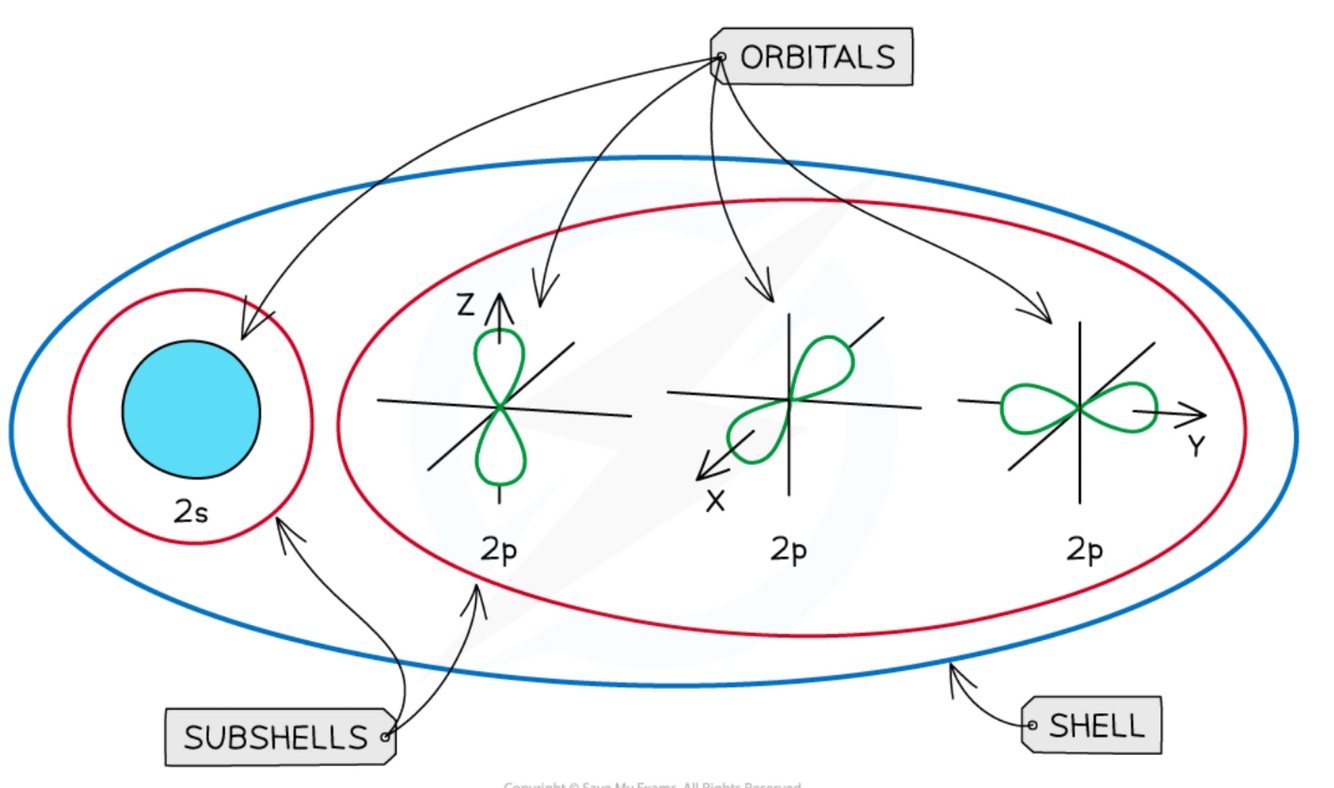
The principle quantum shells are split into sub-shells which are given letters s,p,d and f, only elements with more than 57 electrons have an f shell The energy of the electrons in the sub-shells increases s < p < d
What are orbitals ?
• sub-shells contain one or more atomic orbitals • orbitals exists at specific energy levels and electrons can only be found at these specific levels, not in between them • each atomic orbitals can be occupied by a maximum of 2 electrons • s: 1 orbital • p: 3 orbitals • d: 5 orbitals • f: 7 orbitals
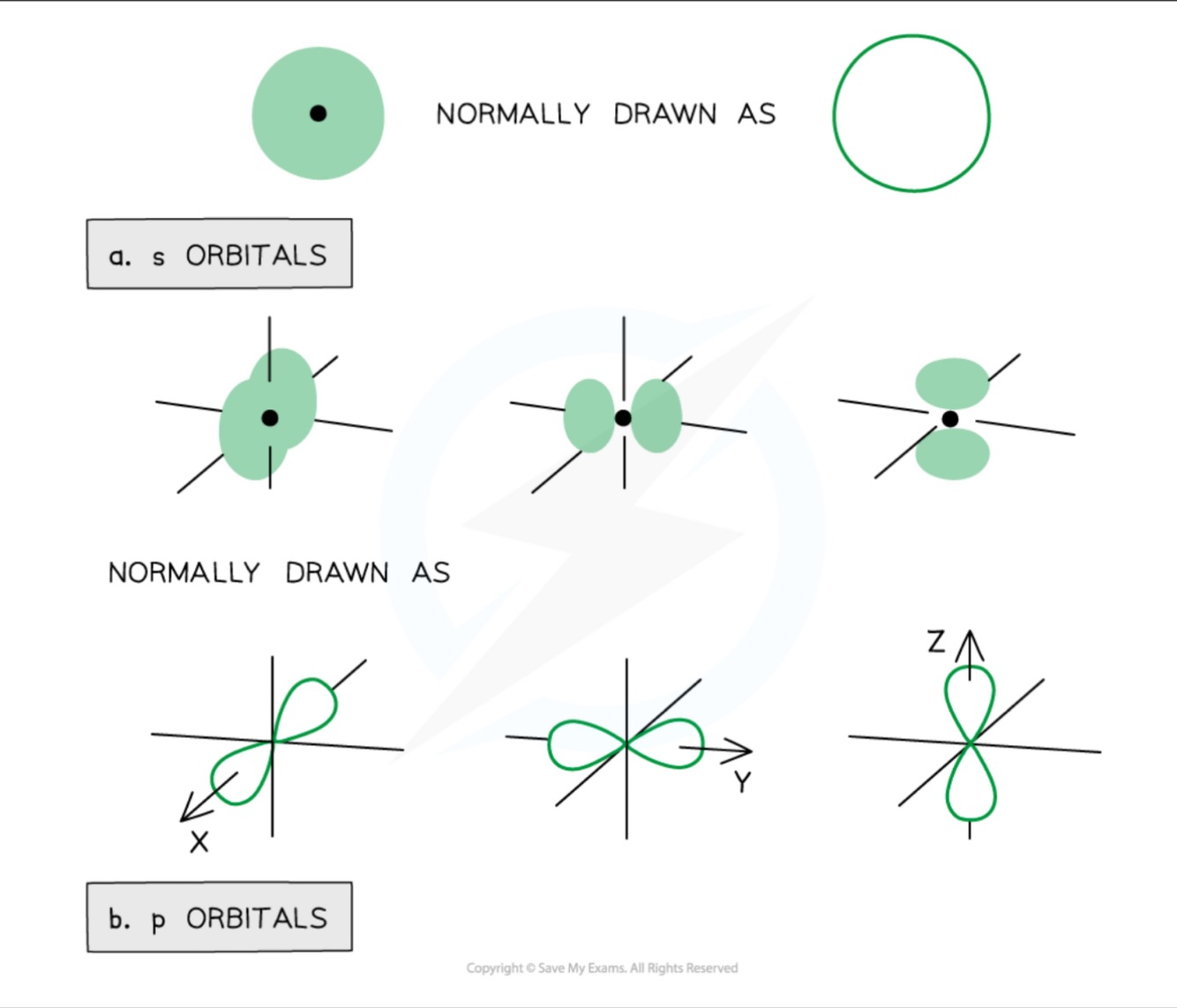
What is the shape of the s orbital ?
• the s orbitals are spherical in shape • the size of the s orbitals are increases with increasing shell number • the s orbital of the 3rd quantum shell is bigger than the s orbital of the 1st quantum shell
What is the shape of the p orbital
• The p orbitals have a dumbbell shape • every shell has 3 p orbitals except for the first one • the p orbitals occupy the x,y, z axes and point at right angles to each other, so are oriented perpendicular to each other
What does a shell and sub shell look like ?
What is electron spin ?
• electrons can be imagined as small spinning charges which rotate around their own axis either clockwise or anticlockwise • the spin creates a tiny magnetic field with N-S pointing up or down • electrons with the same spin repel each other • this means electrons will occupy separate orbitals in the same sub-shells first to minimise this repulsion, and spin in the same direction • they then pair up with the other electron spinning in the opposite direction
What is the Pauli exclusion principle ?
• An orbital can only hold 2 electrons and they must have opposite spin, known as Pauli Exclusion Principle • This is because the energy required to jump to a higher empty orbital is greater than the inter-electron repulsion • for this reason, they pair up and occupy the lower energy levels first.
What is ground state ?
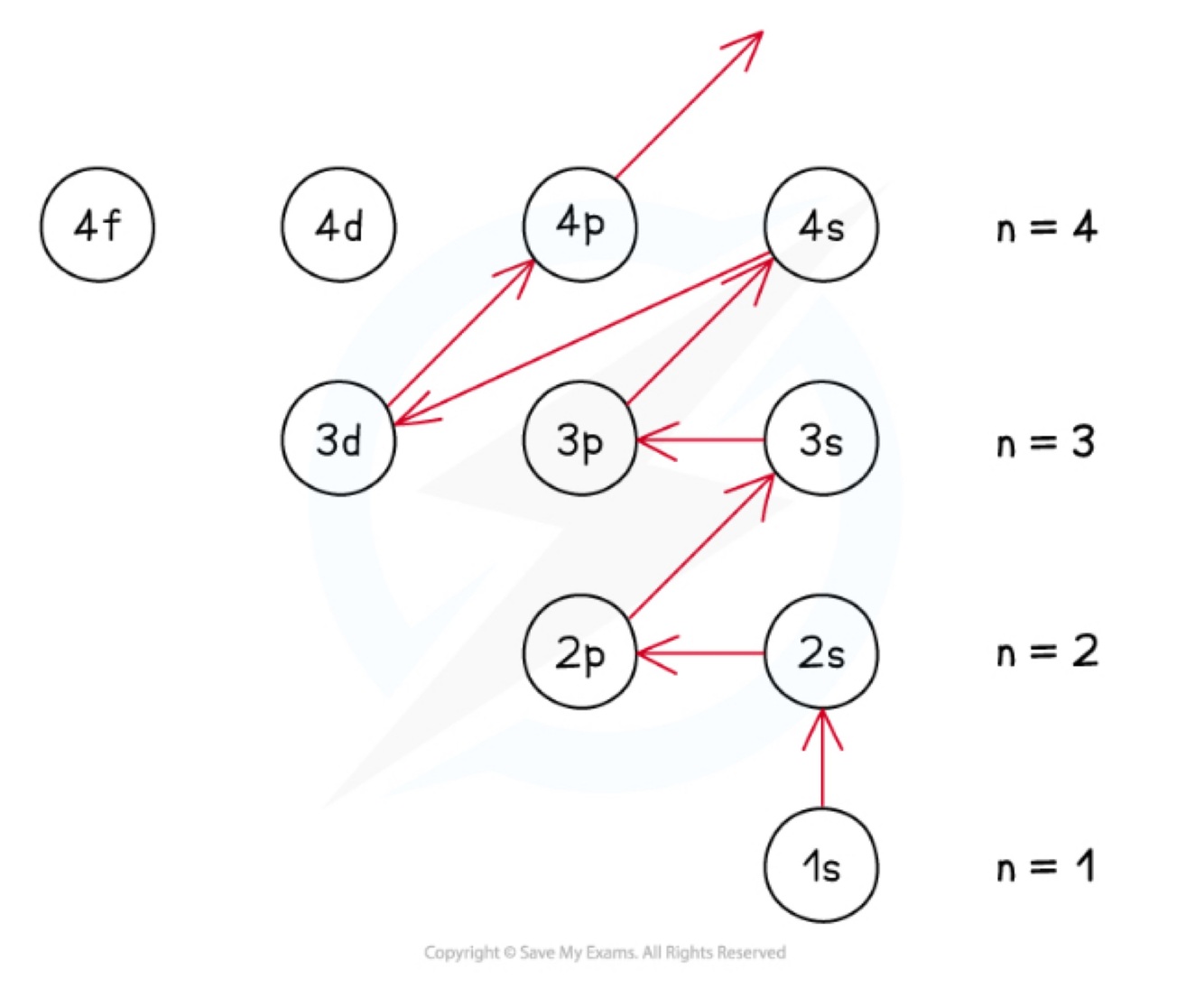
• the ground state is the most stable electronic configuration of an atom which has the lowest amount of energy • the order of the subshells in terms of increasing energy does not follow a regular pattern.
What is the difference between full electron figuration and short hand ?
• the full electron configuration describes the arrangement of all electrons from the 1s subshell up • the shorthand electron configuration includes using the symbol of the nearest preceding noble gas
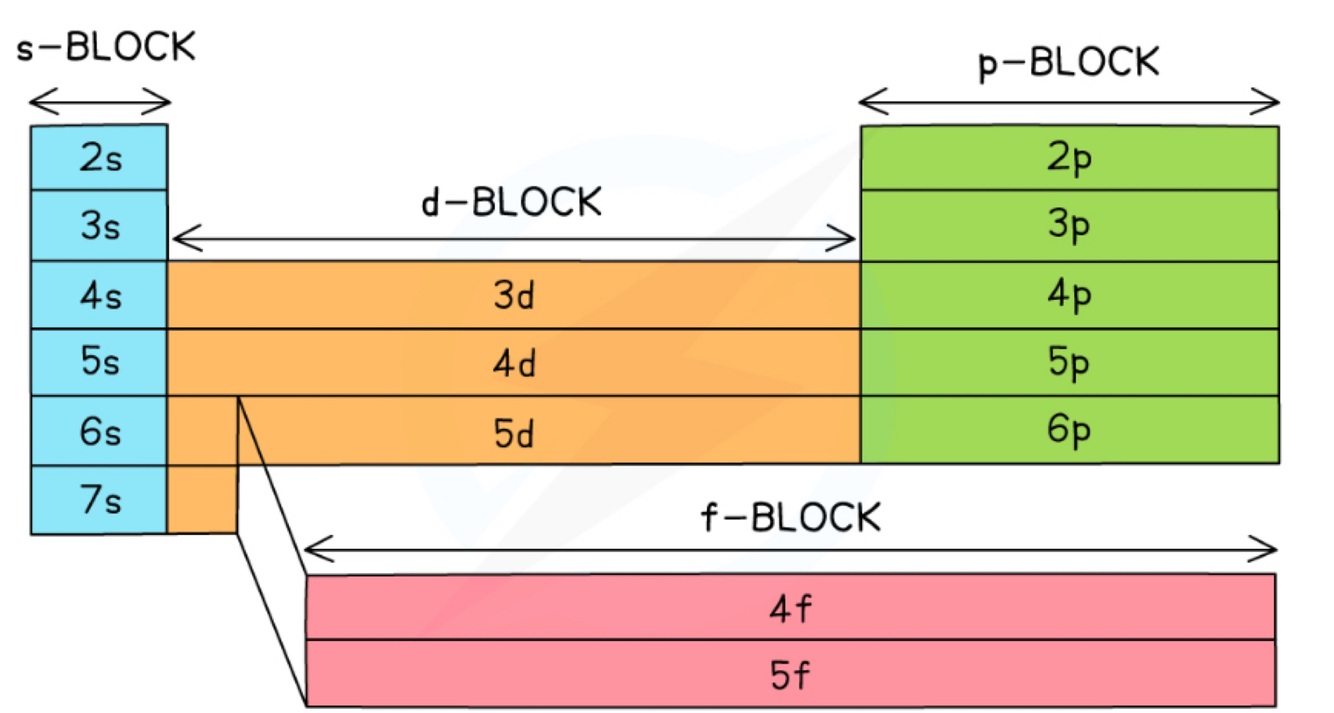
How is the periodic table split up?
• the periodic table is split into 4 main blocks depending on which orbital the outer most electron is held in
What is ionic bonding ?
• ionic bonding involves the transfer of electrons from a metallic element to a non-metallic element • this creates an electrostatic force of attraction between cations and anions • once atoms become ions, their electronic configurations are the same as a noble gas
What are the physical properties of ionic compounds ?
• melting points are higher for lattices that contain ions with a greater ionic charge • many ionic compounds will dissolve in polar solvents e.g water
How does solubility of ionic compounds work ?
Solubility is dependent on: 1. breaking down the ionic lattice 2. the polar molecules attracting and surrounding the ions - The δ+ end of the polar molecule can surround the negative anion - The δ- end of the polar molecule can surround the positive cation - this breaks the electrostatic forces of attraction between the cation and anion
What is covalent bonding ?
• covalent bonds involves the electrostatic attraction between nuclei of 2 atoms and the bonding electrons of their outer shells • no electrons are transferred but only shared in this type of bonding
What is bond energy ?
• The bond energy is the energy required to break one mole of a particular covalent bond in the gaseous states • the larger the bond energy the stronger the covalent bond it
What is bond length ?
• the bond length is the internuclear distance of 2 covalently bonded atoms • the greater the forces of attraction between electrons and nuclei, the more the atoms are pulled closer to each other • this decreases the bond length of a molecule and increases the strength of the covalent bond
What does a dot and cross diagram look like ?
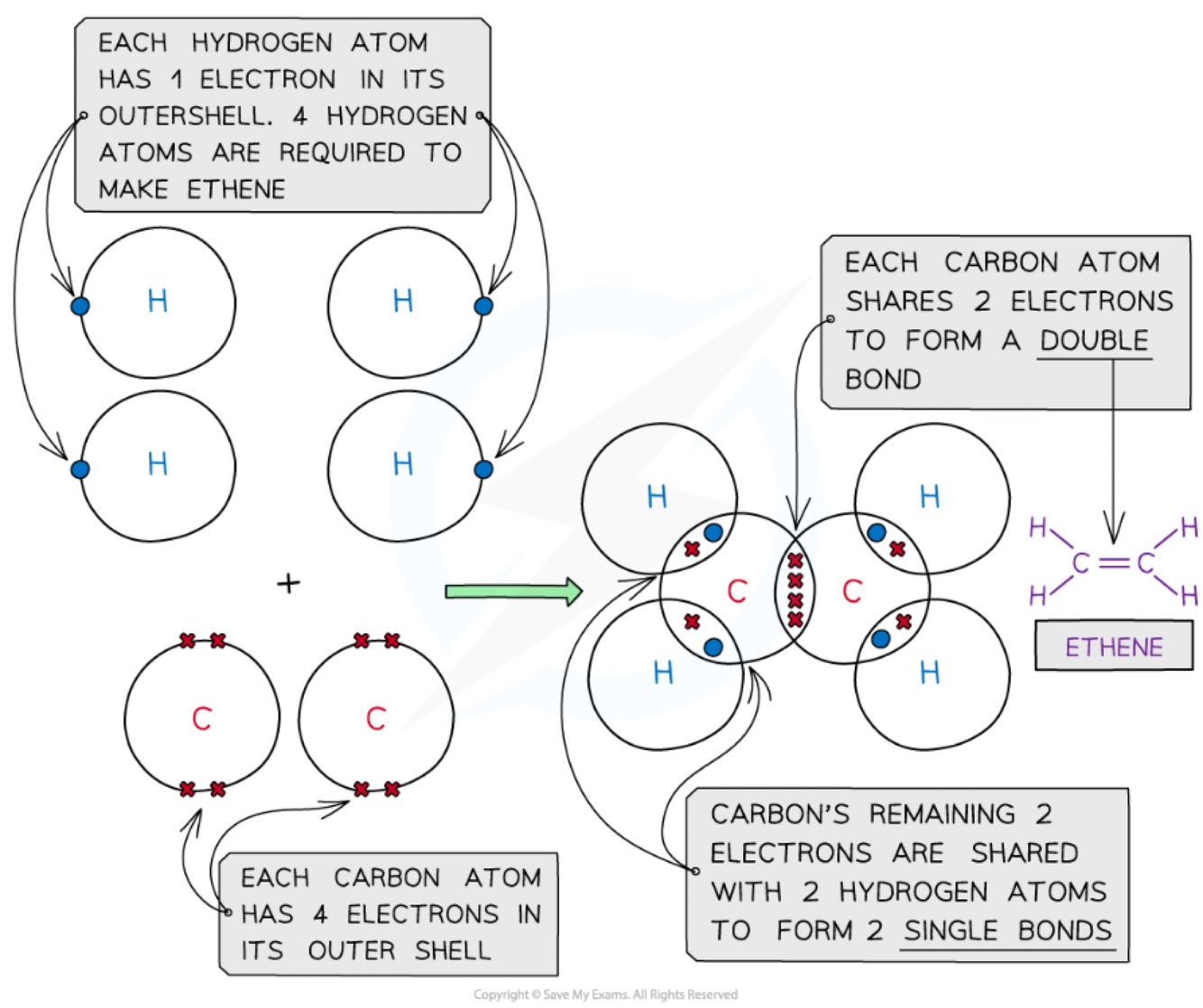
What is an example of expanding the octet rule ?
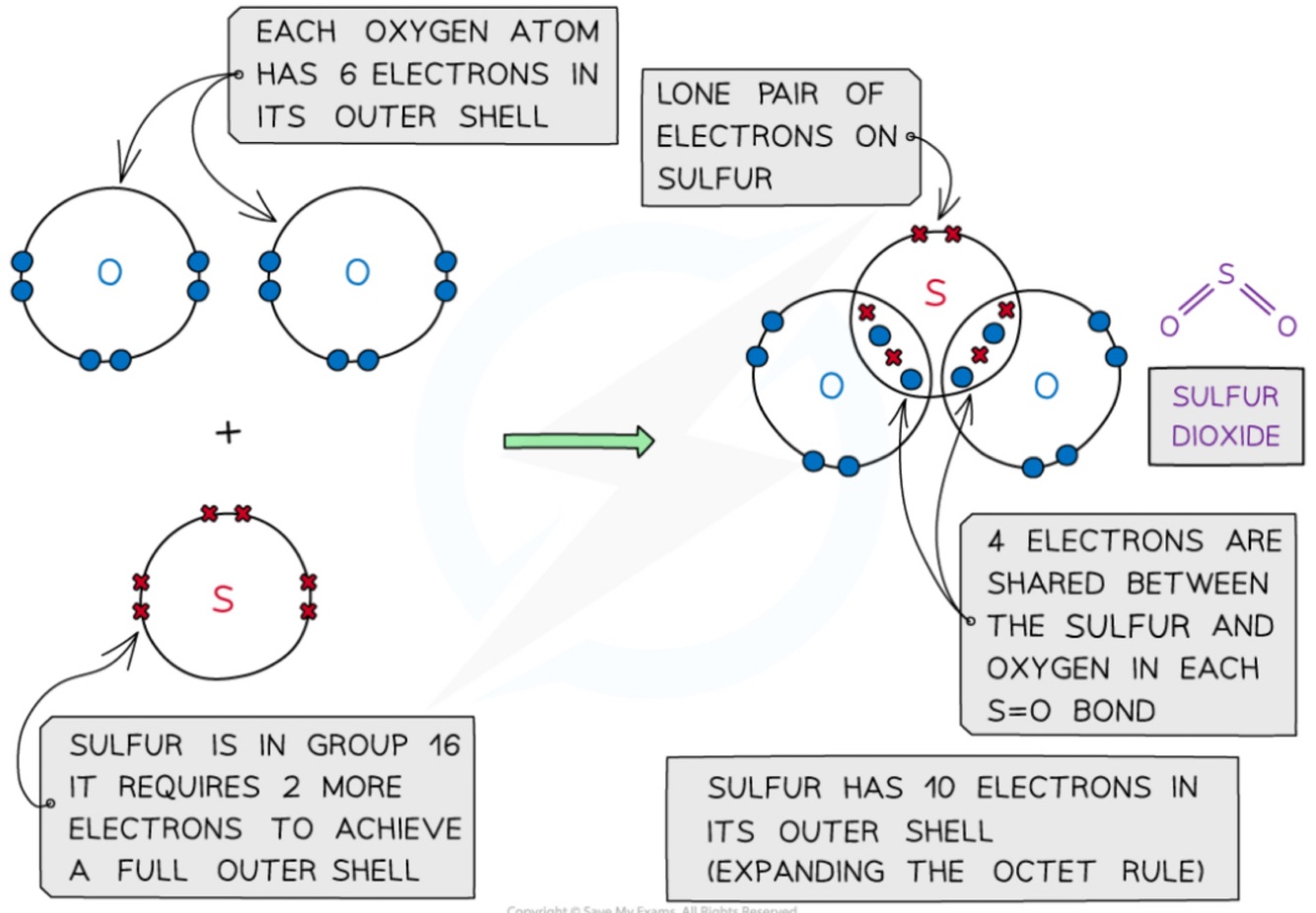
What is dative covalent bond ?
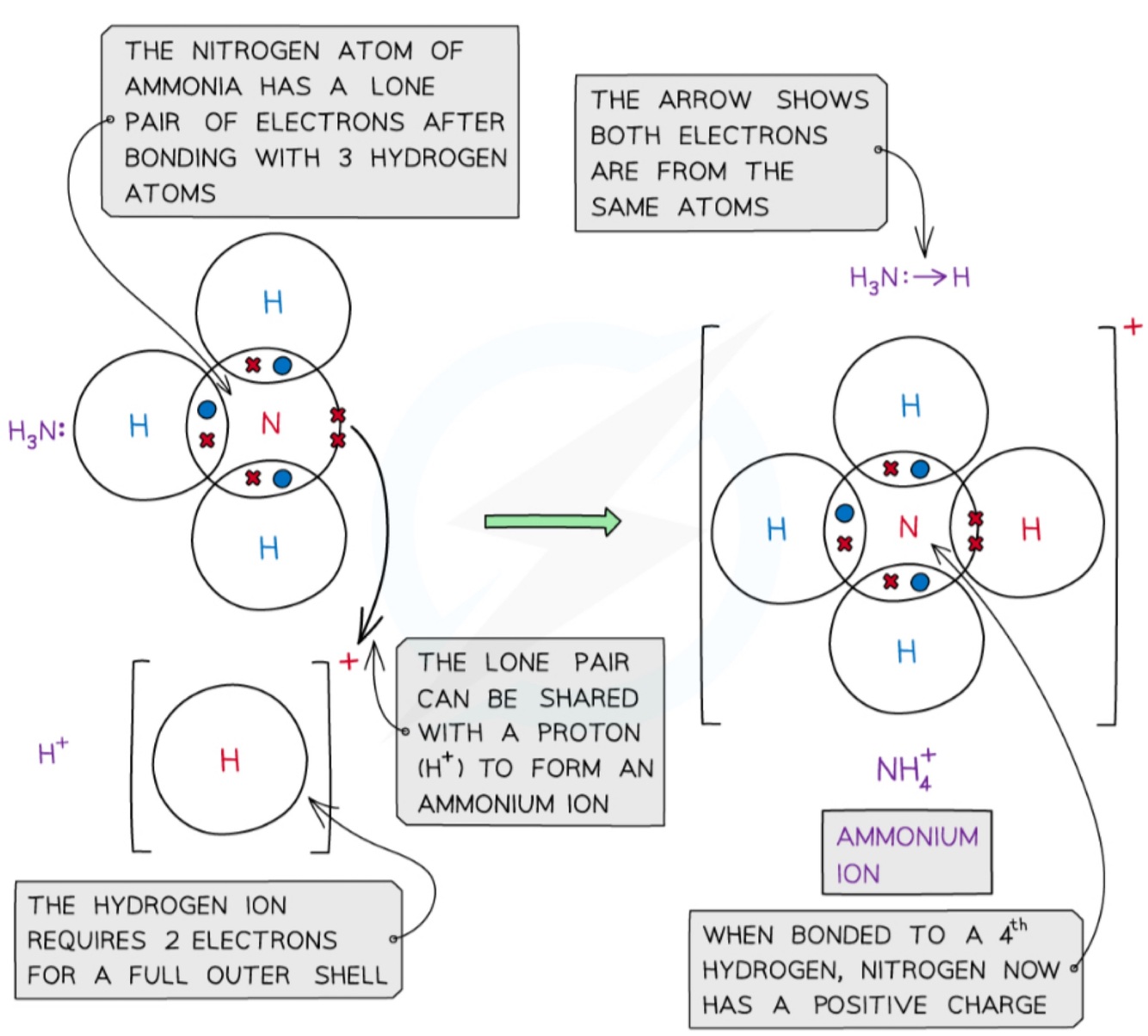
• some molecules have lone pair of electrons that can be donated to form a bond with an electron-deficient atom. • both the electrons are from the same atom • this is called dative covalent bonding
What is an example of a dative covalent bond ?
• ammonium ion, the H+ ion is electron deficient and has space for 2 electrons in its shell. • the nitrogen atom has a lone pair which it donates to hydrogen ion.