Topic 17.6 Organic Structures
No description yet. This curated deck is ready for daily study.
Card preview (24)
Organic synthesis
Making something new form what already exists.
Preparing for planning a synthesis
Put an outline of all the reactions you need to know.
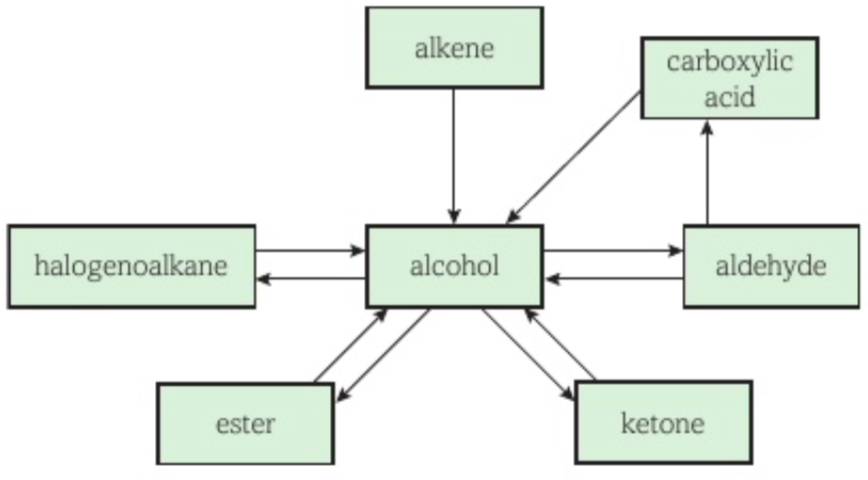
Extending a carbon chain
1) Reacting a halogenoalkane with a cyanide ion (nucleophilic substitution). 2) Carbonyl compound with HCN (nucleophilic addition). 3) Alkylation of benzene (electrophilic subsitutuion).
Grignard reagents
-Organometallic compound. -General formula: RMgX (formed from halogenoalkane RX + Mg). -Magnesium is covalently bonded to both the alkyl group and the halogen. -Unstable and react with water, so prepared immediately before using solvent of dry ether. -RBr + Mg –> RMgBr -After its prepared, the second reagent is added……..
??
In Grignard reagent, the carbon is bonded to a much less electronegative element, Mg, so the carbon becomes polarised ….
Reactions of Grignard Reagents
1) With carbon dioxide: RMgBr –> RCOOH carboxylic acid 2) With methanal: RMgBr –> RCH2OH primary alcohol 3) With an aldehyde R’CHO: RMgBr –> RR’CHO secondary alcohol 4) With a ketone R’COR’’: RMgBr –> RR’R’‘COH tertiary alcohol.
Examples of Grignard reactions: Formation of 3-methylbutanoic acid
Step 1: Formation of Grignard reagents (CH3)2CHCH2Br + Mg –> (CH3)CHCH2MgBr Step 2: Reaction with chosen reagent (CH3)2CHCH2MgBr + CO2 –> (CH3)2CHCH2COOMg Step 3: Hydrolysis using a dilute acid (CH3)2CHCH2COOMgBr + H2O –> (CH2)2CHCH2COOH + Mg(OH)Br The inorganic product of step 3 will react with the dilute acid.
Examples of Grignard reactions: Formation of propan-1-ol
Propan-1-ol (CH3CH2CH2OH) is a primary alcohol.

Examples of Grignard reactions: Formation of pentan-2-ol
Pentan-2-ol (CH3CH(OH)CH2CH2CH3) is a secondary alcohol.

Examples of Grignard reactions: Formation of 2-methylpropan-2-ol
2-Methylpropan-2-ol ((CH3)3COH) is a tertiary alcohol.

Decreasing chain length
-Reaction of methyl ketones or methyl secondary alcohols with iodine and sodium hydroxide forms a yellow precipitate of triiodomethane (iodoform) and a carboxylate salt with one fewer carbon atoms.
Hazards and risks
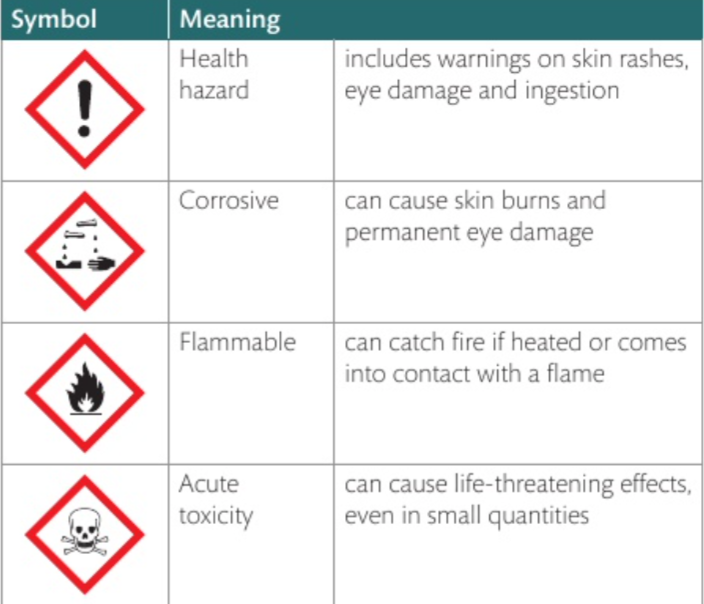
Eg. You are told to wear safety goggles when using acid because of the harm it could do if it got into eyes. –> The hazard exists because hydrochloric acid is corrosive. –> The risk is that hydrochloric acid may get into your eyes and cause harm.
Hazard warning symbols
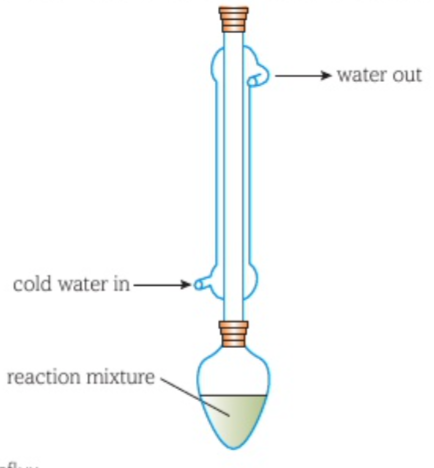
Practical techniques: Heating under reflux
-Some reactions are volatile, and there is a risk they will escape from the reaction during the heating process. -To prevent this from happening, heat in a flask fitted with reflux condenser. -All the vapours rising from the mixture during heating enter the condenser and change back into liquids and return to the flask so unreacted compounds can react.
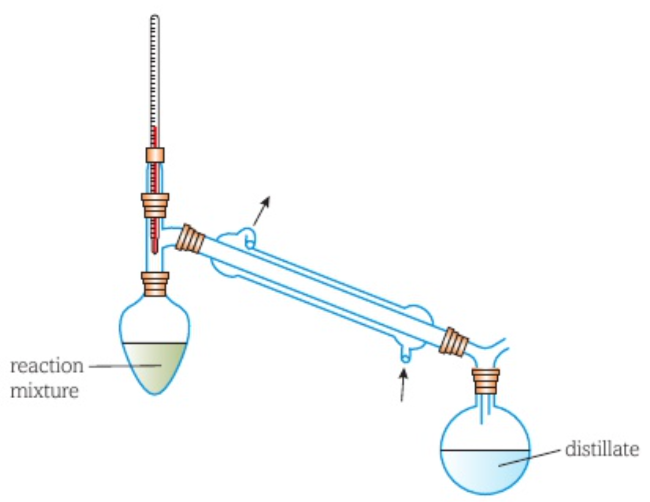
Methods of separation: Simple distillation
-Obtain a liquid product from a reaction mixture that has a boiling temperature much lower than the other substances.
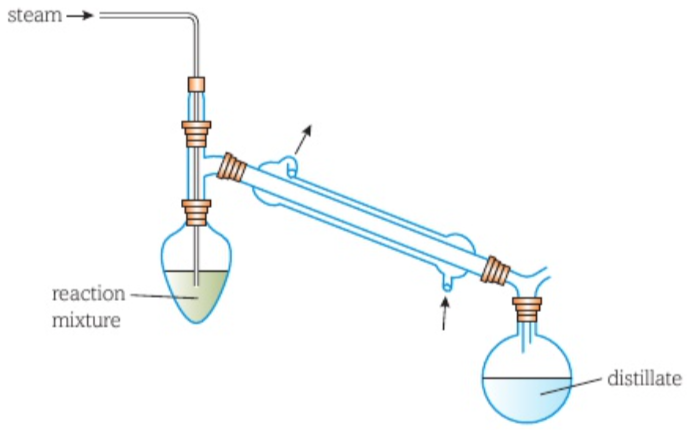
Methods of separation: Steam distillation
-Technique used to separate an insoluble liquid from an aqueous solution. -It involves passing steam into a mixture that contains an aqueous solution and a liquid that forms a separate layer.
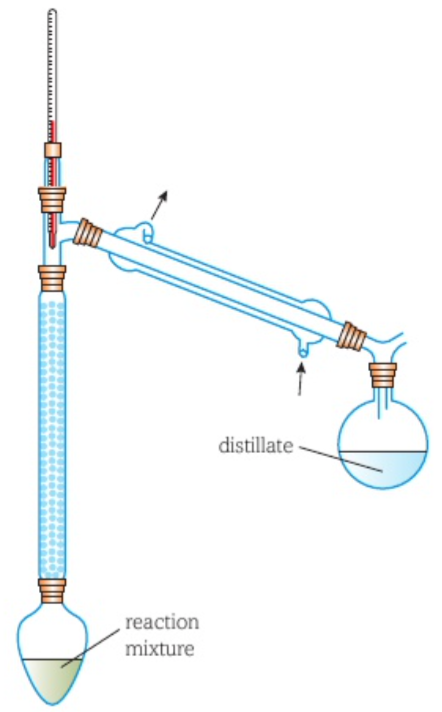
Methods of separation: Fractional distillation
Uses same apparatus as simple distillation, but with a fractionating column filled with glass beads which acts as surfaces of which the vapour leaving the column can condense. -Takes longer than simple distillation. -Best used when the difference in boiling temperatures is small, and when there are several compounds to be separated from a mixture.
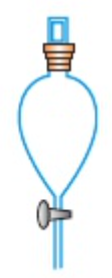
Solvent extraction
1) Place reaction mixture in a separating funnel, then add the chosen solvent- it should form a separate layer. 2) Place the stopper in and gently agitate the contents. 3) Allow the contents to settle into two layers. 4) Remove the stopper and open tap to allow the lower layer to drain into a flask.
Washing
Used to remove impurities from a solid or liquid. Can be water or an organic solvent.
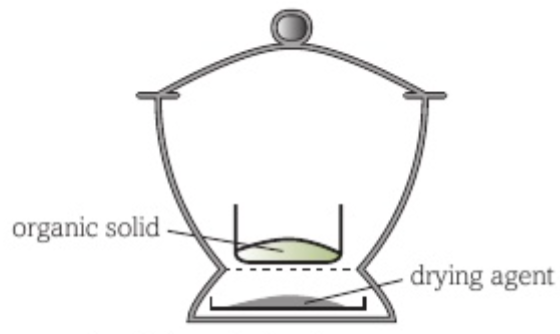
Drying
Left in a warm place or in a desiccator with a soluble drying agent.
Filteration
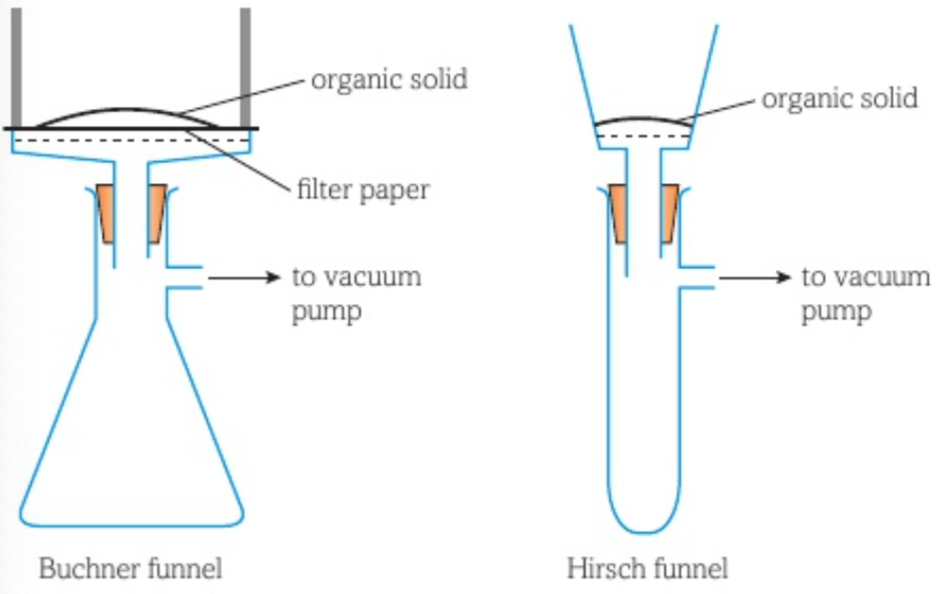
Buchner and Hirsch funnels are vacuumed filtered (under pressure).
Recrystallisation
Testing for purity
-If the compound is a solid, then its melting temperature can be measured. -If it is liquid, then its boiling temperature can be measured.
How does paper chromatography work?
There is a stationary phase and a mobile phase (each component of the mixture is attracted to both phases). -A component that is strongly attracted to the stationary phase but weakly attracted to the mobile phase will not travel very far up the paper. -A component that is weakly attracted to the stationary phase but weakly attracted to the mobile phase will travel a long way up the paper.