Building a Proteome: Modification and Degradation
No description yet. This curated deck is ready for daily study.
Card preview (24)
What is covalent modification?
addition of a functional group
List 4 examples of covalent modification.
Ubiquination Acetylation Phosphorylation Glycosylation
What does a protease do?
cleaves peptide bonds
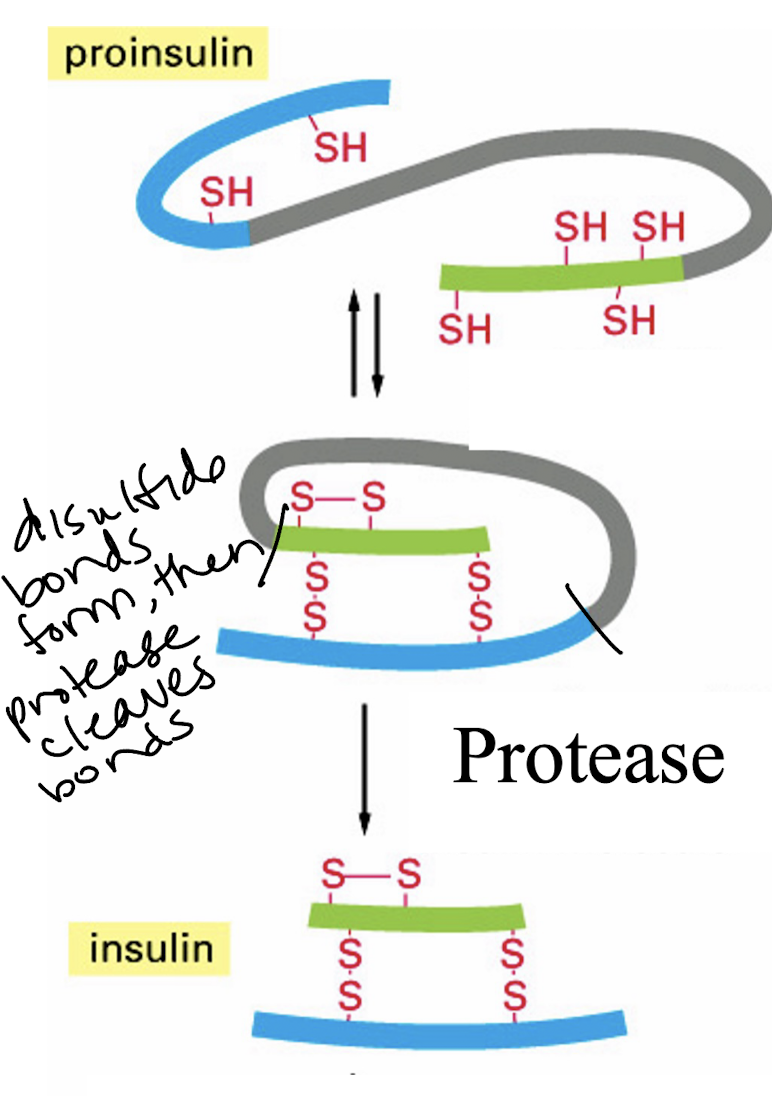
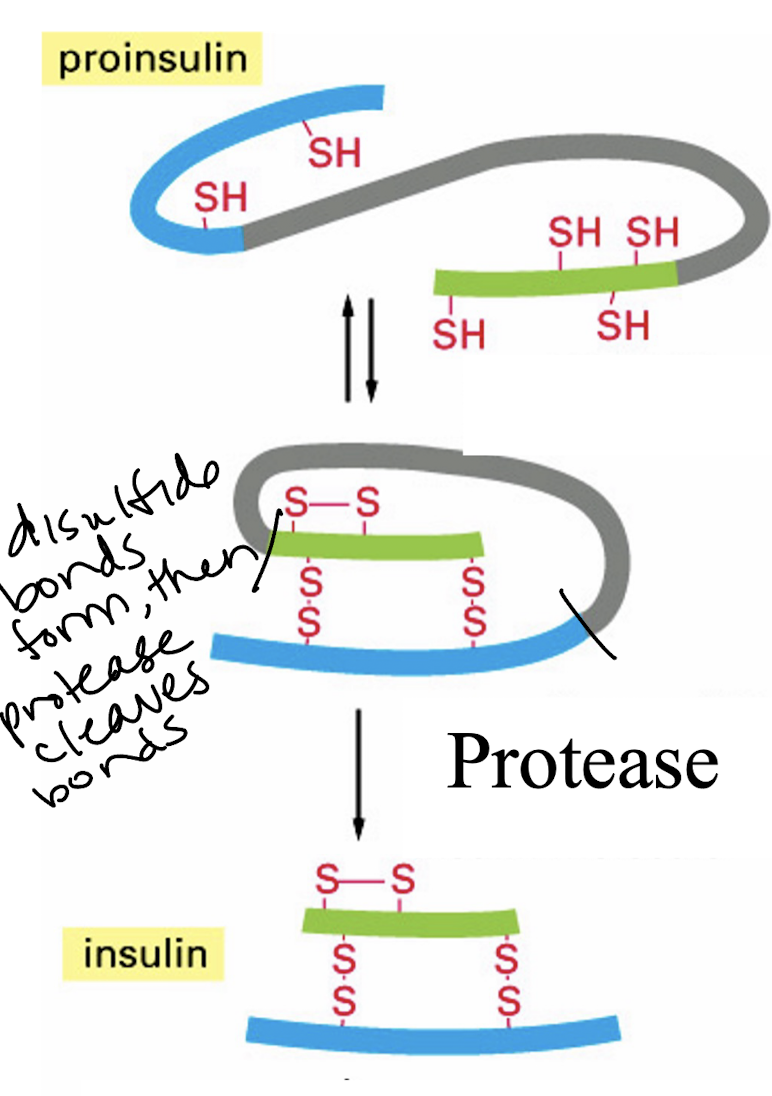
How is proinsulin processed?
A protease cleaves peptide bonds, leaving just insulin.
Which amino acid do phosphate groups get added to (only evidenced by figure)?
Serine

Which amino acid do acetyl groups get added to? (evidenced by example)
Lysine

What are isoforms? Why do they exist?
Peptides with the same amino acid sequence, but different functional groups (after covalent modifications). They help increase molecular diversity, helping cells to regulate processes.
Which amino acids can receive phosphate groups? What quality allows them to do so?
Serine, Threonine, and Tyrosine Only amino acids with OH groups.
Does phosphorylation turn a protein on or off?
Trick question! Can do either, depending on the identity of the protein in question.
What does a protein kinase do?
Removes a phosphate group from ATP, adding it to a side chain (either serine, threonine, or tyrosine)
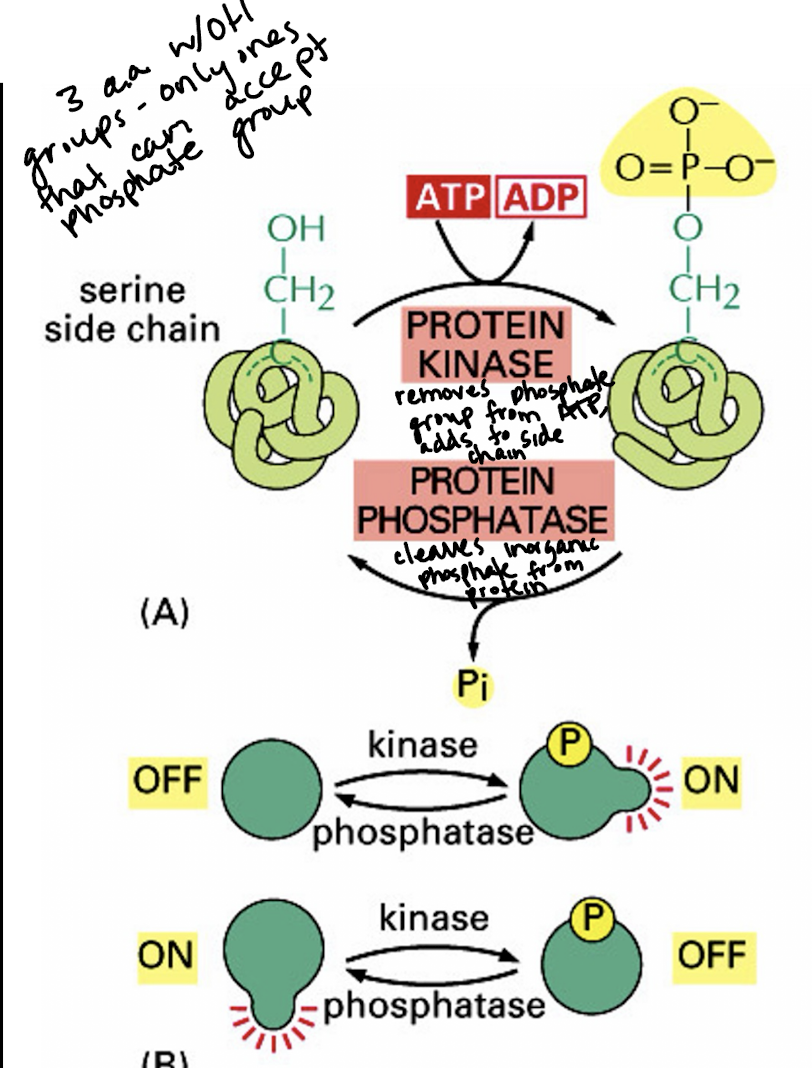
What does a protein phosphatase do?
Cleaves inorganic phosphate from a side chain
What are the three polypeptide degradation methods?
Via the proteosome Via the lysosome Via autophagosomes
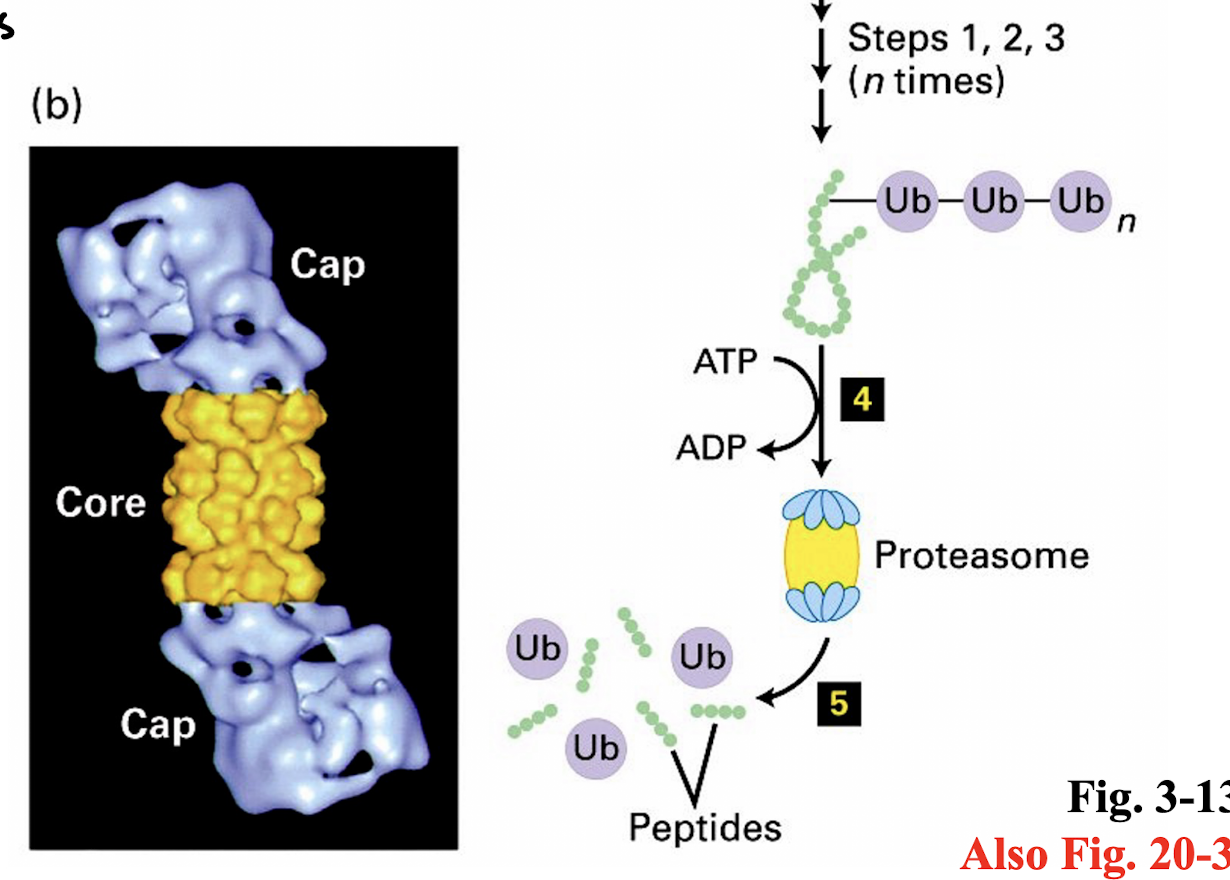
What is a proteosome and what does it do?
Large protein unit comprised of multiple; looks like a hollow tube; core receives 2 caps when operating Degrades (chops up) polypeptides
What determines which mechanism is used to degrade a protein?
The protein in question
What must happen before a proteosome degrades a protein?
Ubiquination; ubiquitin must target a protein for destruction
What is ubiquitin?
78 amino acid sequence that is added enzymatically to a protein being targeted for degradation
What are the potential fates of a newly synthesized peptide? How often do they occur?
1/3 correctly folded without help 1/3 correctly folded with assistance from chaperones and chaperonins Less than 1/3 incompletely folded are degraded via proteosome Small amount aggregate and are unable to be destroyed
Rank the time each fate of a newly synthesized peptide takes.
• Correctly folding without help • Correctly folding with chaperone and chaperonin assistance • Degradation via proteosome • Aggregation
What is turnover?
degradation of an existing molecule and replacement with a newly synthesized molecule of the same type
What are the 3 ways to regulate protein activity?
• Increase or decrease the steady-state level of a protein by changing its rate of synthesis, degradation, or both (changes protein concentration) • Change the location of a protein within a cell (or the volume of the compartment in which the protein resides). • Change the activity of a protein with non-covalent or covalent molecular interactions.
What does a GTPase (small G protein) do?
When activated, noncovalently binds and hydrolyzes GTP (converting GTP to GDP) and binds to effector
What does GAP stand for? What does a GAP protein do?
GTPase Activating Protein binds to G protein and stimulates hydrolysis of GTP; Activating the GTPase activity turns the G protein off (by cleaving the inorganic phosphate)
What happens when GTP is hydrolyzed?
GTP loses a phosphate group and becomes GDP. The small G protein (GTPase) can no longer bind to the effector protein.
What turns the G protein on?
GEF (Guanine Nucleotide Exchange Factor)