Chapter 7A - Function Group Types
No description yet. This curated deck is ready for daily study.
Card preview (24)
Identify the functional group in this hydrocarbon:
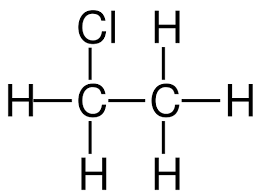
Haloalkane * organic compound that has one or more halogen * polar molecule (due to presence of halogen) * dipole-dipole attractions between molecules
Identify the functional group in this hydrocarbon:
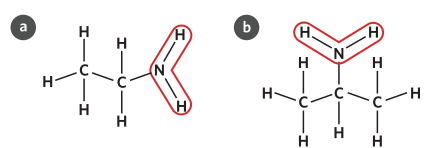
Primary amine * contain an amino group NH2 * derived from ammonia * nitrogen atom is bonded to one carbon atom * polar molecule with hydrogen bonds
Identify the functional group in this hydrocarbon:
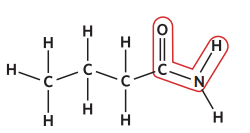
Amide * contains amide functional group CONH * nitrogen atom is bonded to one carbon atom * always on terminal carbon * polar molecule forming multiple hydrogen bonds
Identify the functional group in this hydrocarbon:
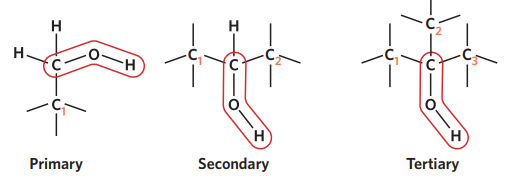
Alcohol * contains at least 1 hydroxyl group * polar molecule with 1 hydrogen bond
Primary Alcohol
OH is bonded to a carbon atom which is bonded to 1 carbon atom only (reactive)
Secondary Alcohol
OH is bonded to a carbon atom which is bonded to 2 carbon atoms (reactive)
Tertiary Alcohol
OH is bonded to a carbon atom which is bonded to 3 carbon atom’s (unreactive)
Identify the functional group in this hydrocarbon:
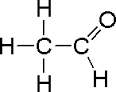
Aldehyde * contains a carbonyl group * always on terminal carbon * polar molecule (C more electronegative than O) * dipole-dipole bonding
Identify the functional group in this hydrocarbon:
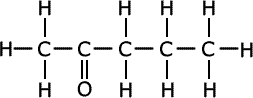
Ketone * contain a carbonyl group * group attached to non-terminal carbon * polar molecule with dipole-dipole bonding
Identify the functional group in this hydrocarbon:
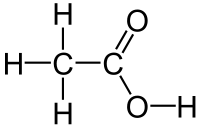
Carboxylic Acid * carboxyl group (carbonyl+hydroxyl) always on terminal carbon * acts as a weak acid by donating H+ from the -COOH * polar molecule forming two hydrogen bonds
Identify the functional group in this hydrocarbon:
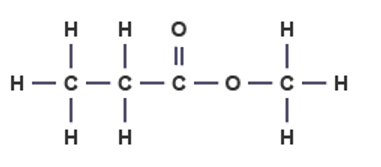
Ester * alcohol + carboxylic acid * contain -COOC- group * have a pleasant fruity smell
Structural Isomer
Compounds with the same molecular formula but different structural arrangements. - similar chemical properties - may differ in physical properties
Chain isomer
Straight (linear) vs branched chain structure
Positional Isomer
Functional groups are in different locations
Functional Isomers
Different functional groups
Physical Property
Can be observed or measured without changing the composition of matter
Chemical Property
Characteristic that becomes evident after a chemical change
Melting point
Temperature in which a solid turns into liquid
Boiling Point
Temperature at which a liquid turns into a gas
Viscosity
Resistance to flow as a liquid
Solubility
The ability of a solute to dissolve in a solvent
Intramolecular forces
• covalent bonds hold atoms together within molecules • sharing of valence electrons • non-metals have high-electronegativity because of core charge
Non Polar
• electrons are shared equally • has no polar covalent bonds • polar bonds but arranged symmetrically
Polar
Electrons are shared unequally * has one or more polar covalent bonds that are arranged asymmetrically * result is called a dipole (opposite poles)