Chemistry Unit #8: Acids and Bases .............. Test on April 19, 2017
No description yet. This curated deck is ready for daily study.
Card preview (24)
What is the acid name of H₃PO₄?
Phosphoric acid
Is F⁻ an acid or a base? (In terms of Brønsted-Lowry)
A base because it can accept a proton?
Define hydroxonium ion
When H⁺ reacts with water to create the hydrate H₃O⁺ H⁺ + H₂O ⇌ H₃O⁺ H⁺ or H₃O⁺ is a hydroxonium/hydronium ion
Who wrote “Experimental History of Colours”
Robert Doyle wrote “Experimental History of Colours”
Is HF a strong or weak acid/base?
Weak acid
Is HNO₂ a strong or weak acid/base?
Weak acid
Weak bases are _____ electrolytes
weak
What is the acidic name of HNO₂?
nitrous acid
What are problems associated with using indicators? 4
People do not always agree on colours Most people only detect 1:10 colour ratio changes Adding yellow to red will not be detectable until you have 1 part yellow to 9 parts red Samples tested must be in solution Adding too much will change the pH Solutions must be clear and colourless Coloured solutions affect indicator colour Some indicators may react with sample Change in composition will change colour
Strong acids are _____ electrolytes
strong
Define electrolyte
When an ionic substance creates an ion in a solution
Define Alkali
A base that is soluble in water
Metal oxides mixed with water form……?
bases
Is this chemical reaction, is the acid monoprotic or diprotic? H₂SO₄(aq) ⇒ 2H⁺(aq) + SO₄²⁻(aq)
Diprotic because when it dissociated, the acid released 2 H⁺
For diprotic acids, the second proton released is always ____ than the first.
Weaker
When acids undergo a neutralization reaction with bases, what forms when the base is a carbonate?
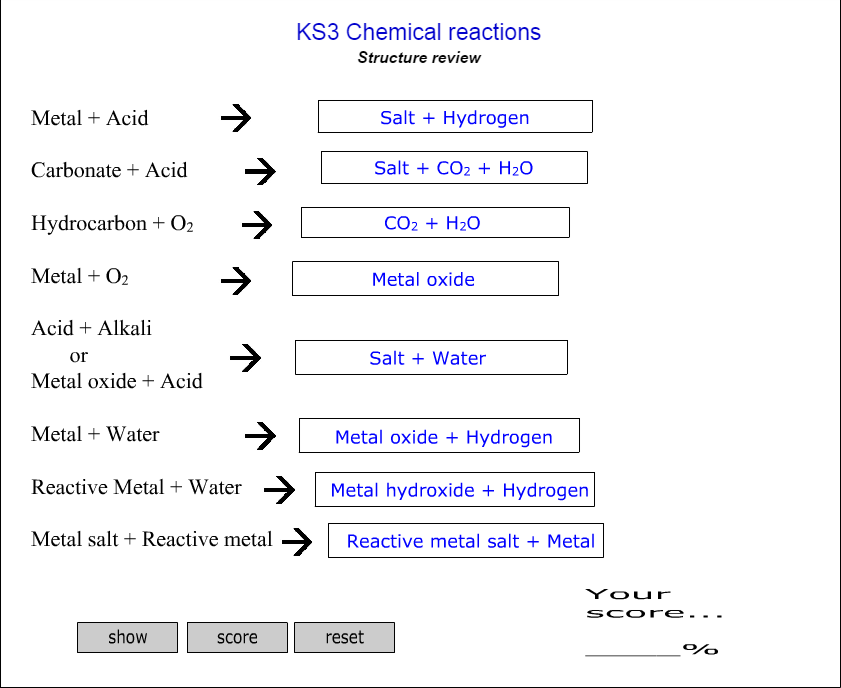
Salt, carbon dioxide and water
In the chemical equation of NH₃ + H₂O ⇒ NH₄ + OH⁻, since NH₄ is the CA, that makes NH₃ the ____
Base. Water is then the acid.
A pH of 1 is ______ times stronger than a pH of 3
A pH of 1 is 100 times stronger than a pH of 3
People do not always agree on colours. Most people only detect _____ ratio colour ratio changes
People do not always agree on colours. Most people only detect 1:10 colour ratio changes
Define Strong Acids 2
Strong bases completely dissociate (split up) into ions in an aqueous solution They release hydroxide ions in an aqueous solution NaOH ⇒ Na⁺ + OH⁻
A pH of 1 is _____ times stronger than a pH of 2
A pH of 1 is 10 times stronger than a pH of 2
What is the points for Temperature as one of the ways we can distinguish between a strong and a weak acid?
Temperature A reaction between an acid and a substance like a reactive metal is exothermic and the strong acid will release more energy.
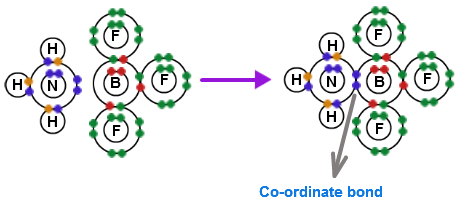
Is the chemical reaction of BF₃ + NH₃ a Lewis definition or a Brønsted-Lowry definition?
a Lewis definition because the BF₃ acid’s valence electron and the NH₃ base’s valence electron is already full.