M4 Haloalkanes and Alcohols Q&A
暂无描述。系统推荐的高质量记忆内容,适合每天坚持背诵学习。
卡片预览 (3 张)
Compare the reactivity of e.g. chloroalkane to bromoalkane in nucleophilic substitution
• Bromoalkane is more reactive than chloroalkane • C-Br bond is weaker than C-Cl bond (C-X bond gets weaker down the group) • Less energy is needed to break the C-Br bond
Describe and explain the difference in boiling point between an alcohol and a hydrocarbon of similar molecular mass
• Alcohol has a higher boiling point • There is hydrogen bonding between molecules • Hydrogen bonding is a stronger than induced dipole-dipole interactions between hydrocarbon molecules • More heat energy is needed to break the intermolecular forces
State the shape and bond angle around each of the labelled carbon atoms in the molecule below:
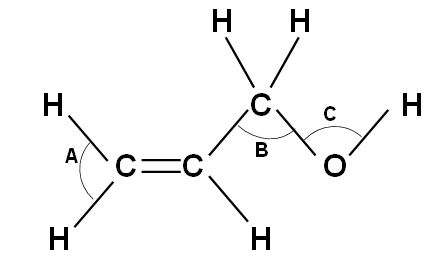
• A (angle HCH) : trigonal planar, bond angle 120o (any unsaturated carbon) • B (angle CCO): tetrahedral, bond angle 109.5o (any saturated carbon) • C (angle COH): non-linear, bond angle 104.5o (any oxygen – due to 2 bond pairs + 2 lone pairs)