Transition metals
No description yet. This curated deck is ready for daily study.
Card preview (24)
Transition Metals
Sc - Cu have at least one stable ion and incomplete d sub-level in atoms or ions
4 characteristics of transition metals
• complex formation • formation of colored ions • variable oxidation state • catalytic activity
Why is Zn not a transition metal?
Zn can only form a +2 ion. In this ion the Zn2+ has a complete d orbital and so does not meet the criteria of having an incomplete d orbital in one of its compounds
complex
is a central metal ion surrounded by ligands
ligand
An atom, ion or molecule which can donate a lone electron pair
Co-ordinate bonding
Co-ordinate bonding is when the shared pair of electrons in the covalent bond come from only one of the bonding atoms.
Co-ordination number
The number of co-ordinate bonds formed to a central metal ion
Ligands can be
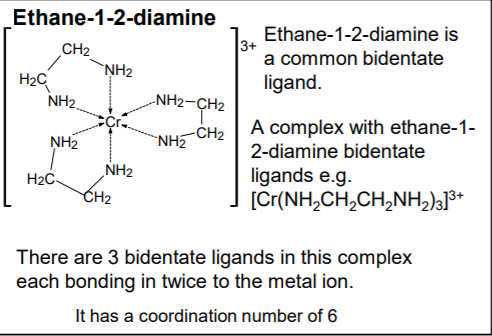
monodentate (e.g. H2O, NH3, and Cl- ) which can form one coordinate bond per ligand bidentate (e.g. NH2CH2CH2NH2 and ethanedioate ion C2O4 2- ) which have two atoms with lone pairs and can form two coordinate bonds per ligand multidentate (e.g. EDTA4- which can form six-coordinate bonds per ligand)
[Cu(NH3 )4 (H2O)2]2+ colour
deep blue solution
Reactions with Chloride Ions
Addition of a high concentration of chloride ions (from conc HCl or saturated NaCl) to an aqueous ion leads to a ligand substitution reaction. The Cl ligand is larger than the uncharged H2O and NH3 ligands so therefore ligand exchange can involve a change of co-ordination number Addition of conc HCl to aqueous ions of Cu and Co leads to a change in coordination number from 6 to 4. Be careful: If solid copper chloride (or any other metal) is dissolved in water it forms the aqueous [Cu(H2O)6]2+ complex and not the chloride [CuCl4]2- complex.
[CuCl4]2- [CoCl4]2-
yellow/green solution blue solution
Ethane-1-2-diamine
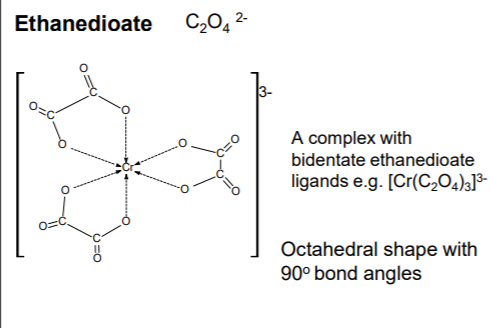
Ethanedioate
Copper equations showing the formation of a bidentate ligands
[Cu(H2O)6]2+ + 3NH2CH2CH2NH2 —– [Cu(NH2CH2CH2NH2 )3]2+ + 6H2O [Cu(H2O)6]2+ + 3C2O4 2— [Cu(C2O4 )3]4- + 6H2O
Partial substitution of ethanedioate ions may occur when a dilute aqueous solution containing ethanedioate ions is added to a solution containing aqueous copper(II) ions.
[Cu(H2O)6]2+ + 2C2O4 2—— [Cu(C2O4 )2 (H2O)2]2- + 4H2O
Equations to show formation of mutidentate complexes
[Cu(H2O)6]2+ + EDTA4—— [Cu(EDTA)]2- + 6H2O
Haem
Haem is an iron(II) complex with a multidentate ligand. Oxygen forms a co-ordinate bond to Fe(II) in hemoglobin, enabling oxygen to be transported in the blood. CO is toxic to humans because CO can form a strong coordinate bond with hemoglobin. This is a stronger bond than that made with oxygen and so it replaces the oxygen, attaching to the hemoglobin.
chelate effect
The substitution of the monodentate ligand with a bidentate or a multidentate ligand leads to a more stable complex [Cu(H2O)6]2+ (aq) + EDTA4- (aq) [Cu (EDTA)]2- (aq) + 6H2O (l) The copper complex ion has changed from having unidentate ligands to a multidentate ligand. In this reaction there is an increase in entropy because there are more moles of products than reactants (from 2 to 7), creating more disorder. This chelate effect can be explained in terms of a positive entropy change in these reactions as there are more molecules of products than reactants. Free energy ΔG will be negative as ΔS is positive and ΔH is small. The enthalpy change is small as there are similar numbers of bonds in both complexes The stability of the EDTA complexes has many applications. It can be added to rivers to remove poisonous heavy metal ions as the EDTA complexes are not toxic. It is in many shampoos to remove calcium ions present in hard water, so helping to lather
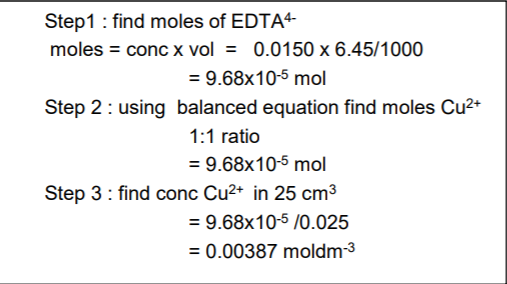
A river was polluted with copper(II) ions. 25.0 cm3 sample of the river water was titrated with a 0.0150 mol dm–3 solution of EDTA4– , 6.45 cm3 were required for complete reaction. Calculate the concentration, in mol dm–3 , of copper(II) ions in the river water
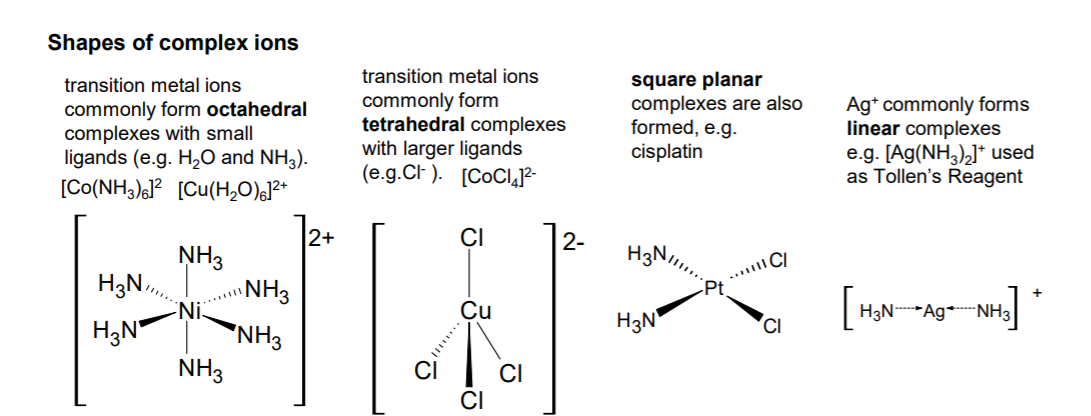
Shapes of complex ions
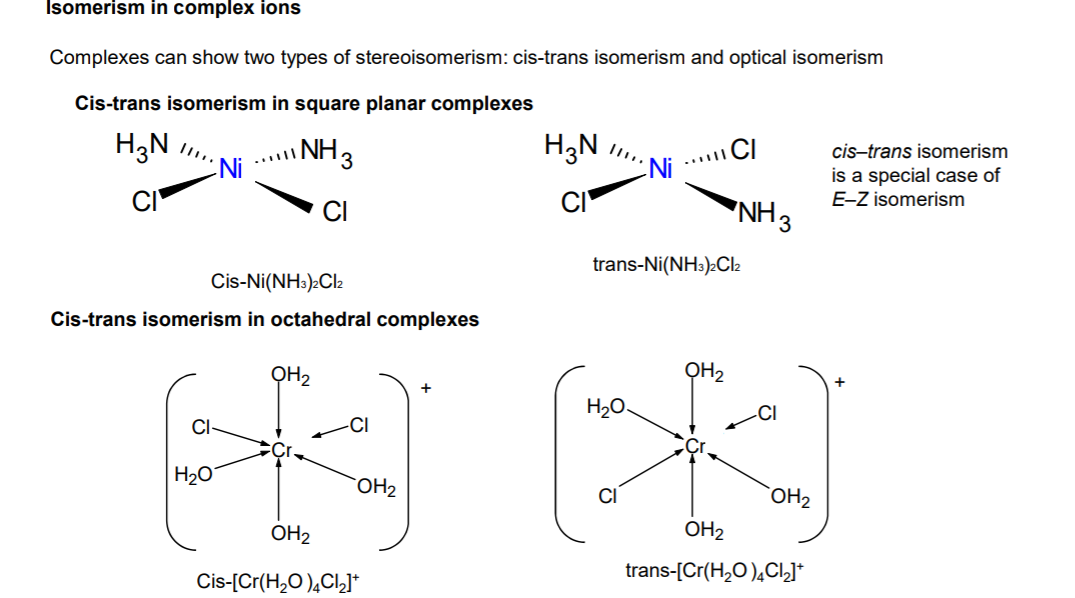
Isomerism in complex ions cis trans
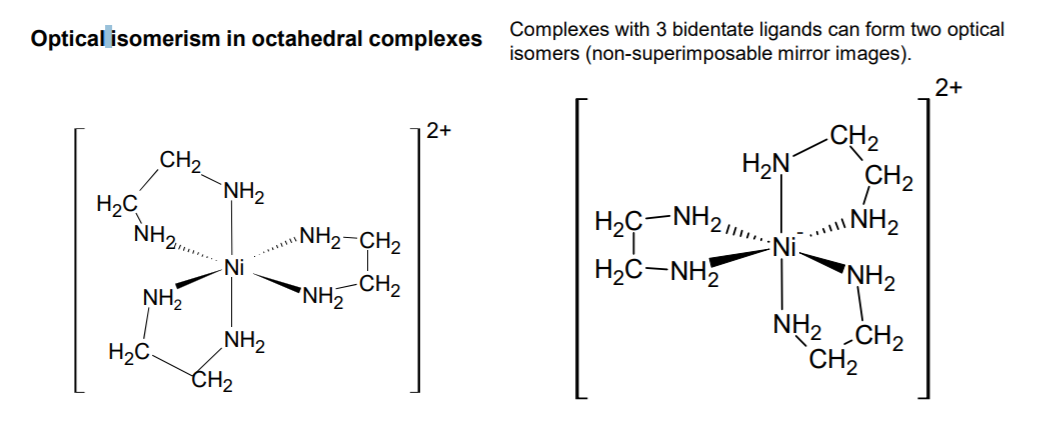
Optical isomerism in octahedral complexes
Color changes arise from changes in
• oxidation state • co-ordination number • ligand
[Co(H2O)6]2+ + 4Cl——[CoCl4]2- + 6H2O
pink to blue