Chapter 11: Oxidation-Reduction Reactions
No description yet. This curated deck is ready for daily study.
Card preview (21)
Oxidation is ________
loss of e-
Reduction is ________
gain of e-
An oxidizing agent causes what?
Causes an atom to be oxidized, and is itself reduced
A reducing agent causes what?
Causes an atom to be reduced, and is itself oxidized
Almost all oxidizing agents contain what?
oxygen or another strongly electronegative element
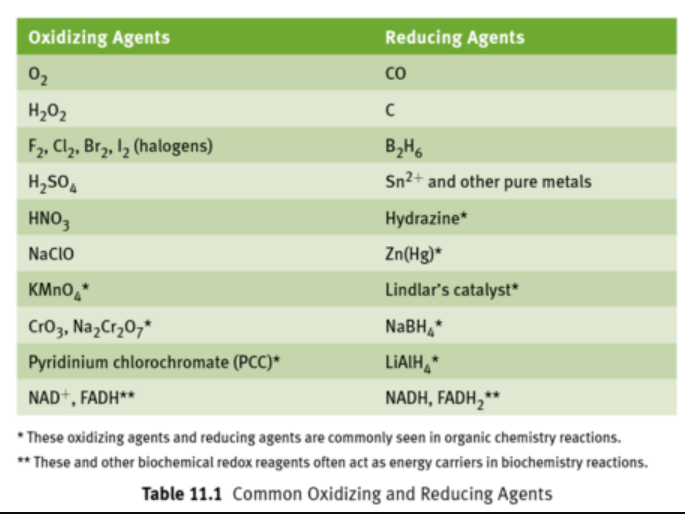
What are some common oxidizing/reducing agents?
________________ ____________ are assigned to atoms to keep track of redistribution of electrons during chemical reactions
Oxidation numbers
What is the oxidation number of a free element?
Zero
The oxidation number of a monatomic ion is equal to what?
The charge of the ion
The oxidation number of Group VIIA is -1, except for when?
When combined with an element of higher electronegative. Example: Cl- is -1 in HCl, but it is +1 in HOCl
Hydrogen is usually ____. However, it is ____ in compounds with less electronegative elements from Groups ____ and ____. Hydrogen is ____ in HCl, but ____ in NaH.
+1; -1; Groups IA and IIA +1, -1
In most compounds, the oxidation number of oxygen is ____. Except in peroxides (O22-), where oxygen is ____, and compounds with more electronegative elements like OF2, where oxygen is ____.
-2; -1, +2
The sum of oxdiation numbers in a neutral compound should be ____
zero
The sum of oxidation numbers of the atoms present in a polyatomic ion is equal to ____
the charge of the ion
Oxidation number assumes ________ ________ of electrons in bonds, “awarding” the electrons to the more electronegative element.
unequal division
Formal charge assumes ________ ________ of electrons in bonds, awarding one electron to each atom in the bond.
equal division
When assigning oxidation numbers, start with what?
The known atoms
What does assigning oxidation numbers accomplish?
Allows us to determine how many moles of each species are required for conservation of charge and mass, which is necessary to balance the equation
How does the half-reaction method work?
Separate the redox reaction into two half-reactions, the oxidation part and the reduction part, then they are balanced separately
________________ is a specific type of redox reaction in which an element undergoes both oxidation and reduction in producing its products.
disproportionation
What is an example of disproportionation?
catalysis of peroxides by catalase