3.8 Aldehydes and Ketones
No description yet. This curated deck is ready for daily study.
Card preview (24)
What are carbonyls?
Compounds with a C=O bond.
If the C=O is on the end of a chain with a H attached what is the compound?
Aldehyde
If the C=O is in the middle of the chain what is the compound?
Ketone
Are carbonyls soluble in water?
The Smaller carbonyls are soluble in water because they can form hydrogen bonds with water.
Why is the C=O bond polarised?
O is more electronegative than carbon. The positive carbon atom attracts nucleophiles.
What are aldehydes oxidised to?
Primary alcohol —> Aldehyde —> Carboxylic acid
What are ketones oxidised to?
Secondary alcohols —> Ketones —>do not oxidise
What are the reagents and conditions needed for aldehydes to oxidise to carboxylic acids?
Reagent: Potassium dichromate (VI) solution and dilute sulfuric acid. Conditions: heat under reflux.
How else can aldehydes be oxidised?
Using Fehling’s solution or Tollins reagent. These are used as tests for the presence of aldehyde groups
What conditions are needed for aldehydes to react with Tollens Reagent?
heat gently
What is the observation of the reaction between Tollens and aldehydes?
with aldehydes, a silver mirror forms coating the inside of the test tube. Ketones result in no change.
How do Tollens and aldehydes react?
Aldehydes only oxidise by Tollens’ reagent into a carboxylic acid. The silver ions are reduced to silver atoms in the Tollens’.
What conditions are needed for aldehydes to react with Fehling’s solution?
heat gently
How do Fehling’s and aldehydes react?
aldehydes only are oxidised by Fehling’s Solution into a carboxylic acid. The copper (II) ions are reduced to copper(I) oxide.
What is the observation of the reaction between Fehling’s and aldehydes?
Aldehydes :Blue Cu 2+ ions in solution change to a red precipitate of Cu2O. Ketones do not react.
What conditions and reagents are needed for the reduction of carbonyls?
Reagents: NaBH4 In aqueous ethanol Conditions: Room temperature and pressure
What do reagents such as NaBH4 and LiAIH4 reduce carbonyls to?
alcohols
What to aldehydes reduce to?
Primary alcohols
What do ketones reduce to?
Secondary alcohols
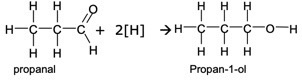
Draw the equation of the reduction of propanal.
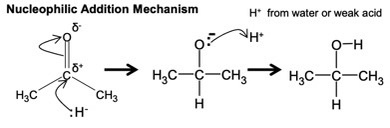
Draw and name the mechanism when propanone reacts with NaBH4.
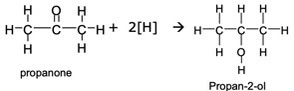
Draw the equation of the reduction of propanone.
Carbonyls can also be reduced using catalytic hydrogenation what reagent and conditions are needed?
Reagent: hydrogen and nickel catalyst Conditions: high pressure
What is the reagent, conditions and name of the mechanism for the Addition of hydrogen cyanide to carbonyls to form hydroxynitriles?
Reagent: sodium cyanide (NaCN) and dilute sulfuric acid. Conditions: Room temperature and pressure Mechanism: nucleophilic addition