7. Regime types, agenda setters and veto players
No description yet. This curated deck is ready for daily study.
Card preview (24)
According to Lijphart, what is the difference between government by majority and government by concensus
Government by majority Government by concensus Who will do the governing? The majority of the people As many people as possible To who’s interests will the government be responsive?
What is the majoritarian model according to Lijphart
• Pursues democratic ideal of not allowing rule by an elite minority by giving power to the majority wishes of the population • An electoral majority is formed and should be able to govern without constraint • Westminster model in UK - largest party is awarded bonus seats to give them ability to govern • Some call this dictatorship by the majority
What is the concensus model according to Lijphart
• Encourages policy-making that is supported by as many groups and interests as possible • Requires building broad support accross a range of institutions in order to pass a new policy • Ensures no single group can become dominant
What institutional features constrain the power of the majority (and increase the chance of having a concensus government)
• Presidential regime - to separate powers and encourage concensus-building on individual issues • Coalition/minority governments - by having a proportional electoral system • Bicameral legislature - having 2 levels (congress and senate) • Germany, lower house elected nationally, upper house elected regionally (you need support at both levels to get a bill passed) • Federalism/decentralisation - restricts power of central government • Referendums - places power directly in people’s hands • Written constitutions, bills of rights and contitutional courts - formal limits on policies, can be challenged in court
Describe the interaction between Government Type and Regime Type
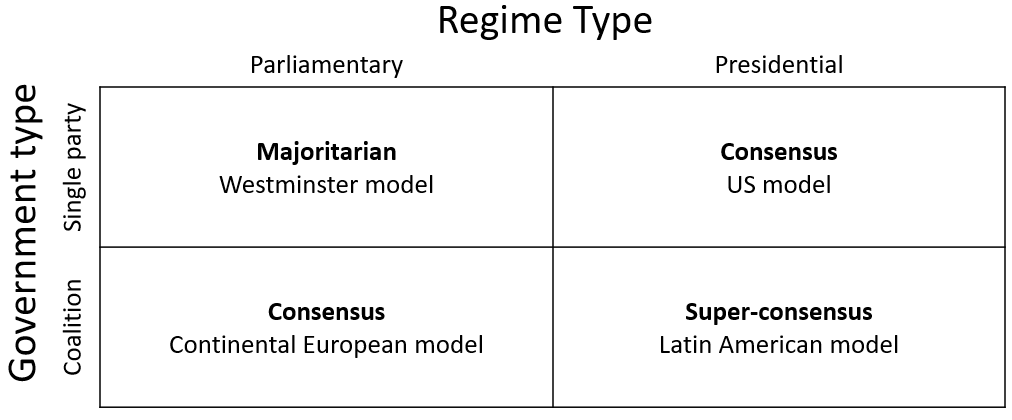
List the 4 assumptions about political actors and their behaviour proposed by the spatial model of politics
• Politics and policy-making can be conceptualized in a political space, such as the left-right dimension • Each policital actor (voter, party, polititian) has an ideal point in the policy space based on their preferences • When choosing between policies, each actor will vote for the policy which is closest to their ideal point • If no policy is agreed, the status quo remains
What is Black’s Median Voter Theorem
In an environment with no parites, policies will converge on the median voter Example: • SQ is the status quo • P1 is adopted because it has support from CDE • P2 is then adopted because it has support from ABC • P3 is then adopted because it has support from CDE

What 2 powers did George Tsebelis identify that political actors might have
Powers a political actor can have • Agenda setting power • Veto power
How does agenda setting power affect policy-making in a majoritarian (single-party) government
The adopted policy will end up closer to the position of the leader of the government because he has the ability to enforce party cohesion Example: • SQ is the status quo • B is the majority party leader • P1 is adopted because it has support from AB and B has the ability to force C to vote with him (even though P1 is further from his desired party position than SQ)

How does agenda setting power affect policy-making in a concensus (coalition) government
The adopted policy will end up between B and C because though B is the leader of the government, he does not have the ability to enforce party cohesion Example: • SQ is the status quo • B is the majority party leader • P1 is adopted because it has support from ABC but B had to compromise in order to keep C’s support

What is gridlock
• Can occur when there are 2 veto players who have different policy positions • Presidential system where the president and legislature are not from the same party • Coalition government • Provides greater policy stability but can also render a government non-functional • The further apart the positions of veto players, the greater the gridlock interval

What were Tsebelis’ propositions based on application of agenda setting and veto powers
• The addition of new veto players increases policy stability • The bigger the party distance between 2 veto players, the less policy change there will be
Is policy change good or bad
Neither inherently good or bad, it depends on the situation and perspective • Political minorities would welcome processes that delay or prevent policy changes when they are worried their rights will be eroded • In a situation of exogenous shock (recession 2007-08), rapid policy change is more desirable
What happened in the global recession of 2007-08
Belgium • High number of political parties who were unable to form a government at the time • So they were not able to react UK • Majority government responded very rapidly
Why do parties stick to their manifestos when they are a majority single-party government
• They don’t need to comprimise • They are more accountable
What are the Pros of a majoritarian government
• Decisive • Clear responsibility • Electoral promises kept
What are the Cons of a majoritarian government
• Decisions too quick • Elective dictatorship • No compromises • Threat to minority interests
What are the Pros of a coalition government
• Slow and deliberative decisions • Broad political compromise • Protection of minority interests
What are the Cons of a coalition government
• Decisions too slow • No clear responsibility • Electoral promises broken • Vetoes by minority groups
Describe the 3 different democratic regime types
• Parliamentary democracy - a fusion of powers between the executive and the legislative • Presidential democracy - separation of powers • Mixed democracy - has both a president (elected by the people) and a prime minister (elected by the president)
Historically, which type of democratic regime has been most popular
• Historically, parliamentary democracy • More recently presidential and mixed
Describe how agenda setting and veto power work in a parliamentary democracy
• Agenda setting power usually lies with the government who propose the legislative agenda • Veto power lies with the majority in parliament
Describe how agenda setting and veto power work in a presidential democracy
• Agenda setting power lies with any member of the legislature In some cases the president also has agenda setting power • Veto power lies with the majority in the lower chamber President also has veto power
Describe how agenda setting and veto power work in a mixed democracy
• Agenda setting power lies with the parliamentary government However, since the president appoints the prime minister, he has indirect agenda setting power • Veto power lies with the majority in parliament The president does not have veto power