Introduction, Chemical Shift and Integration
No description yet. This curated deck is ready for daily study.
Card preview (21)
What is the main type of NMR looked at in this course?
Solution phase NMR spectroscopy
What property of atoms allow NMR to be performed
Nuclear spin (many nuclei possess a magnetic moment - can be reguarded as behaving like small magnets)
What happen when you put a nucleus wit a spin in a magentic field
The nucleus spins on its axis In the presence of a magnetic field, this axis of rotation will precess around the magnetic field
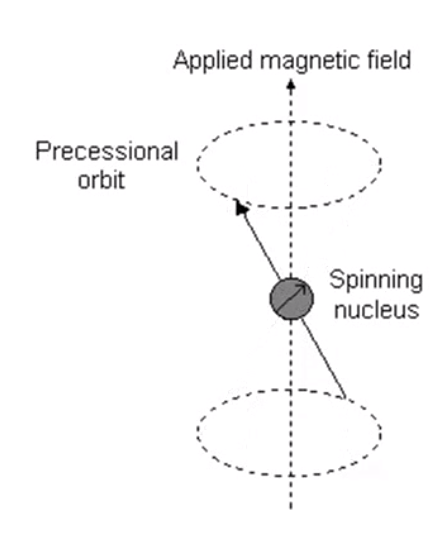
The frequency of the procession around the magnetic field by a nucleus is called…
Resonance OR Larmor Frequency
How is nuclear spin calculated?
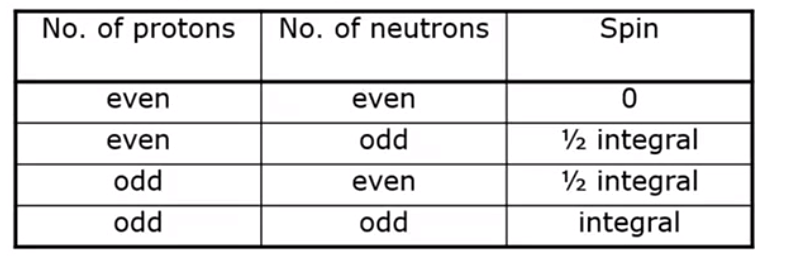
nuclear spin arises from the unpaired proton and neutron spins in the nucleus (compared to electron spin from unpaired electrons)
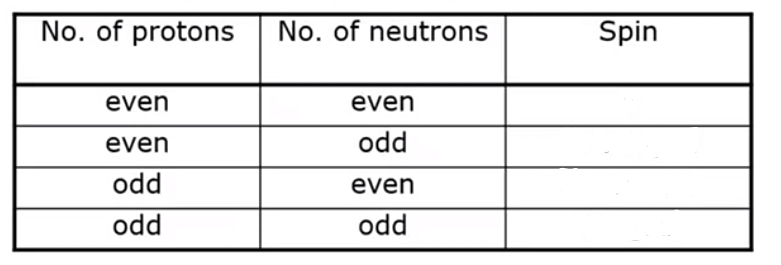
Fill out the following table
Nuclear spin is characterised by which quantum number
Spin quantum number I
Spin quantum number I , is proportional to
the nuclear magnetic moment μ (related by this constant of proportionality, γ, which is different for each nucleus)
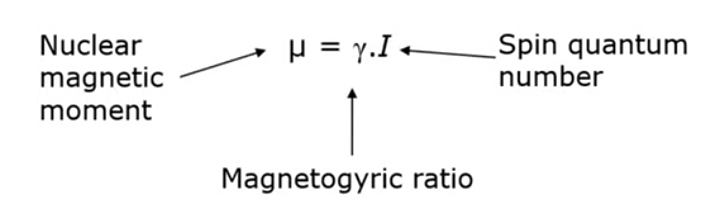
Why is the magnetogyric (γ) different for each nucleus
due to each nucleus having a different ratio of its orbital angular momentum to its magnetic moment (due to each nucleus having different charge and mass)
a spin of +1/2 is ……. to the magnetic field a spin of -1/2 is ……. to the magnetic field
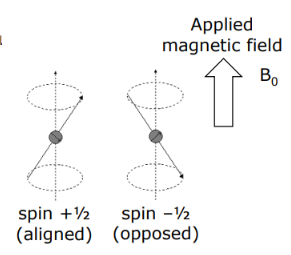
The orientation of the nuclear magnetic momenet μ, is aligned to an arbitrary axis (z) = μz μz is quantised due to the following equation What values can m take?

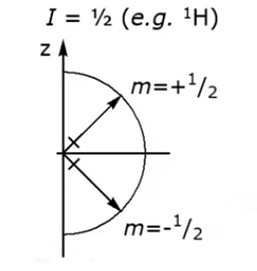
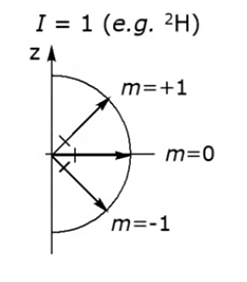
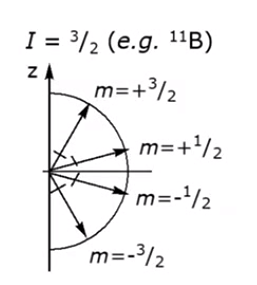
m = +I, +(I-1), …0… , -(I-1), -I there will be 2I + 1 allowed nuclear spin states of μz associated with nuclear spin I
In a magnetic field, what values of m would there be aligned to z, when I =1/2
In a magnetic field, what values of m would there be aligned to z, when I = 1
In a magnetic field, what values of m would there be aligned to z, when I = 3/2
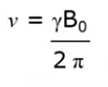
What is the equation to would out the difference in energy between two spin states (ΔE) this is also equal to resonance frequency (v)
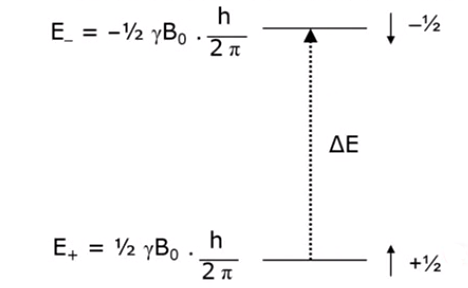
B0 = applied magnetic field γ = magnetogyric constant v is the frequency which allows ΔE to occur
Why do we deuterate chloroform as the solvent for NMR
• If you are running a 1H NMR, it means the protons observed within the spectrum are more from the compound and less from the solvent • AND helps to avoid signal drift (due to slow rate of NMR) to allow sharp peaks
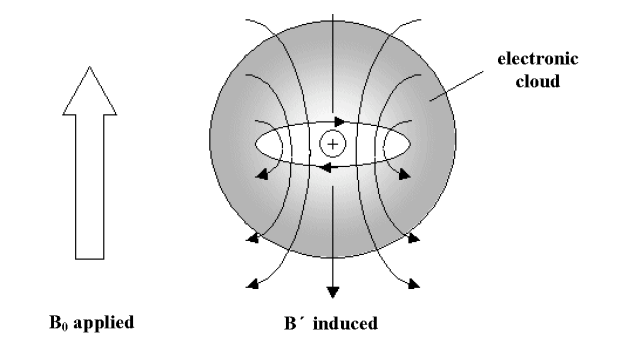
Although a magnetic field of B0 is applied to the sample, the effective magnetic field (Beff ) experienced by each nucleus is not necessarily the same Why?

σ is due to the motion of the electrons surrounding the nucleus, causing small induced magnetic fields opposing the applied field B0
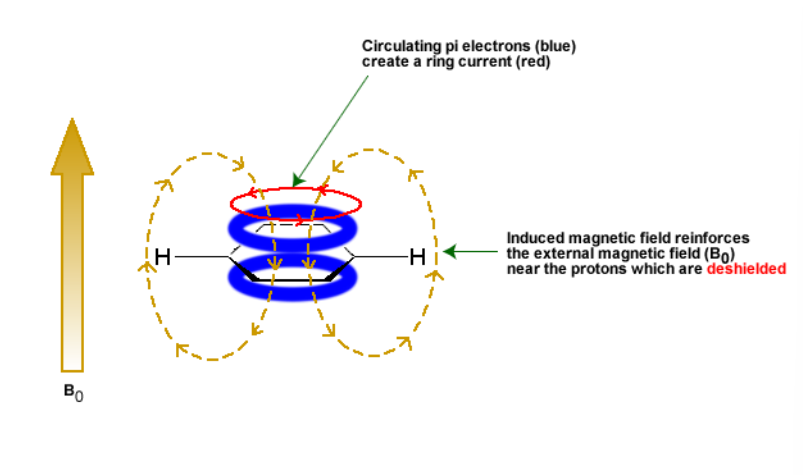
What happens when you apply an external magnetic field to benzene?
The external magnetic field (B0) is reinforced by the induced magnetic field An example of this is in Benzene, where there is a circulating ring of pi electrons, which results in the deshielding on protons
The induced magnetic field experienced by each nucleus is dependent on
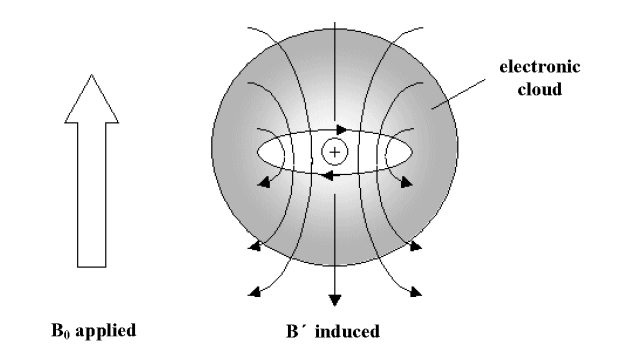
Upon the chemical environment of the nucleus (Chemical shielding)
How do we work out chemical shift?
x10⁶ make it into ppm (Benefit of working it out this way is it’s independent of the applied magnetic field)

What can be the issue with some intergration values?
Intergration values can sometimes be inaccurate as some nuclei relax slowly (protons are only really good for intergration)