M2 - Chemical Bonding (2)
No description yet. This curated deck is ready for daily study.
Card preview (24)
Explain what is meant by the term electronegativity [2].
The ability of an atom to attract electrons ✔ (Electron pair) in a (covalent) bond ✔
How is electronegativity measured?
On the Pauling scale
What does a higher Pauling value mean?
A higher electronegativity and thus a greater attraction for an electron pair in a covalent bond
What makes a bond polar? Provide an example of a polar bond
Two atoms with differing electronegativities, bonding electrons are pulled towards the more electronegative atom, making it polar. For example, H-Cl which has a polar bond.
What force does a polar bond form?
A permanent dipole-dipole force
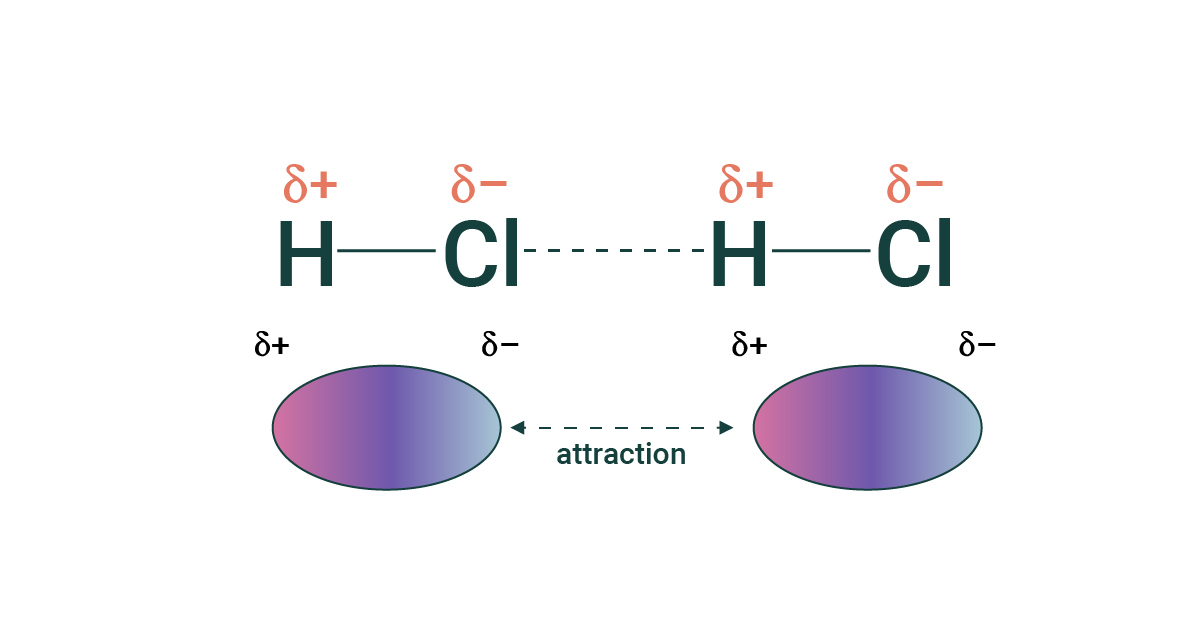
How are the differences in electronegatives displayed?
With the use of a dipole: 𝛿− is more electronegative 𝛿+ is less electronegative
Are diatomic gases (e.g. H2, Br2, N2, I2 etc) polar or non-polar, why?
Non-polar Because the atoms have equal electronegativities and so the electrons are equally attracted to both nuclei
What happens to the polarity of the molecule if polar bonds are arranged symmetrically, for example in CCl4
• The CCl4 molecule is symmetrical • The dipoles cancel each other out • Molecule has no overall dipole and is non-polar
What happens to the polarity of the molecule if polar bonds are arranged unsymmetrically, for example in CHCl3
• The CHCl3 molecule is unsymmetrical • The dipoles do not cancel each other out • Molecule has an overall dipole and is polar NOTE: Lone pairs in a compound automatically make them a Polar molecule
What is the general strength of intermolecular forces (IMFs)?
Very weak intermolecular forces between molecules
What is the order of the intermolecular forces from strongest to weakest?
1) Hydrogen bonding 2) Permanent dipole-dipole forces 3) Induced dipole-dipole forces
How are induced dipole-dipole forces formed?
• At any moment there may be an uneven distribution of electrons in a molecule • This causes a temporary dipole • The instantaneous dipole in one molecule causes an induced dipole in a neighbouring molecule • The δ+ of a dipole in one molecule attracts the δ- of a dipole in a neighbouring molecule to produce an induced dipole-dipole force
When can hydrogen bonding occur?
When hydrogen is covalently bonded to fluorine, nitrogen or oxygen.
Why are hydrogen bonds brought about?
Hydrogen has a high charge densiy and F, N and O are very electronegative. The bond is so polarised that a weak bond forms between the hydrogen of one molecule and a lone pair on a neighbouring molecule’s F, N or O.
What effect does hydrogen bonding have on a molecule?
Soluble in water. Higher boiling and freezing points than molecules of a similar size that don’t form hydrogen bonds.
What is an interesting property of ice caused by hydrogen bonding?
In ice, water molecules are held together in a lattice. When ice melts, hydrogen bonds are broken, so ice has more of these than water. As hydrogen bonds are long, this causes ice to be less dense than water.
How do intermolecular forces explain simple covalent compounds having low melting and boiling points?
Weak intermolecular forces to overcome.
How do intermolecular forces explain simple covalent compounds sometimes being soluble in water?
Water is also a polar molecule, hydrogen bonded molecules can form these with water molecules so are soluble.
How do intermolecular forces explain simple covalent compounds not conducting electricity?
Overall covalent molecules are uncharged, permanent dipoles are not strong enough.
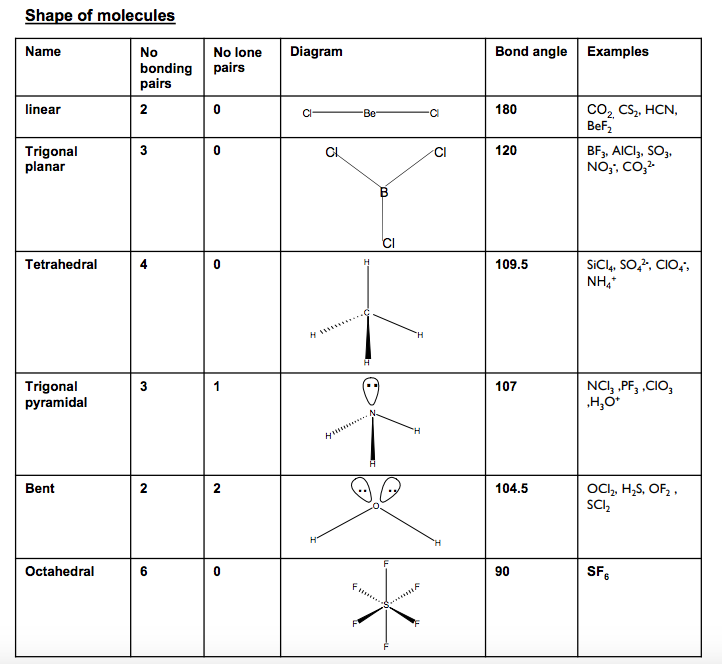
what is the shape of molecules table?
Describe and explain two anomalous properties of water from hydrogen bonding (4)
Liquid H2O is more dense than solid Ice has open lattice H2O has a relatively high boiling point Hydrogen bonds need to be broken
Magnesium melting point: 650°C Chlorine melting point: -101°C Describe the structure and bonding of these elements and explain the difference in melting points (6)
Mg has a giant structure Mg has metallic bonding Electrostatic attraction between positive ions and electrons Cl has a simple covalent lattice Cl has induced dipole-dipole Less energy is needed to overcome induced dipole-dipole than metallic bonds
Why does H2S have a much lower boiling point than H2O? (2)
No hydrogen bonding Weaker intermolecular forces
What is meant by hydrogen bonding? (1)
Interaction between lone pair of F, N or O and a H in a neighbouring molecule