After the Main Sequence
No description yet. This curated deck is ready for daily study.
Card preview (14)
Why does a star expand?
• As it uses up hydrogen the core collapses since there are fewer atomic nuclei. • A smaller core means more frequent collisions between the remaining hydrogen atoms and hence more heat is generated. • More heat means increasing gas pressure and the outer layers expand.
Red Giants
• At some point all the hydrogen in the core is burnt and fusion in the core stops. • Thus the core undergoes a major collapse releasing huge amounts of gravitational energy. • This causes the outer envelope of the star to rapidly expand, cooling as it does so. • The result is a star about 100 times larger but much cooler (~3500K) – a Red Giant.
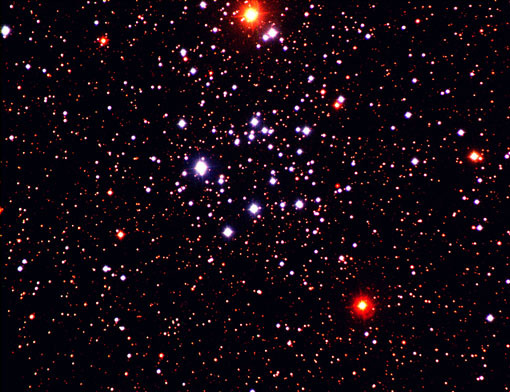
End of the Main Sequence
• At the point in which a star has used up all its core hydrogen it will then start to leave the MS. • Thus the Red Giant phase begins, but the helium in the core is still not hot enough to begin fusion. • However, ongoing H fusion in shells around the core continue to produce more helium. • The core continues its collapse, temperatures continue to rise till 108K is reached, and helium burning can now begin.
Helium Fusion
Helium fusion The “Triple Alpha “ process (it utilises 3 alpha particles - helium atoms): 4He + 4He → 8Be 8Be + 4He → 12C + γ(photon) The result of this process is to produce carbon in the star. This can then fuse with more He to produce oxygen: 12C + 4He → 16O + γ Thus carbon and oxygen are the “ash” of He burning.
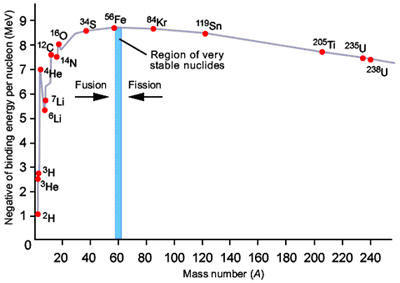
Hydrogen and Helium releases most of the fusion energy
This figure makes it obvious why hydrogen to helium releases most of the fusion energy available to a star – it shows the binding energy/nucleon. It also shows that the next step must be helium to carbon since fusion to lithium, beryllium or boron would consume rather than liberate energy. It also shows that the final product of fusion must be iron. After that the binding energy/nucleon declines.
How Helium core fusion begins in different Red Giants
Mass of star - Onset of Helium burning in core Less than 2-3 solar masses - Explosive (helium flash More than 2-3 solar masses - Gradual
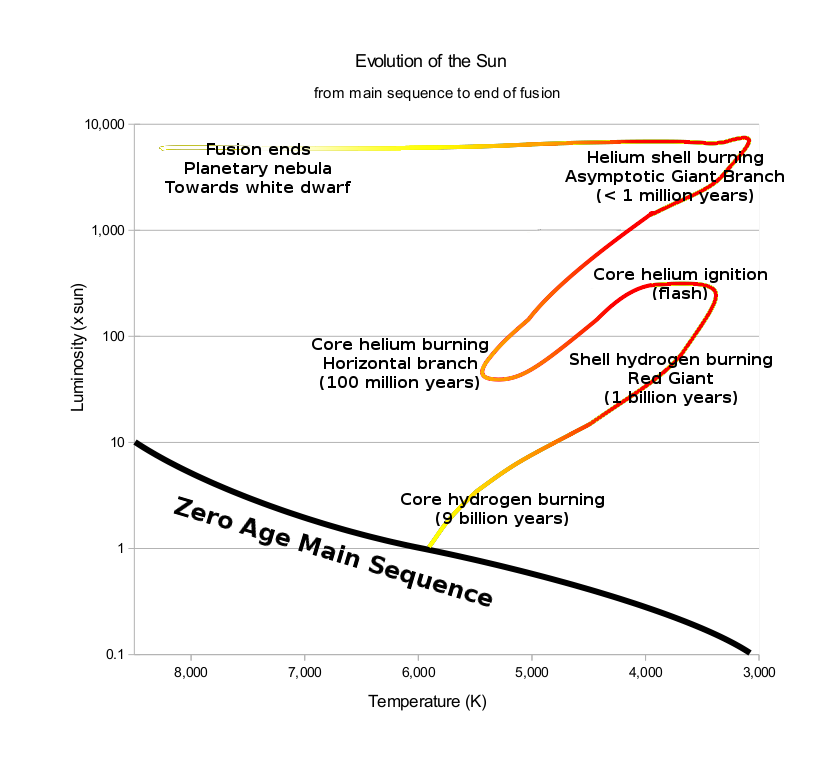
Evolution of the Sun
Our sun will go through a helium flash
Evolution of Star Cluster
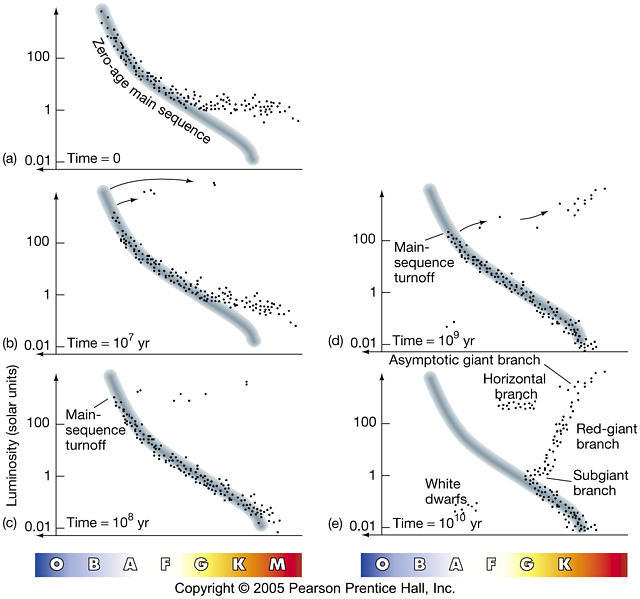
So what do we see in the sky?
• Stars spend relatively little time passing through the Red Giant phase compared to their lifetime on the MS • Consequently, when we look at the sky we primarily see MS stars. • For example, there are about 36 stars within 4pc, but only one (Procyon) is moving into the giant phase.
Globular Clusters
These are ancient (billions of years old) clusters of stars • They exhibit the beautifully symmetric configuration which has come from being gravitationally relaxed • They contain up to 1 million stars • Because they are so old we can see many evolved stars in them.
Population I and II stars
Important astronomical term : “Metallicity” In astronomy any element that is not H or He is called a metal. The fraction of “metals” in a star is very important. The very first stars are metal-poor and are called Population II Subsequent generations of stars may be metal-rich and are known as Population I (eg our Sun).
Stellar Pulsations
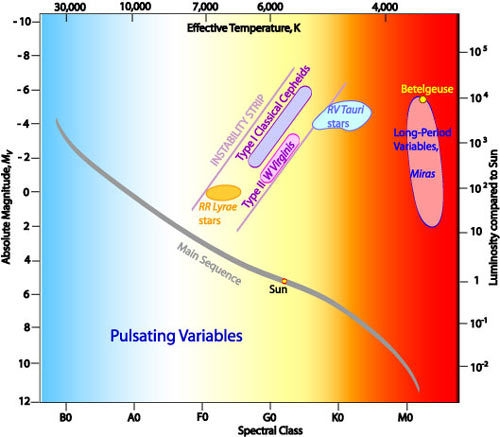
• Many stars vibrate or pulsate • Our own sun vibrates with periods of a few minutes • Stars that show large pulsations or regular-variability are primarily evolved, post MS stars. • Omicron Ceti was the first star discovered to pulsate (in 1660). Astronomers were so amazed they gave it a new name : Mira (which means wonderful in latin). • It has a period of 332d.
Cepheid Variables
• These stars are named after Delta Cephei discovered in 1784. • Its brightness varies by a factor of about 2.3 (~1 magnitude) and repeats every 5.4d. • The critical proof that it was expanding and contracting came from Doppler studies of its spectral lines. • One extremely important property of Cepheid variables is that their pulse period is related to their intrinsic brightness. • This was discovered in 1908 by Henrietta Swan Leavitt • Also they are very luminous and can be seen over distances up to Mpc. • Thus if we see a Cepheid pulsate we can determine its distance from its apparent brightness and the above diagram of actual brightness.
Binary Systems
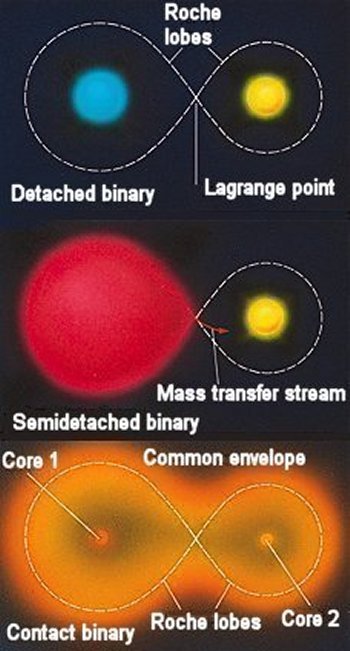
• Some binary pairs are so close together that large amounts of mass may transfer from one star to the other. • Whether material transfers from one to the other depends on the gravitational field. • The result is a modulated light pattern which reveals the binary period of the system.