Lecture 8 : Membrane transport
No description yet. This curated deck is ready for daily study.
Card preview (7)
Passive Transport
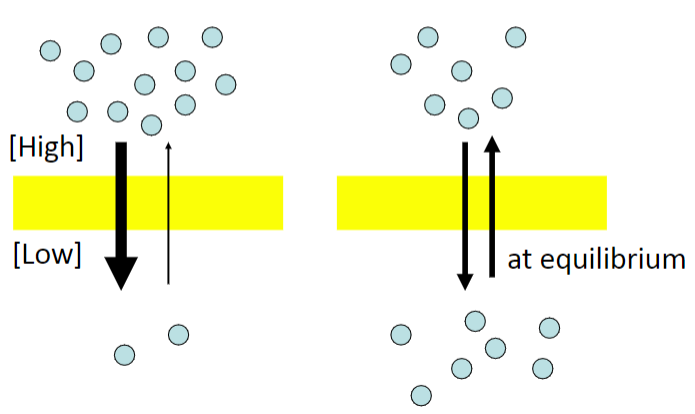
• Simple diffusion • No membrane proteins involved • Driven by CONCENTRATION GRADIENTS • Facilitated diffusion • Involves membrane proteins • Driven by concentration gradients For both, no energy (ATP) is required
Simple Diffusion
Up and down a concentration gradient. Depends on - - Concentration gradient - Hydrophobicity / charge (membranes are highly impermeable to ions) - Size So hydrophobic molecules go straight through, small molecules are easier to pass through, polar molecules find it difficult, ions just dont pass through.
Facilitated diffusion
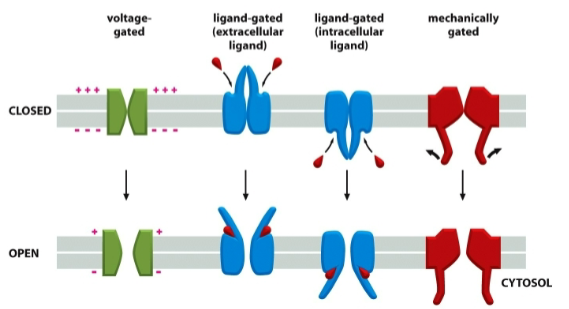
Because semi-permeable membranes are impermeable to ions, ion channels are required to transport ions across the membrane. Involves the transport of inorganic ions / small molecules across the membrane passively along concentration / electrochemical gradients. (Electrochemical gradient is a combination of concentration gradient and membrane potential. It essentially is the force driving charged molecules to pass through a semi-permeable membrane. ) Channels : • Discriminate by size or charge Carrier Proteins : • Involves binding sites for solutes
Ion channels
Ion Channels : • Specific to types of ions • Driven by electrochemical gradient • (conc grad, membrane potential) • Fast (can transport up to 10 million ions per second) • Can be regulated • Open and close in response to a stimulus K+ Channels : • Most common ion channel present in pretty much every cell • K+ leak channels are an important subset of K+ channels which are not gated (So continuously open)
Uniporter Carrier Proteins
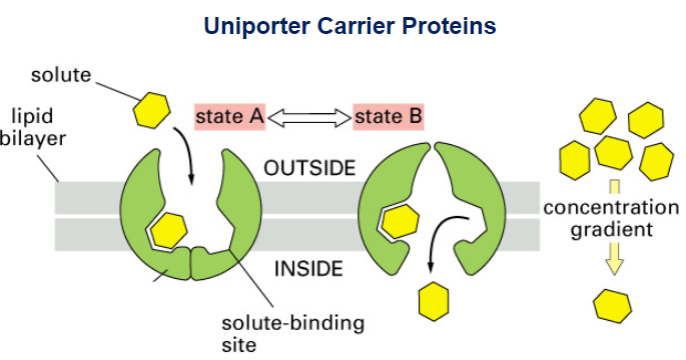
• Highly selective (the transport molecule binds to carrier) • Quite slow (fewer than 1000 molecules per second) • Example, Glut 2 in gut (glucose transporter)
Glucose transporters
Glucose transporters • uniporters, so only transport glucose • expressed by most cells • 12 pass membrane spanning proteins • alternate between 2 conformations (same sort of mechanism as shown above) • Glut 1 deficiency leads to seizures or retardation . . Glut 1 transports glucose into erythrocytes. • Glucose conc higher in blood than in RBC • Transported into cell by glut1 along conc gradient • glut1 works in both directions, so essential conc gradient is maintained • This is achieved by converting glucose into glucose-6-phosphate upon arrival in the RBC • glucose-6-phosphate is unrecognisable to glut1 does not diffuse back through the membrane into the blood.
Active Transport
Sodium Potassium pump, do a bit on this