Exam 4
No description yet. This curated deck is ready for daily study.
Card preview (24)
timing of behavior/physiology tightly correlated w/
environment (i.e. day and night) optimal times for behavior vary, but there’s a general pattern behaviors cycle in oscillatory pattern
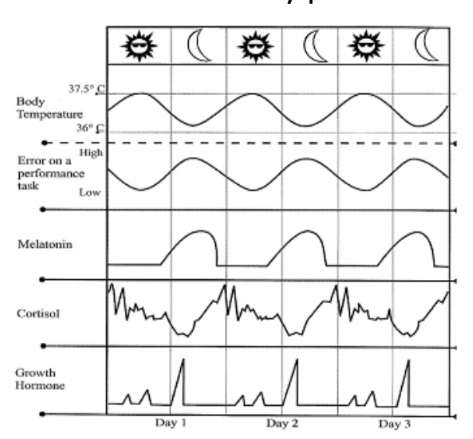
how to demonstrate circadian rhythm experimentally
• Put animal in constant environment (temp, noise, light) • example: constant darkness (DD) • Measure activity (wheel running) • Results: every day, activity starts a little sooner (cycles, but slightly less than 24 hours) • Activity is circadian (periodic) but not exactly 24 hours
circadian pattern of humans in constant darkness
circadium rhythm slightly longer than 24 hours (but there’s genetic variation) those w/ most genetic variation likely to have sleep disorders
circadian rhythm in constant light
rhythm of more than 24 hours (unlike less than 24 hours in constant darkness) causes more health problems than in dark since nocturnal
properties of circadian rhythms
• Found in all organisms • Period in constant conditions is close to, but not exactly 24 hours • Can depend on light dark cycle and other cues (zeitgebers) • Many single cells can display circadian rhythm; multiple cells release hormones to synchronize
nocturnal, diurnal, and crepuscular animals: definition + example
nocturnal: sleep during day (mice) diurnal: sleep at night (humans) crepuscular: sleep middle of day and middle of night, active dawn and dusk (fruit flies)
who discovered molecular mechanisms controlling circadian rhythms
Hall, Rosbash, Young
Konopka
identified gene that when mutated, change cycle duration called period (per mutants)
Hall and Rosbash
discovered the function of the per gene
Young
determined function of a second clock gene, called timeless (tim) found that per and tim proteins bind to each other
observations about per protein made by Rosbash
• per mRNA levels vary in cyclic fashion • mRNA cycling is circadian (cycle b/w high mRNA and protein levels) • per protein levels are also cyclic, peak level reached several hours after mRNA peak
initial model proposed by Rosbash about per protein function (5 steps)
• Transcribe per mRNA • make per protein in cytosol • import per protein into nucleus • Per protein inhibits its own promoter (mRNA and protein levels fall) • Inhibition is relieved, begin making per mRNA again
what is the actual mechanism w/ per and tim proteins that regulate timing of cycle
proteins clock (dCLK) and cycle (CYC) are required to activate transcription of per and tim per and tim proteins dimerize, are phosphorylated, then enter the nucleus phosphorylated dimer inhibits transcription of per and tim mRNA
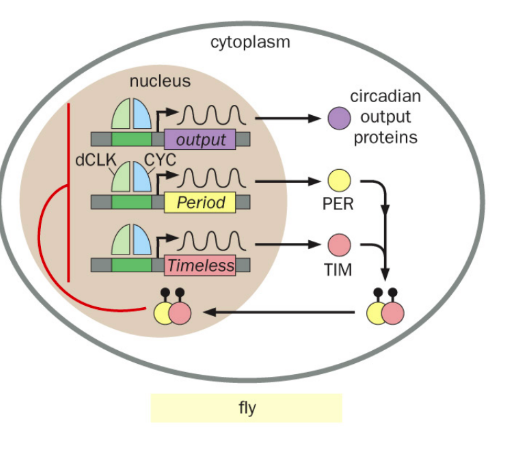
how is timing of clock mechanism regulated
via phosphorylation of per and tim proteins by Doubletime (per) and crytochrome genes (tim)
Doubletime gene
produces kinase that regulates per protein in cytosol degrades per: extends cycle duration by preventing dimer formation
Cryptochrome (Cry) gene
produces kinases that regulate tim proteins in both cytosol and nucleus degrading tim in cytosol: extends cycle duration by preventing dimer formation degrading tim in nucleus: destroys dimer, removing inhibition, next cycle starts
how does light entrain the clock
in flies (not mammals): cryptochrome is light sensing protein light activated cryptochrome promotes rapid degradation of tim protein in cytosol (can’t form dimer, cycle stops)
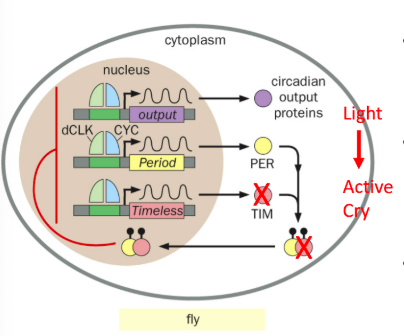
phase shifting from travel
normally: light during day breaks down cytosolic tim, extends cycle duration travel: light during night breaks down nuclear tim, advancing onset of next cycle (shortens cycle duration, phase advance)
how is mammalian clock different from flies
there are proteins homologous in structure/function to dCLK, CYC, and PER PER forms dimer with CRY, not TIM (timeless lost) cryptochrome (CRY) not light sensing
light input in mammals is different from flies how
CRY isn’t light sensitive light input based on retinal projections to the SCN (suprachiasmatic nucleus)
evidence for role of SCN to generate circadian rhythms
• isolated SCN cells are sufficient to generate circadian rhythms • electrical synapses b/w SCN neurons synchronizes entire nucleus • intact SCN is necessary for whole animal rhythms • hamsters w/o SCN have no circadian rhythm • when transplant SCN back in, circadian rhythm comes back
melatonin and the SCN
melatonin (hormone) gives feedback to SCN melatonin can phase shift SCN clock depending on when it’s present
circadian control in mammals by SCN: what are 4 things SCN can affect
autonomic innervation body temperature glucocorticoids feeding
drosophila and melatonin
drosophila also use hormones to synchronize brain to body, but NOT same hormones as mammals