Halogenalkanes
No description yet. This curated deck is ready for daily study.
Card preview (24)
What are the two types of reactions that can occur with haloalkanes?
Only elimination or substitution reactions can occur
Describe and explain the nucleophilic substitution of bromoethane with aqueous hydroxide ions to produce ethanol
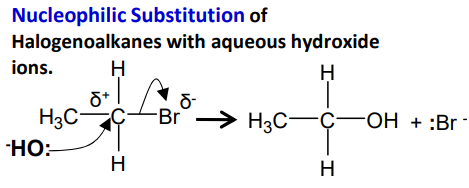
Describe and explain the nucleophilic substitution of bromoethane with cyanide ions to produce propanenitrile
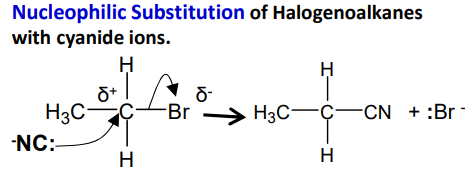
Describe and explain the nucleophilic substitution of bromoethane with ammonia to produce a primary amine
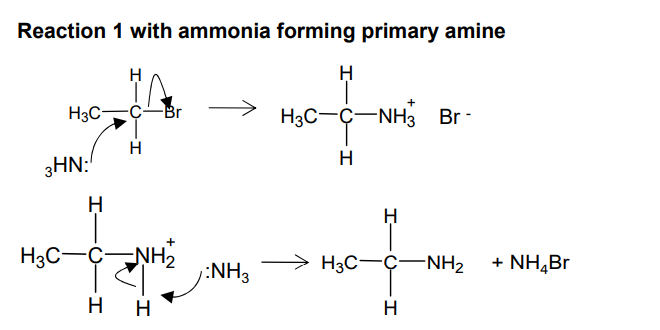
State what is meant by the term nucleophile
An electron pair donater.
What is hydrolysis?
Splitting molecules using water
How can we test for halogenoalkanes? (brief)
Do a substitution reaction which turns the halogen into a halide ion Then test for that ion with silver nitrate soln.
Describe how you would test for haloalkanes
Warm the haloalkane with NaOH soln. in a mix of ethanol and H2O Halogen displaced to become an ion Acidify with dilute nitric acid and then add silver nitrate Various precipitates may be formed You can confirm the precipitate by adding ammonia soln.
Why do you acidify the halide ion mixture with nitric acid?
To prevent any unreacted OH- ions reacting with the silver and giving a confusing precipitate
Adding silver nitrate soln. to a halide ion produces a white precipitate. What ion is it?
Cl-
Adding silver nitrate soln. to a halide ion produces a very pale yellow precipitate. What ion is it?
I-
Adding silver nitrate soln. to a halide ion produces a very pale cream precipitate. What ion is it?
Br-
What are the conditions for haloalkane substitution by OH- ions?
Aqueous and warm
What are the conditions for haloalkane substitutions by CN- ions?
Aqueous/alcohol Warm
What is produced by haloalkane substitution with CN- ions?
A nitrile
What are the conditions for haloalkane substitution by NH3?
Excess ammonia (NH3) Sealed tube
Give a general reaction for the substitution of a haloalkane by NH3
R-X + 2NH3 –> R-NH2 = NH4+X-
In substitution by NH3, NH3 acts in two ways. What are they?
As a nucleophile and as a base
What are the reagents and conditions for elimination reactions?
Reagents - NaOH/KOH Conditions - dissolved in ethanol
Describe and explain the elimination reaction of 2-bromopropane with ethanolic hydroxide ions to form propene
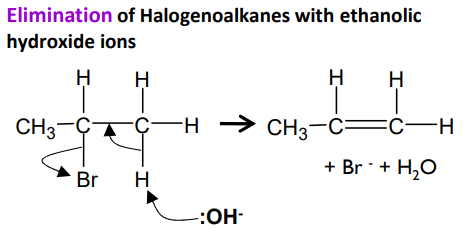
What does CFC stand for?
Chlorofluorocarbons
What are the common uses of CFCs and why?
Low toxicity, low reactivity and low flammability led to common use as refrigerants and aerosol propellants
What is the ozone layer?
A thin layer of the atmosphere consisting of O3, that filters out some UV
What does the ozone layer do?
Filter out shorter wavelengths of UV light that would be harmful to most life in larger doses