Transition Metals
No description yet. This curated deck is ready for daily study.
Card preview (24)
Transition element definition
Element Forming one or more ions with incomplete d sub shell
4 characteristics of TM
Complex formation Variable oxidation states Form coloured ions Catalytic activity
Ligand definition
Donates lone pair to form coordinate bond with metal ion
Complex definition
Central metal atom / ion surrounded by ligands joined by coordinate bonds
Coordination number?
Number of coordinate bonds to central metal atom/ ion
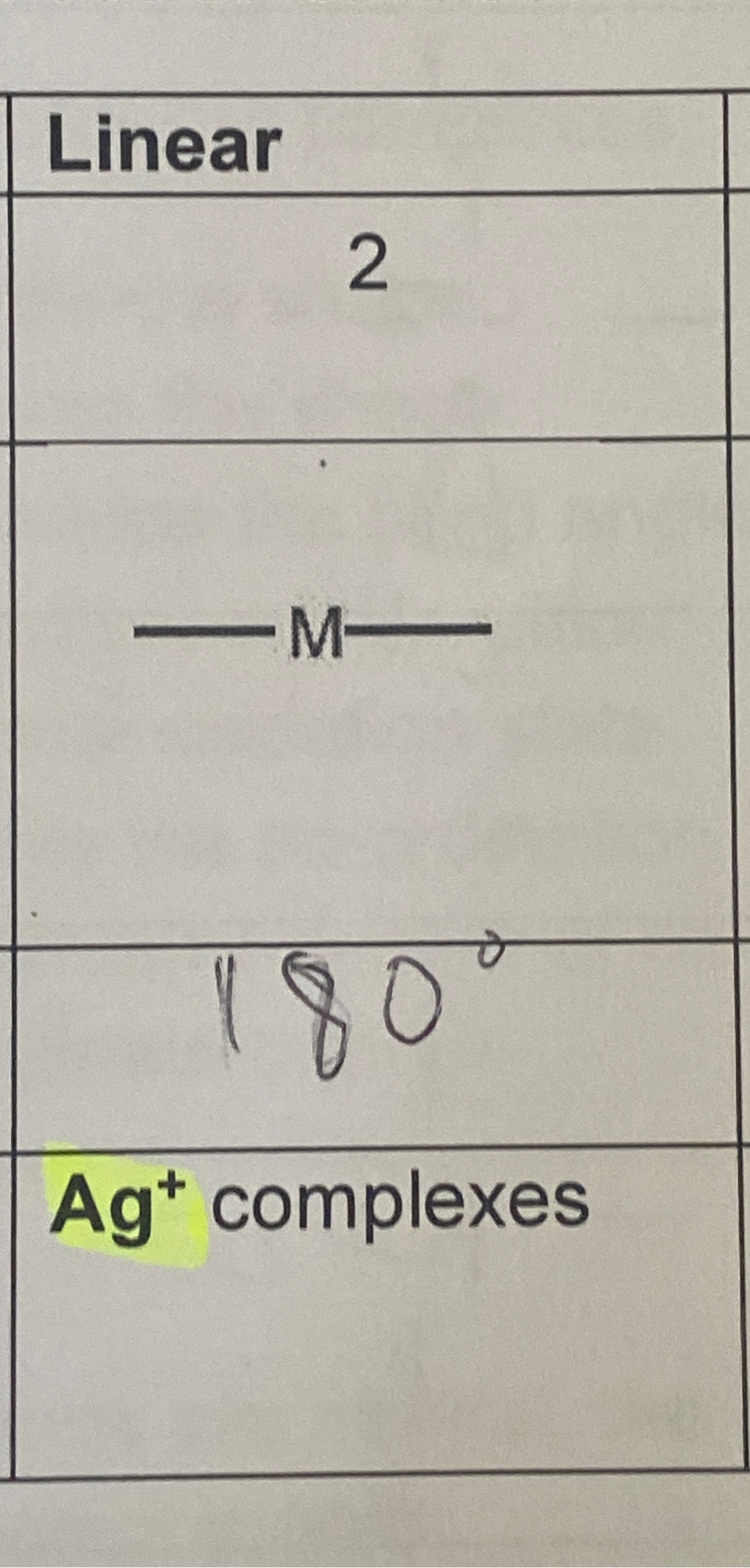
Linear shape - coordination number , bond angle and which TM ( and shape )
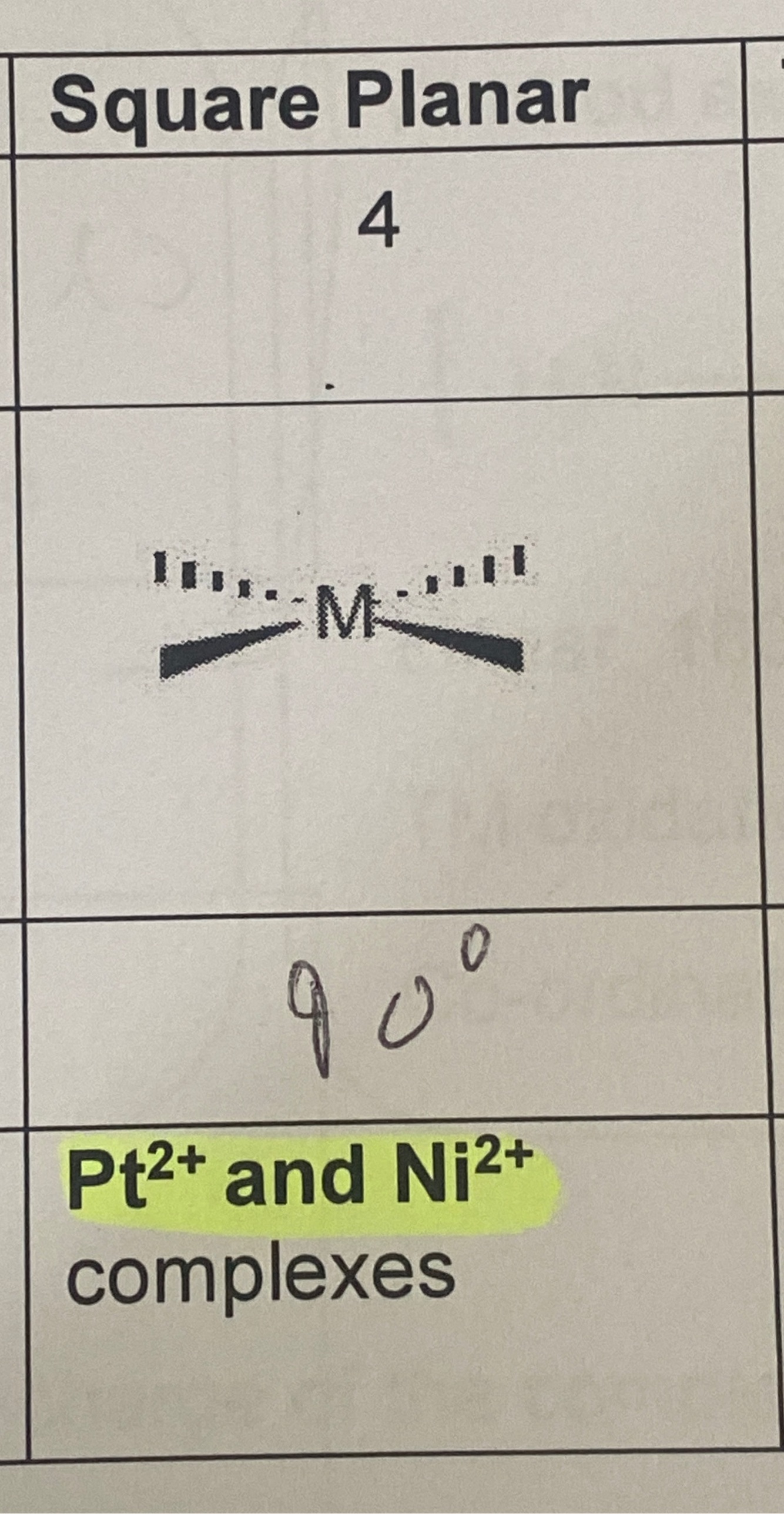
Square planar- coordination number , bond angle and which TM ( and shape)
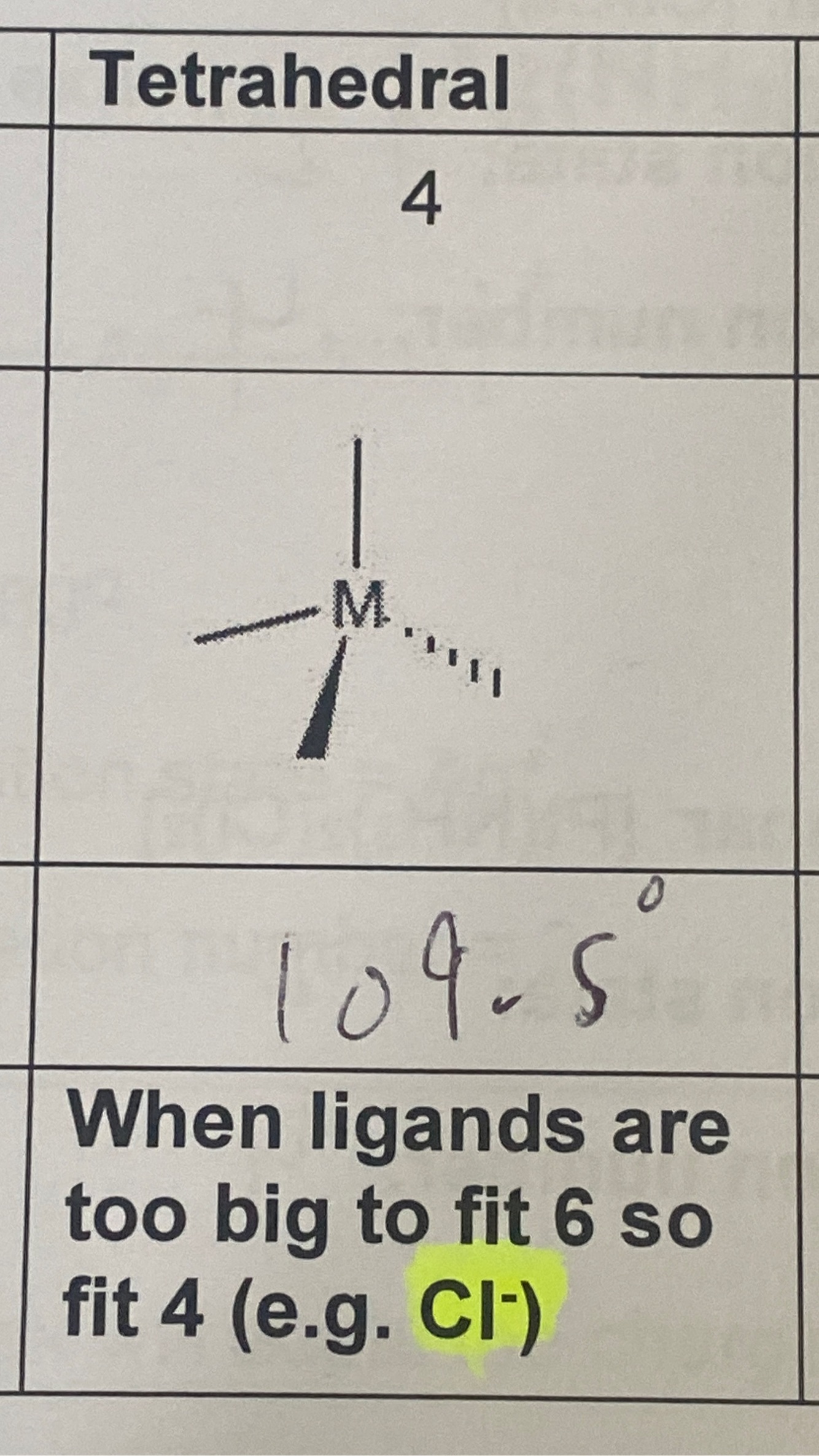
Tetrahedral- coordination number , bond angle and which TM ( and shape)
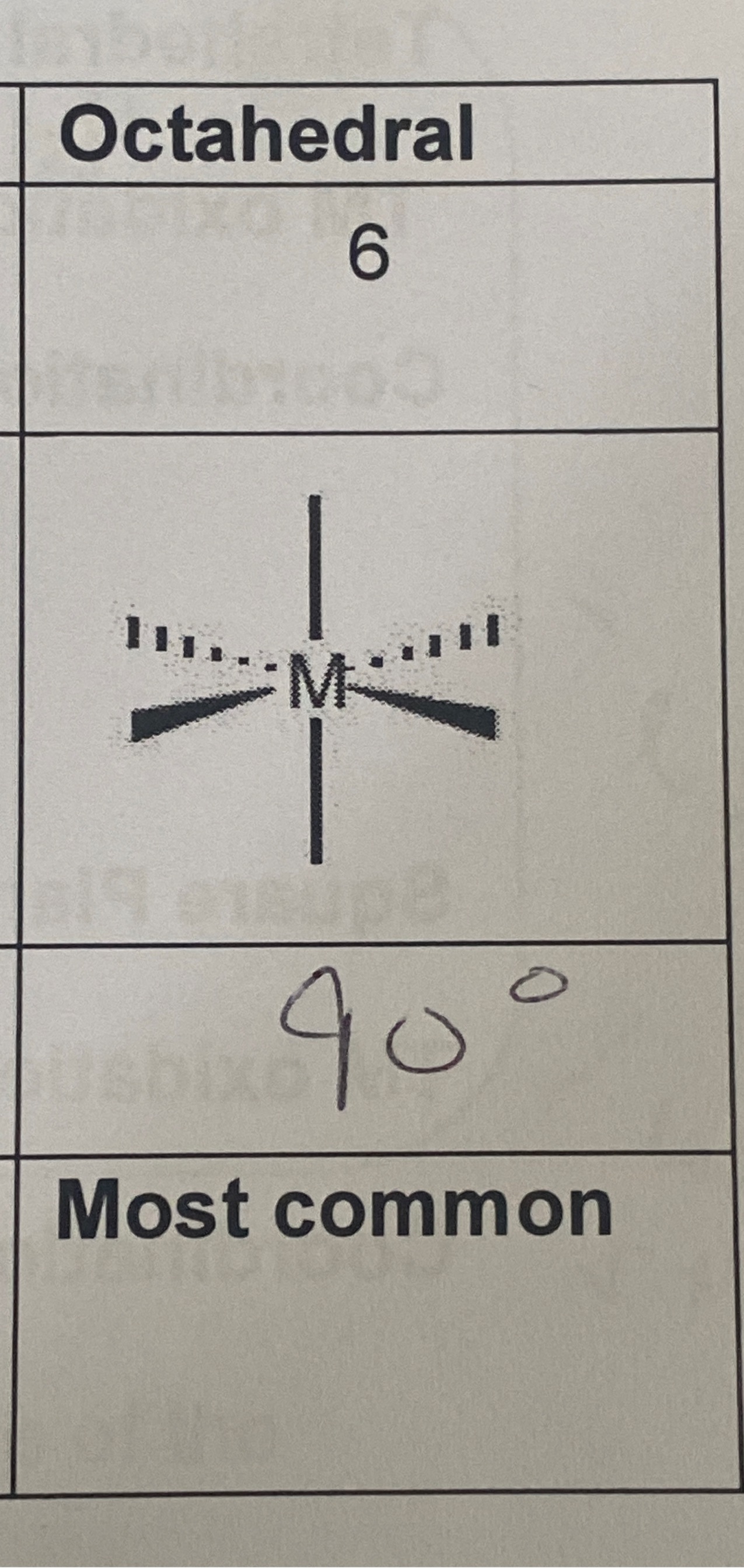
Octahedral- coordination number , bond angle and which TM ( and shape)
What’s a monodentate ligand
Forms one coordinate bonds to TM ion Using One lone pair of electrons
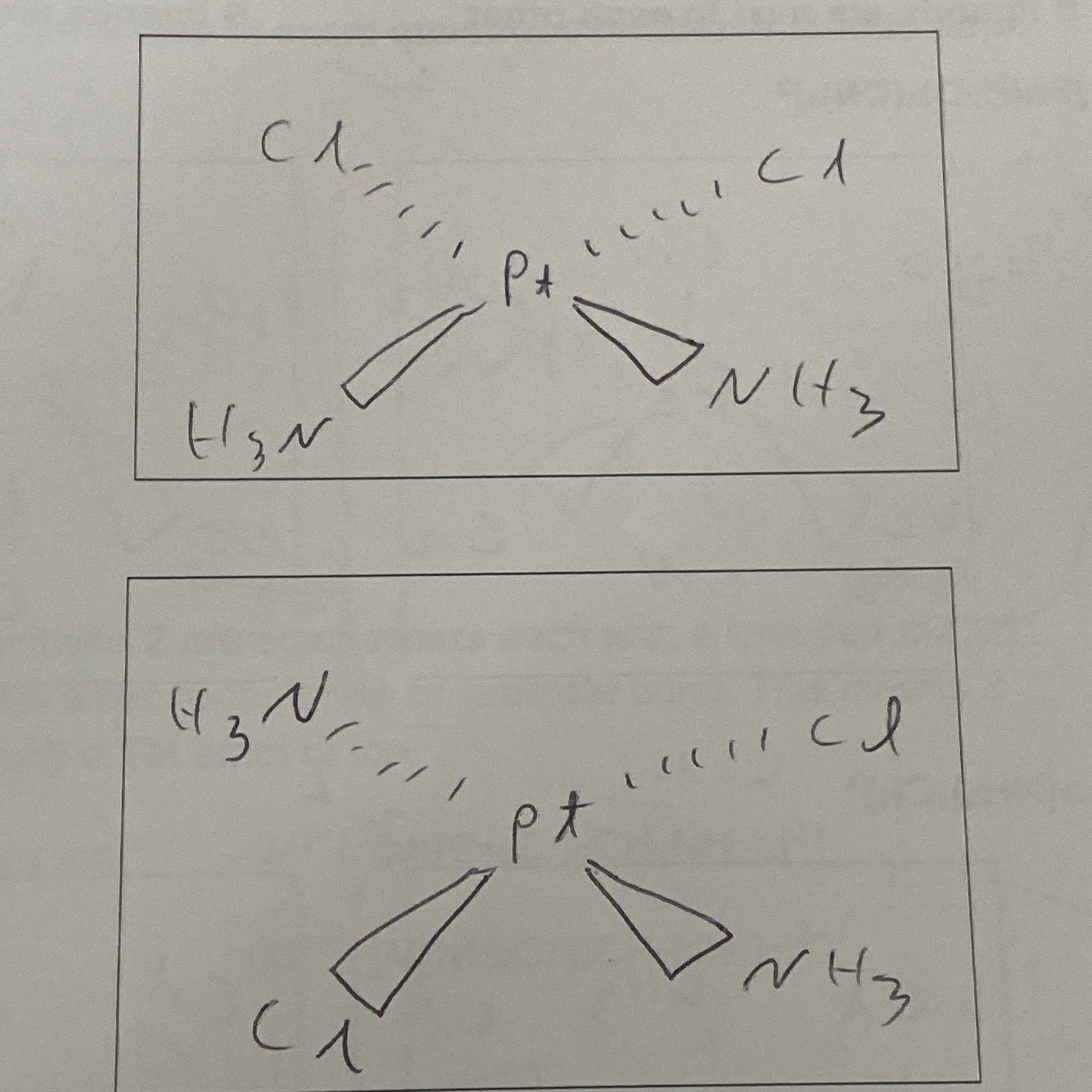
What type of isomerism can occur in TM complexes
Cis Trans Eg cis Platin and Trans Platin Advantages- kills cancer cells Disadvantages- hair loss
What’s a bidentate ligand
Ligand that donates 2 lone pairs to form 2 coordinate bonds
Give 2 bidentate ligands
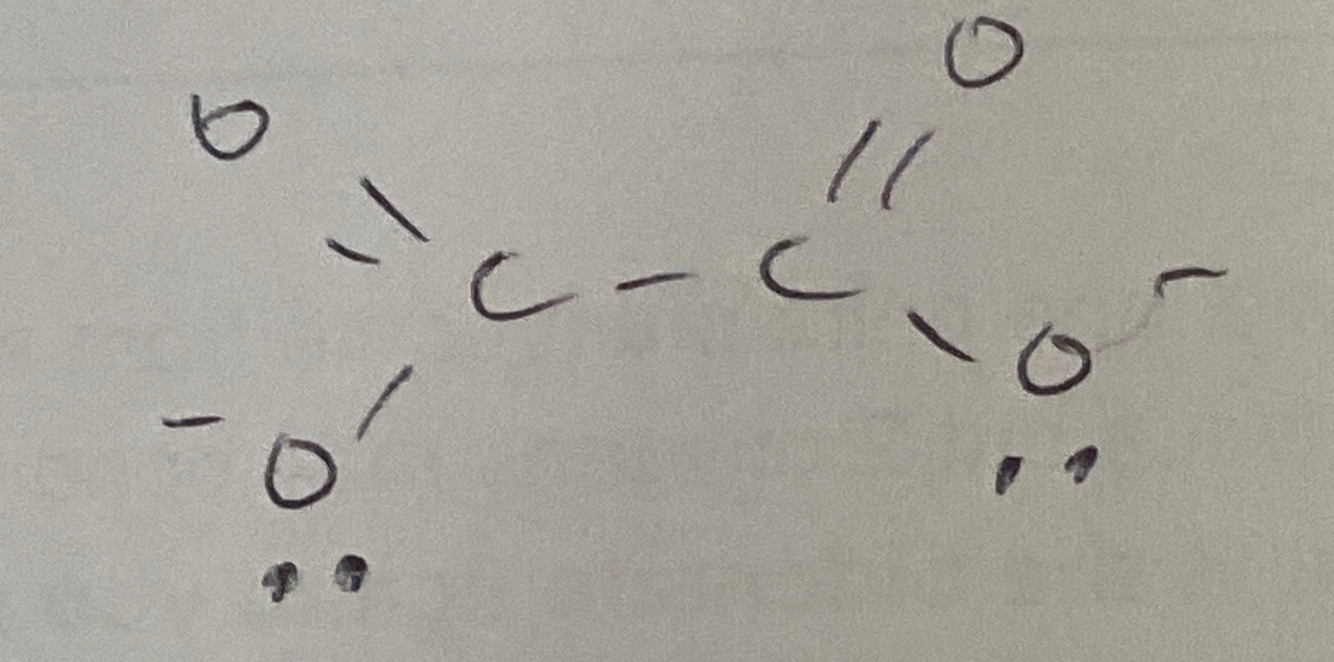
1,2- diaminoethane C2O4 2-
Draw ethanedioate ions
Draw 1,2-diaminoethane

How would you draw this ?
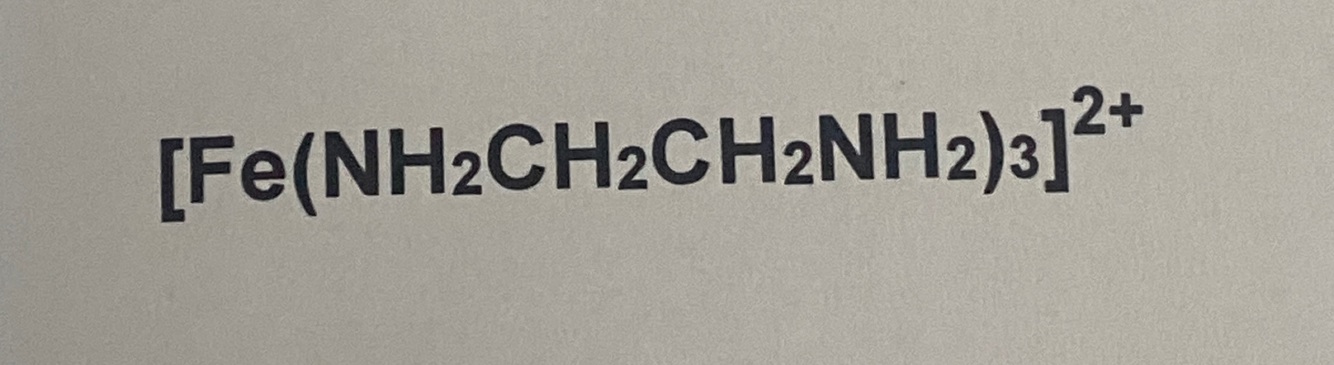
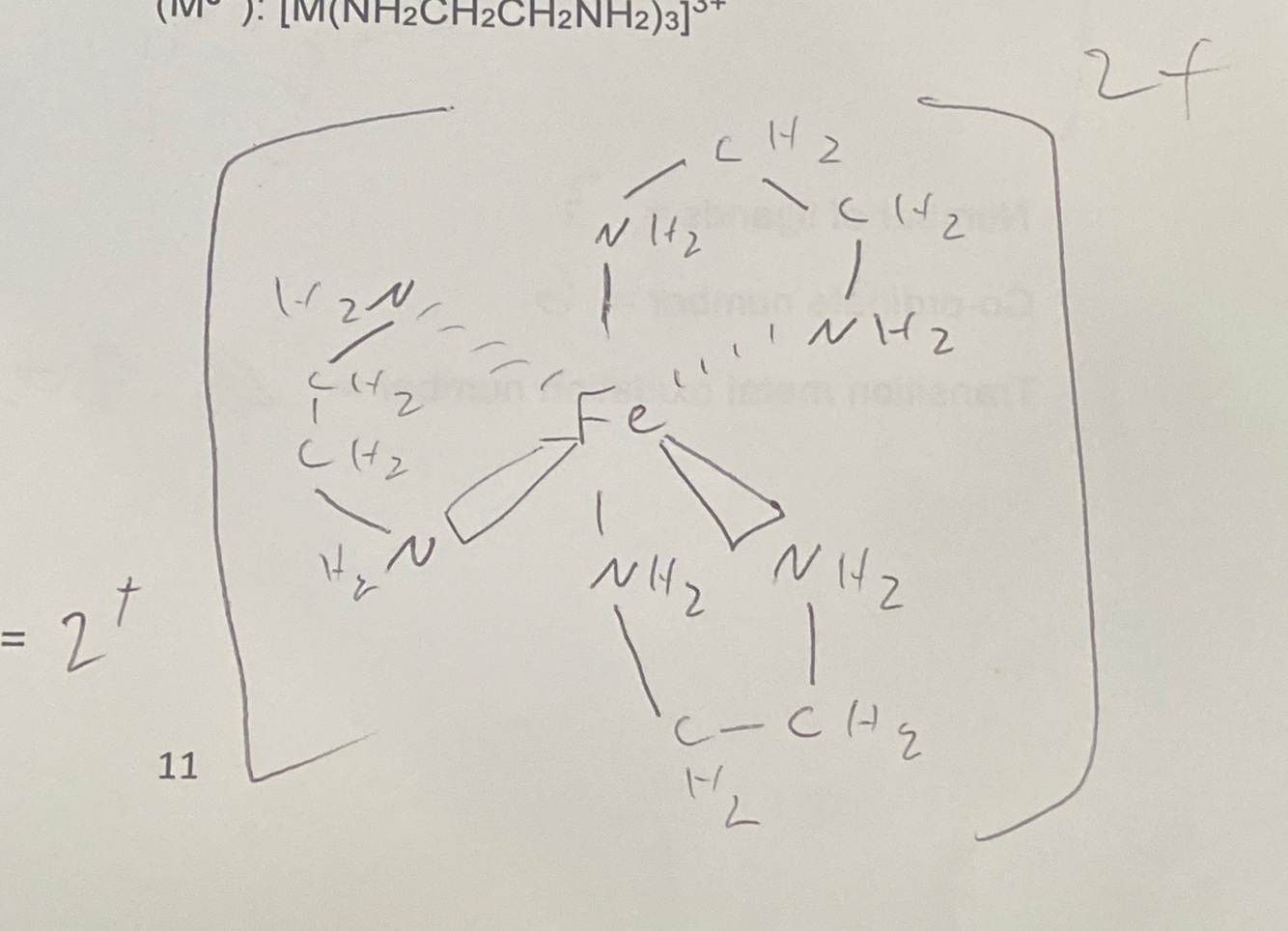
How would you draw this?
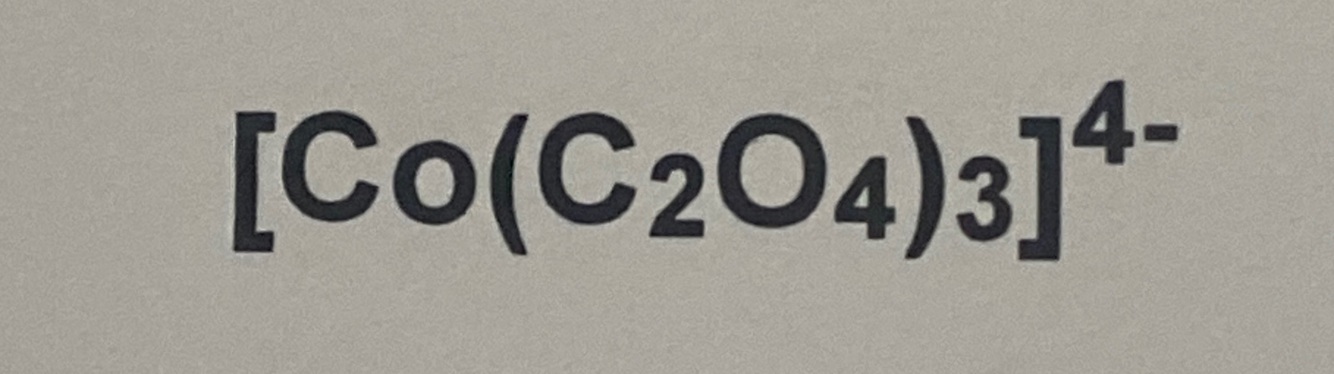
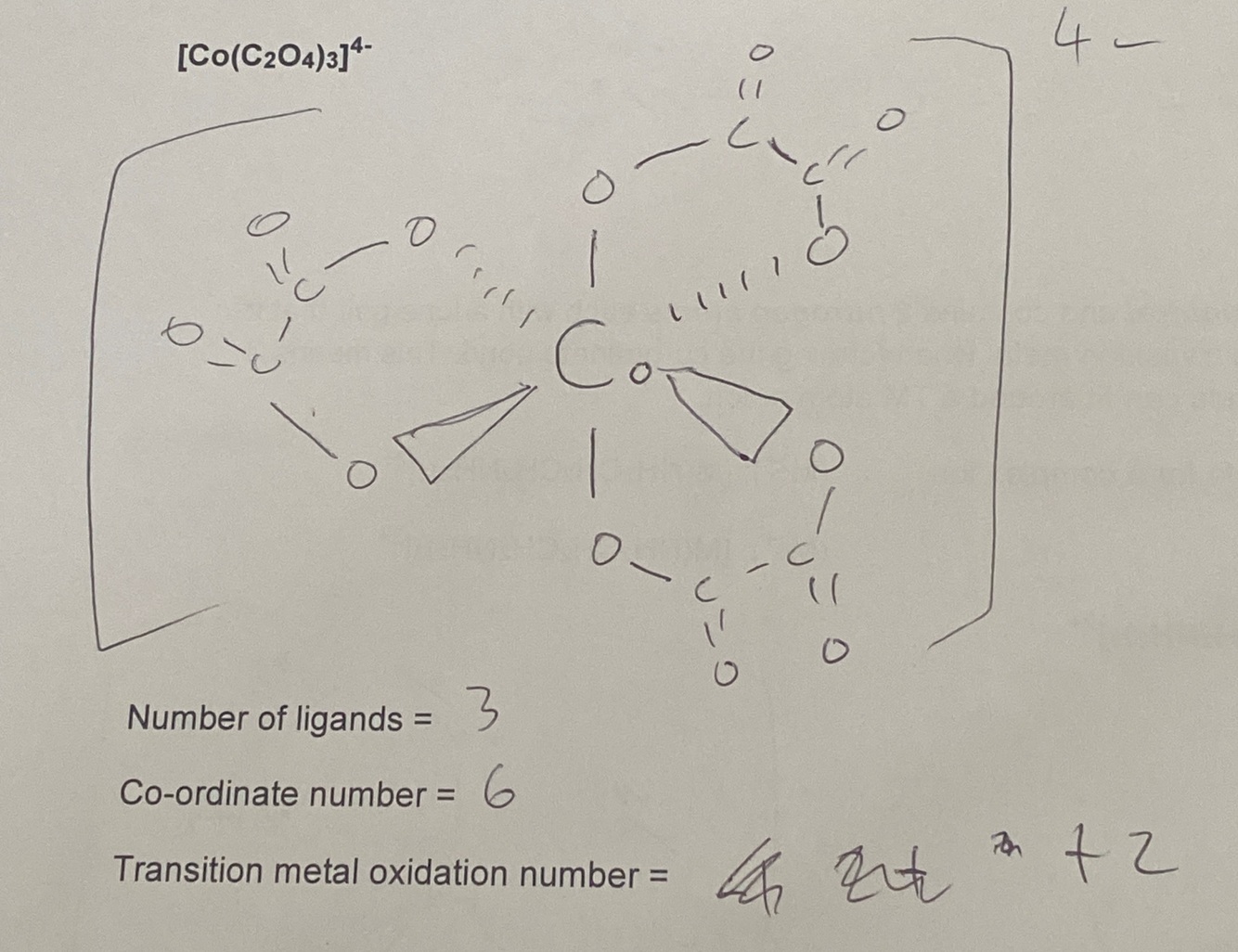
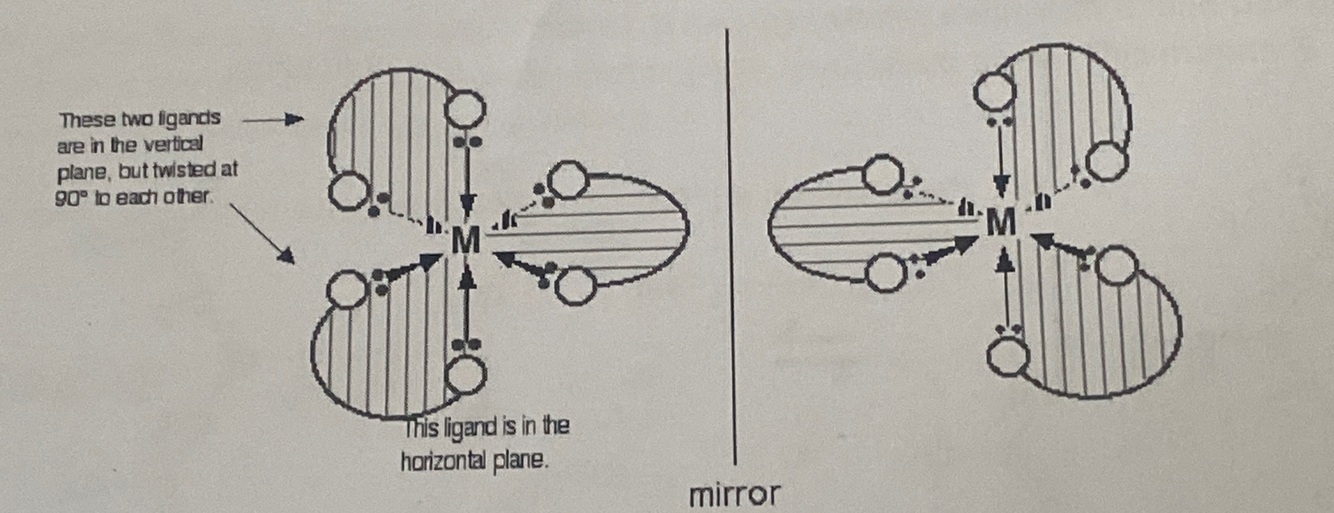
What type of isomerism do octahedral complexes containing bidentate ligands show
Optical isomerism
How does haemoglobin transport oxygen around body ?
Via ligand substitution Oxygen coordinately bonds with Fe2+ then when transported replaced by water or CO2
Why is carbon monoxide (CO) toxic
Forms a stronger coordinate bond than oxygen preventing transport of oxygen
Iron (II) colours as aqueous ion , OH- dropwise, excess OH-, NH3 dropwise , excess NH3 and finally HCL
Aq- green solution OH- dropwise — green ppt Excess OH- — no change NH3 dropwise- green ppt ( may oxidise to brown in air) Excess nh3 and HCL no change
Iron (III) colours as aqueous ion , OH- dropwise, excess OH-, NH3 dropwise , excess NH3 and finally HCL
Aq- orange brown solution OH- dropwise- brown ppt OH- excess - no change NH3 dropwise- brown ppt Excess NH3 or HCL no change
Copper (II) colours as aqueous ion , OH- dropwise, excess OH-, NH3 dropwise , excess NH3 and finally HCL
Aq- blue solution OH- dropwise - blue ppt OH- excess - no change NH3 dropwise- blue ppt Excess NH3 - deep blue solution HCL- yellow solution
Manganese (II) colours as aqueous ion , OH- dropwise, excess OH-, NH3 dropwise , excess NH3 and finally HCL
Aq- pink solution OH- dropwise - light brown ppt ( may oxidise in air to dark) OH- excess- no change NH3 dropwise- light brown ppt Excess NH3 or HCL - no change