Kinetics 6: Main recall
No description yet. This curated deck is ready for daily study.
Card preview (23)
Rate constants often vary with temp, many according to the Arhenius equation. • Give the eq • Define the components, giving units
KT = Aexp(-Ea/RT) • KT = rate constant, units vary • A = A-factor / pre-exponential factor* same units & dimensions as K, since exp term is dimensionless • Ea = act energy in kJ mol-1 • R = gas constant, in kJ [temp unit]-1 mol-1 (so that overall, exp term is dimensionless) • T = temp, K * A is the collision rate per unit reactant concentration. A is also the rate constant at infinite temp, since 1/T = 0 when lnK = lnA. A is independent of or weakly dependent on temp
Range of typical values for Ea
10-200 kJ mol-1
Value of RT at room temp
~2.4 kJ mol-1
What fraction of molecules have sufficient energy to attain the transition state?
Fraction = exp(-Ea/RT) Recall RT = 2.4 kJ mol-1 at room temp
Gas kinetic theory • Expression for mean speed, give unit • Bimolecular collisions depend on the relative motion of the molecules. Expression for mean relative speed?
ĉ = √(8KBT/πm) in ms-1 KB is Boltzmann constant, m = particle mass in kg ĉ = √(8KBT/μ) in ms-1 Where reduced mass, μ = (mAmB/mA+mB) μ in AMU, atomic mass units
Define and give the eq for the steric factor.
Steric factor p is the fraction of sufficiently energetic collisions which lead to reaction p = Aexperimental/Acoll theory normally p <1, but p >1 when molecules interact over larger distances than predicted by gas kinetic theory
Gas kinetic theory • Expression for mean speed, give unit • Bimolecular collisions depend on the relative motion of the molecules. Expression for mean relative speed?
ĉ = √(8KBT/πm) in ms-1 KB is Boltzmann constant, m = particle mass in kg ĉ = √(8KBT/μ) in ms-1 Where reduced mass, μ = (mAmB/mA+mB) μ in AMU, atomic mass units
1st order rate law
r = k1st[A] d[A]/dt = -k[A]
integrated 1st order rate law in terms of reactant
[A]t = [A]0exp(-k1stt)
Produce and solve the rate law for the second order reaction A –> products.
rate law d[A]/dt = -k2nd[A]2 ∫(from [A]t to [A]0) 1/[A] d[A] = k2nd ∫(from t=t to t=0) dt 1/[A]t = k2ndt + 1/[A]0
Give the expression for the half-life for a first-order reaction.
t1/2 = ln2/k1st
Give the expression for the half-life for a second order reaction.
t1/2 = 1/(k2nd[A]0)
Study the reaction scheme below. What conditions are required for the pre-equilibrium hypothesis to apply?
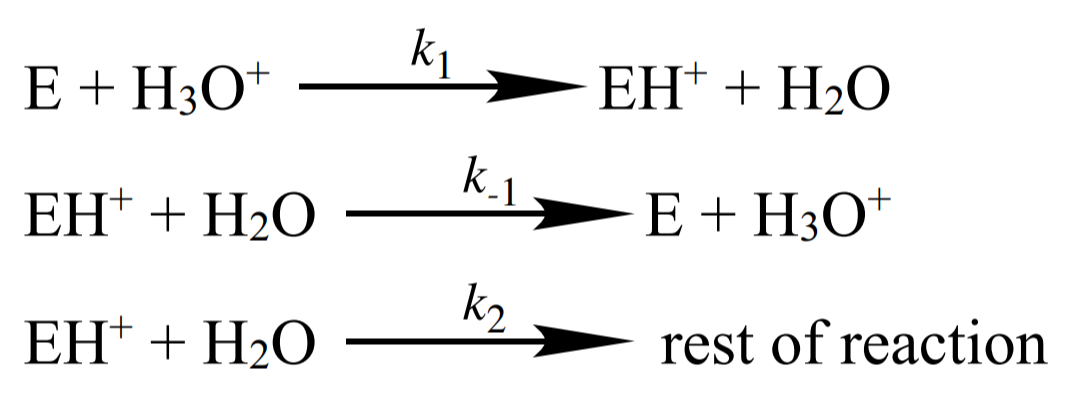
Rate of process 1 >> rate of process 2, such that rates of [1] and [-1] are equal (in equilibrium), and process [2] is rate-determining. pre-eq hypothesis is often useful for intermediates involving protonation or deprotonation, since these processes are usually faster than breaking/making bonds to atoms heavier than hydrogen
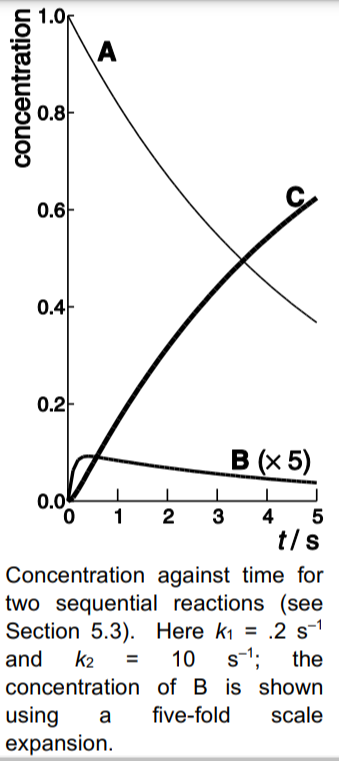
What conditions permit using the steady state approximation? Include a graph of concentration against time.
Applicable when, in a complex mechanism, a reactive intermediate reacts as soon as it’s formed, such that its concentration is assumed to be constant. Only applicable when reaction is in steady state - not in the initial or final phases. simplifies solving differential eqs since it removes the time dependence
Write out the Michaelis-Menten scheme.
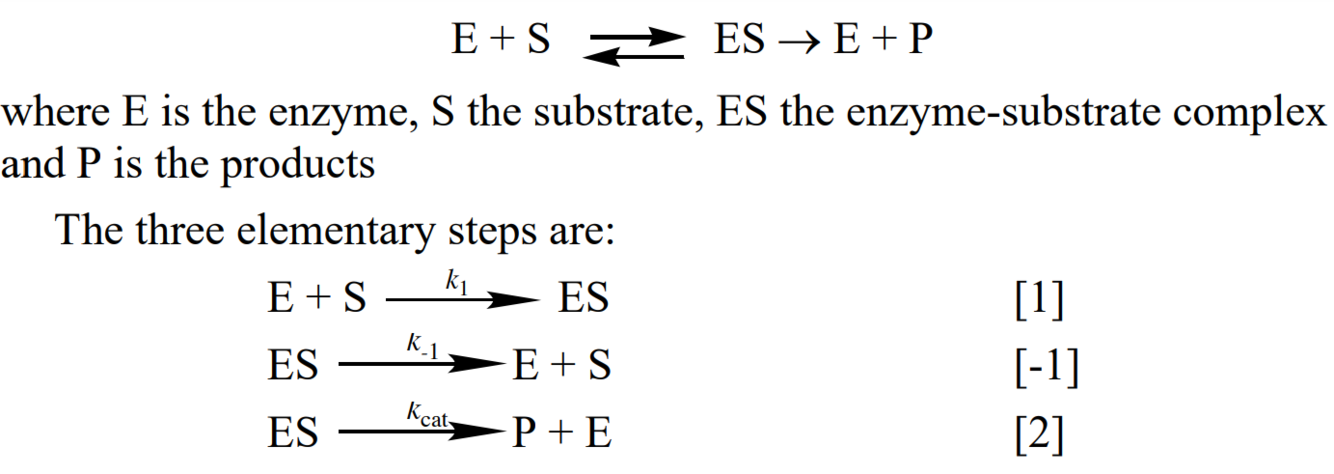
Shown is the Michaelis-Menten scheme. Write the expression for Vmax and define it.
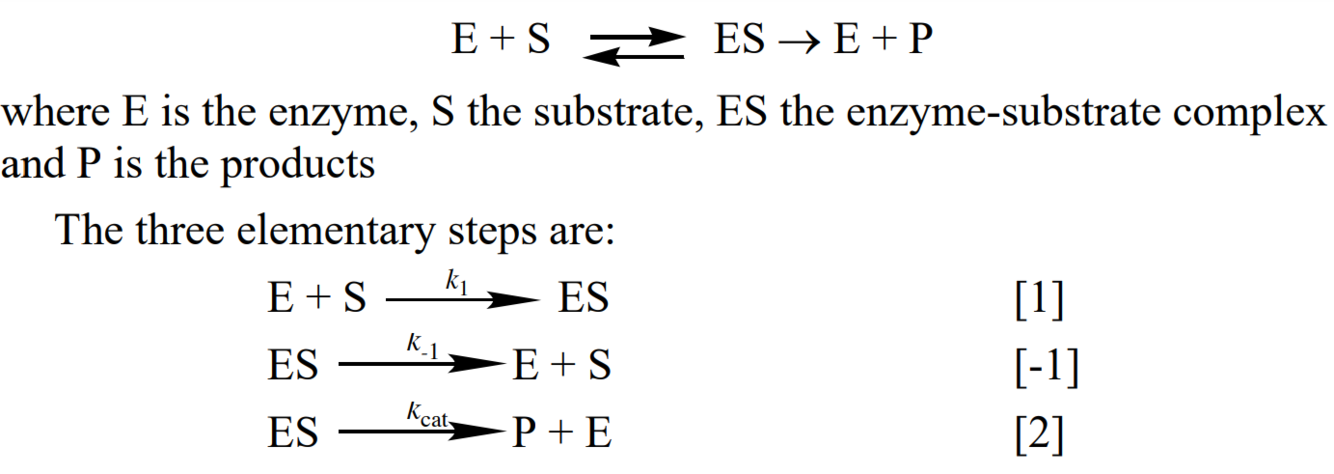
Vmax = kcat[E]0 Maximum velocity which occurs when all enzyme is saturated, i.e. 0 order in [S].
Shown is the Michaelis-Menten scheme. • Give the expression for KM • What units does it have? • define it
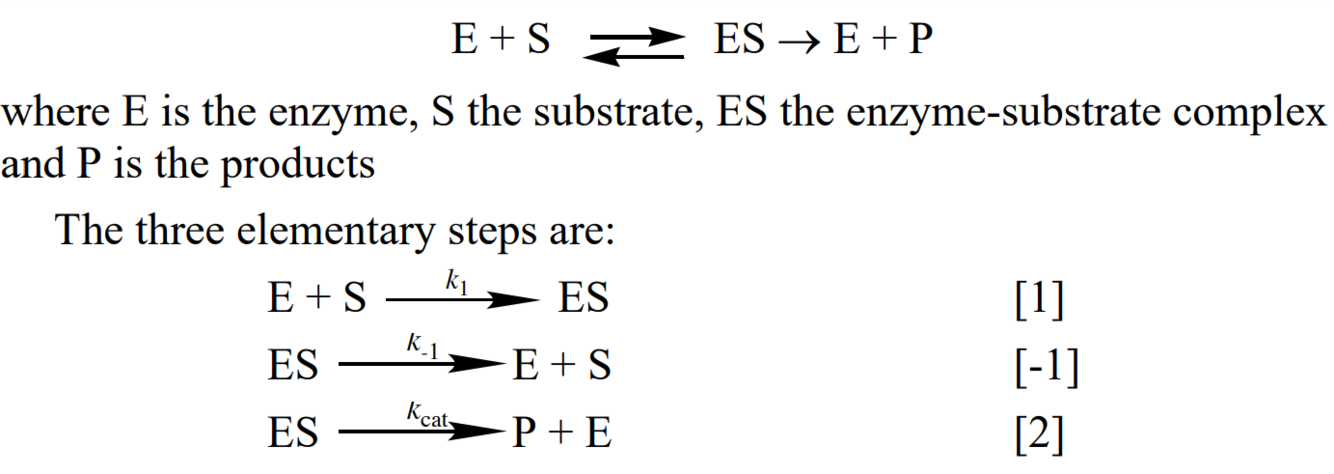
kM = (k-1 + kcat)/k1) Units of conc KM is the substrate conc which gives ha;f-maximum velocity.
Shown is the Michaelis-Menten scheme. Write the Michaelis-Menten equation, i.e. the expression for the velocity, V (ie rate) of reaction.
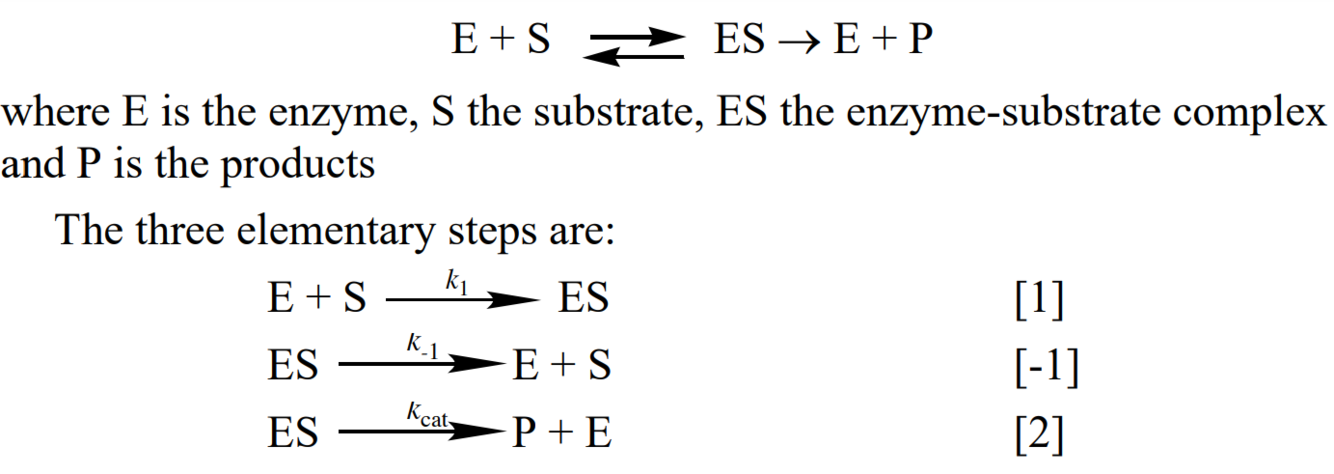
V = (kcat[E]0[S]) / ([S] + (k-1 + kcat)/k1) = (kcat[E]0[S]) / ([S] + kM) where KM is the michaelis constant
What is a chain reaction?
A reaction comprised of non-linear elementary steps, which form chains in which the output of one step may be the input of an earlier step.
What are the general stages of a chain reaction?
• Initiation generates chain carriers • Propogation maintains chain carriers • Inhibition reduces reaction rate by destroying product (but not chain carriers) • Termination destroys chain carriers • Chain branching (sometimes): one chain carrier reacts to give 2+ carriers (results in explosion, eg combustion)
The thermal chain reaction H2 + Br2 –> 2HBr is well-characterised. Illustrate the stages of this reaction.
Initiation Br2 + M –> 2Br + M where M is a molecule Or photodissociation: Br2 + hv –> 2Br Propogation Br + H2 –> HBr + H H + Br2 –> HBr + Br Inhibition HBr + H –> H2 + Br Termination 2Br + M –> Br2 + M (M absorbs excess energy from new Br2 molecule, such that the Br2 doesn’t immediately fall apart)
What is a chain carrier?
An intermediate formed during a chain reaction, which is an input into earlier reactions, and thus propogates the reaction.
Define chain length. Give its expression.
The average number of times that the closed cycle of steps producing products is repeated per chain carrier. chain length, l = (overall reaction rate)/(rate of initiation)