Electrochemistry
No description yet. This curated deck is ready for daily study.
Card preview (24)
Oxidation numbers
Total number of electrons that an atom gains or loses in order to form a chemical bond with another atom
What does it mean if a compound is not neutral
It is a polyatomic ion
Group 1 fixed oxidation number
+1
Group 2 fixed oxidation number
+2
Flourine fixed oxidation number
-1
Hydrogen with non-metal fixed oxidation state
+1 (hydrogen acts as the metal)
Hydrogen with metal or boron fixed oxidation state
-1 (hydrogen acts as the non metal)
Oxygen fixed oxidation state Exceptions (3)
-2 except in H2O2 and Na2O2 where it is -1, or bonded with fluorine
Group 7 fixed oxidation state
-1 except Cl Br and I when bonded to O or F
What elements can have varying oxidation numbers (7)
Nitrogen Phosphorus Oxygen (H2O2, Na2O2) Sulphur Transition metals Chlorine Hydrogen
Applications of redox reactions/electrochemistry (3)
Batteries in computers Electric cars Remote controls
REDOX reactions
Reactions that involve the transfer of electrons OILRIG
What happens when electrons are lost
The element/compound is oxidised and the oxidation number increases to become less negative
What happens when electrons are gained
The element/compound is reduced, the oxidation number decreases/ becomes more negative
Reducing agent
Substance that is oxidised
Oxidising agent
Substance that is reduced
Hydrogen-oxigen fuel cells
Hydrogen and oxygen react in a hydrogen-oxygen fuel cell to produce electricity, water and small amounts of heat. The electrochemical converts chemical energy to electricity which is useful in cars, spacecraft and is being developed for portable electronic devices
What is the result of hydrogen fuel cells called
Clean fuel
3 equations within a hydrogen oxygen fuel cell
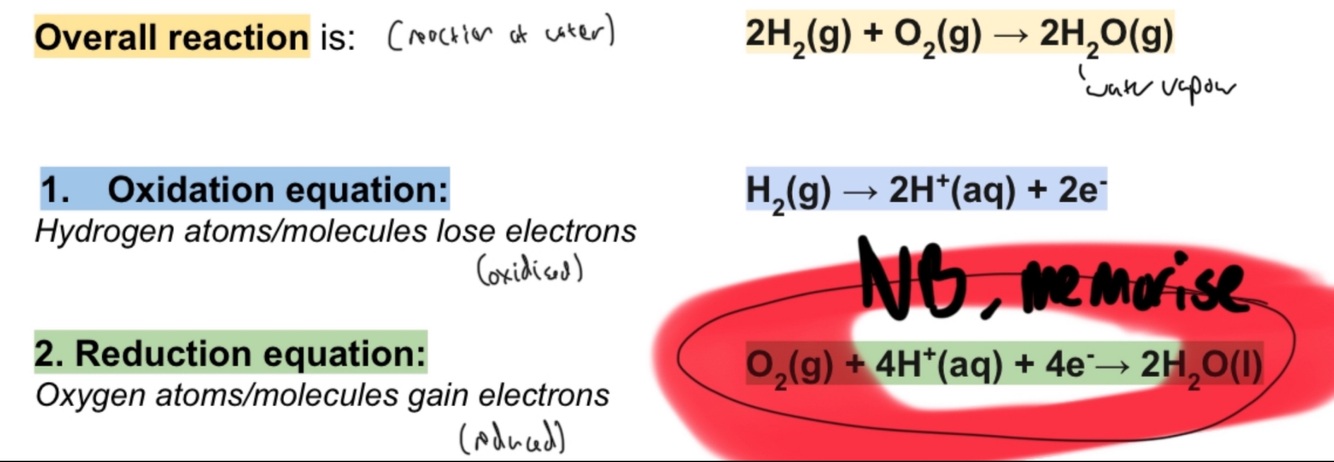
Advantages of hydrogen fuel cells (5)
Renewable energy source Plentiful cheap supply of reactants High efficiency process (>60% compared to 33% for petrol) Similar energy content Produces zero carbon emmisions
Disadvantages of hydrogen fuel cells (5)
Lack of facilities and methods for widespread use Compressed gases are harardous Reactants are gases so must be compressed for storage Hydrogen sourced from methane uses a non-renewable source Hydrogen sourced from water is expensive to produce
Electrolysis
Decomposition of an ionic compound, when molten or in an aqueous solution by the passage of an electric current
Positive electrode
Anode
Negative electrode
Cathode