COGS 154 Final
暂无描述。系统推荐的高质量记忆内容,适合每天坚持背诵学习。
卡片预览 (24 张)
What are motor speech disorders
difficulty with properly planning and executing motor movements for speech
Motor planning
Processes that define and sequence articulatory goals -prior to initiation of movement `
Motor Programming
processes that establish and prepare the flow of motor info across muscle, as well as control timing and force of movement -prior to initiation of movement
Motor Execution
processes that activate relevant muscles -during and after initiation of movement
Motor planning/programming disorders:
inability to group and sequence the relevant muscle with respect to each other (apraxia)
apraxia of speech (AOS)
speech disorder due to dysfunctional motor planning and programming -the messages from the brain to the mouth are disrupted -severity of apraxia depends on the nature of the brain damage -can occur in conjunction with dysarthria or aphasia acquired and developmental
Motor Execution Disorders:
deficits in physiology and movement abilities of muscles (dysarthria)
dysarthria
-speech disorder due to dysfunctional motor execution resulting in incoordinated, weak, and slow articulatory movements -impaired movement for the muscles used for speech production -lips, tongue, vocal folds and/or disphragm acquired and developmental
signs of apraxia of speech
difficulty coordinating the muscle movements necessary to say all the sounds in the words -often say something completely different or make up words (bipem or chicken for kitchen) -quite frustrating for the person
causes of apraxia
in adults, damage is often to the left frontal cortex surrounding Broca’s Area -In kids, no known specific cause –theories suggest disruption of messages form brain to muscles to produce speech
apraxia treatment
focus of intervention is on improving the planning, sequencing, and coordination of muscle movements for speech production -retraining with repetition -AAC
Auditory habilitation (Aud Hab)
Subspecialty of SLP -Primary Goal: Learning through listening Concern is communication development Make speech louder, deliver a better speech signal, provides a language through another modality (sign language)
Aural Rehabilitation (Aural Rehab)
Subspecialty of SLP or audiologist Primary Goal: Make the signal louder and teach the client compensatory strategies (Speechreading, preferential seating, environmental modifications, conversational strategies)
Candidates for Aud Hab or Aural Rehab
congenital or pre-lingual hearing loss (genetic, disease, trauma, cancer drugs) Acquired Hearing Loss (presbycusis-old ear-disease, trauma, cancer drugs, noise induced[ipods])
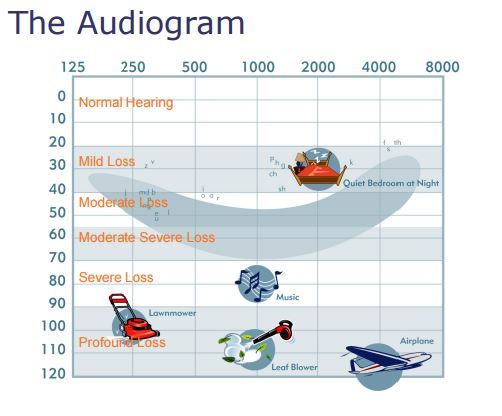
Hearing loss is measured in terms of:
pitch loudness discrimination (how clear is what you hear)
The Audiogram
How does a cochlear implant work?
• sound waves enter through microphone • the sound processor converts the sound into a distinctive digital code • the electrically coded signal is transmitted across the skin through the headpiece to the internal portion of the device • the internal device delivers the sound to the electrodes • the electrodes stimulate the hearing nerve • the hearing nerve sends teh signal to the brain for processing
Hearing Aids Vs Cochlear Implants
Hearing Aids: • acoustically amplify signal • rely on the responsiveness of healthy, inner ear sensory cells Cchlear implants • converts speech info into electrical signals • bypasses the inner ear sensory cells & stimulates the hearing nerve directly
Inpatients VS Outpatients
Inpatients: patients still in the hospital after a traumatic event Outpatients: patients dismissed from hospital but who still require speech/language therapy
Work settings fpr Speech-Language Pathology (SLP)
Home health care (provide therapy in patient’s home) Clinics Schools (therapy for kids age 3-22)
What does an SLP do?
Evaluate provide therapy teach tools/strategies to help clients communicate AND help family members and caregivers communicate with clients • educate the client and family • continuing education
signs of dysarthria
• Slurred, choppy, or mumbled speech that may be difficult to understand • slow rate of speech • rapid rate of speech with a mumbling quality • limited tongue, lip and jaw movement • abnormal pitch and rhythm when speaking • changes in voice quality, such as a hoarse or breathy voice or speech that sounds nasal or stuffy
Causes of Dysarthria
Damage to nervous system pathways results in the inability to send proper messages from brain to the muscles involved in speech • stroke, brain injury, tumors • parkinsons, lou gehrigs, huntingtons, MS • cerebral palsy (damage to motor control venters of the developing brain during pregnancy, birth, or shortly after • progressive neurological disease
Upper Motor Neurons *UMN”
• originate in the motor cortex • axons synapse on cell bodies of lower motor neurons in brainstem and spinal cord • cell bodies and axons totally contained within central nervous system (CNS)