Carboxylic Acids and Esters
No description yet. This curated deck is ready for daily study.
Card preview (18)
What is the functional group of carboxylic acids?
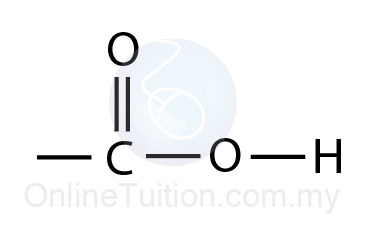
What are the names and structural formulae of the first four carboxylic acids?
• Methanoic acid - HCOOH • Ethanoic acid - CH₃COOH • Propanoic acid - CH₃CH₂COOH • Butanoic acid - CH₃CH₂CH₂COOH
What is the general formula of carboxylic acids?
CₙH₂ₙ₊₁COOH Note that this does not apply to methanoic acid
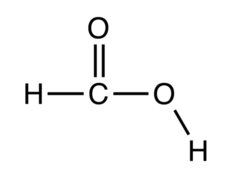
What is the displayed formula of methanoic acid?
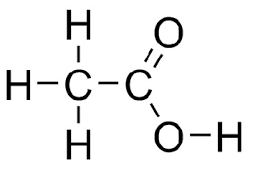
What is the displayed formula of ethanoic acid?
The displayed formuale of propanoic and butanoic acid follow a logical progression
What is vinegar?
An aqueous solution of ethanoic acid with the volume consisting of 5% ethanoic acid
What happens when a carboxylic acid reacts with a metal?
• They react with metals to form a salt and hydrogen just like other acids • For example: Ethanoic acid + magnesium –> magnesium ethanoate + hydrogen
What happens when a carboxylic acid reacts with a metal oxide?
• They react with metals to form a salt and water just like other acids • For example: Ethanoic acid + magnesium oxide –> magnesium ethanoate + water • This is of course a neutralisation reaction • As you should know, a similar thing will happen when reacting with metal hydroxides
What happens when a carboxylic acid reacts with a metal carbonate?
• They react with metals to form a salt, water and carbon dioxide just like other acids • For example: Ethanoic acid + magnesium carbonate –> magnesium ethanoate + water + carbon dioxide
What is the equation for the reaction between propanoic acid and sodium hydroxide (as an example)?
CH₃CH₂COOH + NaOH –> CH₃CH₂COONa + H₂O You can see that the metal displaces the hydrogen on the end of the functional group
What is the functional group of esters?
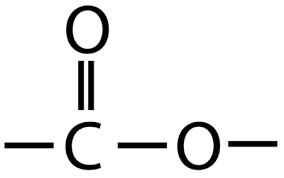
How are esters formed?
• Alcohols and carboxylic acids are reacted • This is in the presence of a concentrated acid catalyst (such as sulfuric acid) • The ester, along with water is produced This is known as an esterification reaction
How are esters named?
• The prefix of the alcohol used has ‘yl’ added to it • This is followed by the prefix of the carboxylic acid with ‘oate’ added to it • For example, if pentanol and methanoic acid are reacted together, pentyl methanoate will form
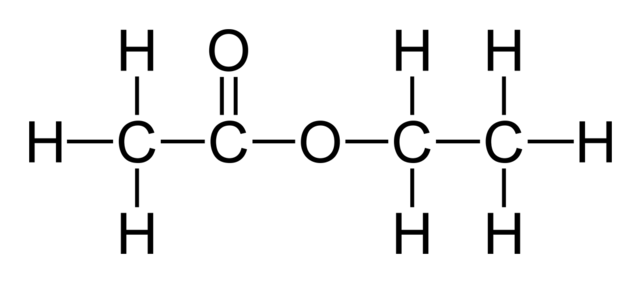
What is the displayed formula of ethyl ethanoate (as an example)?
• The carboxylic acid section is first, followed by the alcohol section • You can see that, when reacting, the carboxylic acid loses the OH on its functional group, and the alcohol loses the H on its functional group
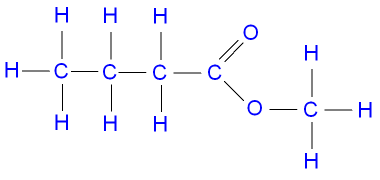
What is the displayed formula of methyl butanoate (as another example)?
What is the reaction between ethanoic acid and ethanol with the balanced chemical equation?
• Ethanol + ethanoic acid –> ethyl ethanoate + water • C₂H₅OH + CH₃COOH –> CH₃COOC₂H₅ + H₂O The reaction happens in the presence of a concentrated sulfuric acid catalyst
What are the general properties of esters and what are they therefore used for?
• Sweet, strong and distinct smelling • Volatile (easily evaporating) • They are therefore used as perfumes and sometimes as food flavourings
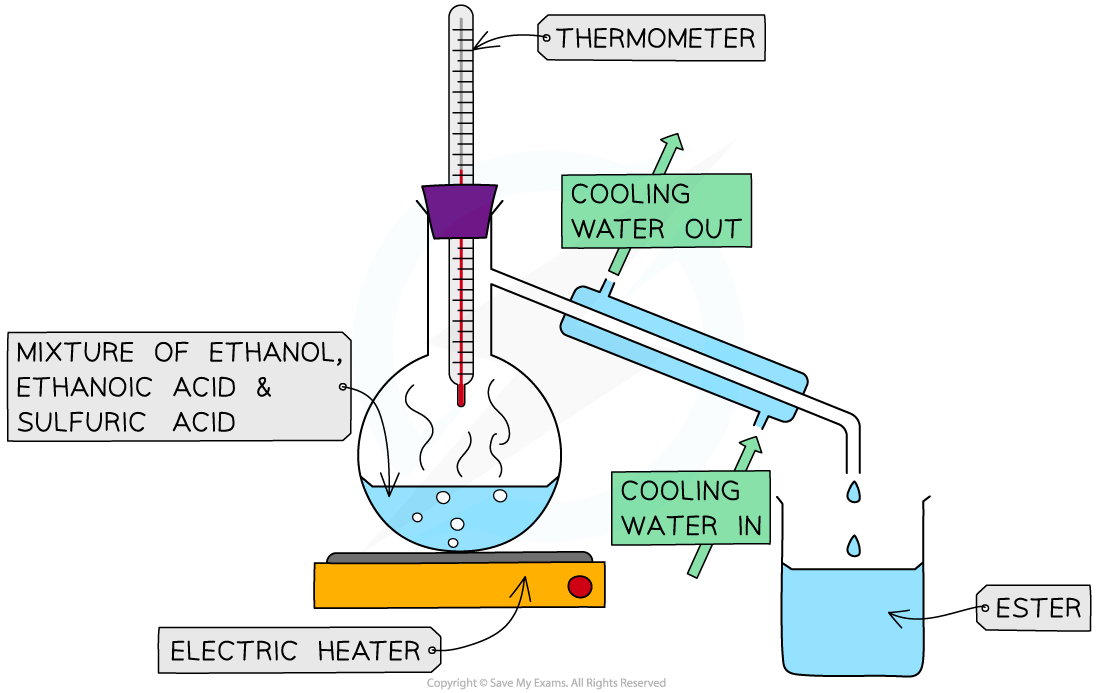
Describe an experiment to prepare ethyl ethanoate
• Mix ethanoic acid, ethanol and concentrated sulfuric acid and heat it with an electric heater • The ester is then distilled off and collected through condensation (this is easy as it has a low boiling point and is volatile) • Sodium carbonate can be added to the final solution to remove acidic impurities, and calcium chloride to remove alcoholic impurities