U2 HL friction and drag (7.2)
No description yet. This curated deck is ready for daily study.
Card preview (12)
friction def (2)
• When an object’s surface is microscopically rough, caused by ‘interlocking’ of the surface features of the two objects • Occurs when two surfaces are in contact and inhibits the movement of one surface over another
manipulation of friction
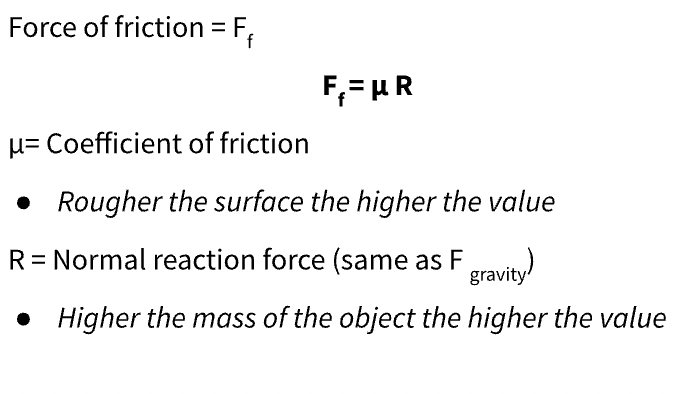
coefficient of friction (µ) - 2 why does it matter (4)
Different surface combinations have different coefficients of friction. The more interlocking they have the closer to 1 µ becomes. No unit and scalar. why does it matter: * Picking the appropriate material for a piece of sporting equipment. * Sliding sports * Base layer material * Picking the appropriate material for a playing surface (cleats / shoes).
types of friction (2)
• Static Friction is the frictional force between two static (non-moving) objects • Dynamic Friction is the frictional force between 1 dynamic (moving) and one stationary object. Same formula but the coefficient of friction is different if an object is moving or static. Once you pull with a force that is greater than the Static Friction force the object will start moving. Also, the friction will change to dynamic friction. Usually: µstatic>µdynamic therefore F static > F dynamic
what is drag (2)
The force or forces acting to oppose the motion of an object through a fluid medium such as air or water. Drag is caused by the object bumping against the particles of the medium. Even though microscopic, all of this bumping will slow you down. Newton’s third law • Fluid = liquid or gas ex: Air resistance, water resistance, sticking your hand out the window of a moving car, etc.
type of drag: surface drag (3)
The drag found between a solid surface interacting with the fluid medium. * As the object moves through the medium, the fluid that touches the surface will be slower than the fluid further away from the object. * This difference of speed of the fluid causes the drag. Ie: swimming
type of drag: form drag
As an object pushes through a fluid, the fluid pushes back on the object. Ie: cycling, bobsled, skiing
type of drag: wave drag (3)
• When a body moves along the surface of a fluid (usually water) some fluid is displaced to form a wave. These waves cause additional forces that oppose motion. • Fluid on fluid friction. • Forward motion creates a wave of fluid which interacts with the stationary fluid. This causes drag which slows down the object.
manipulating surface drag
The smoother the object is, the less contact it will have with the fluid. Less contact leads to less drag. Swimming: shaving all body hair before a race reduces surface drag Racing: wearing smooth and/or slippery clothing Bobsled/Cycling: smooth/slippery materials
manipulating form drag:
Reducing the size of the surface interacting with the fluid Swimming: swimming in streamlined position Cycling: cycling in a tuck position, helmet design Speedskating: skating in a tuck position with limited lateral movements Skiing: Tuck position Clothing: wearing form fitted clothing reduces form drag
manipulating wave drag
Reduce the time when on the surface of a fluid Swimming: holding your dive/flip turn for the full legal distance - more time underwater = less wave drag time
how does speed impact drag
Drag increases exponentially with speed. The faster you want to go the better you need to be at minimizing drag. Engineers and biomechanists spend a lot of lab time investigating small ways to reduce drag.