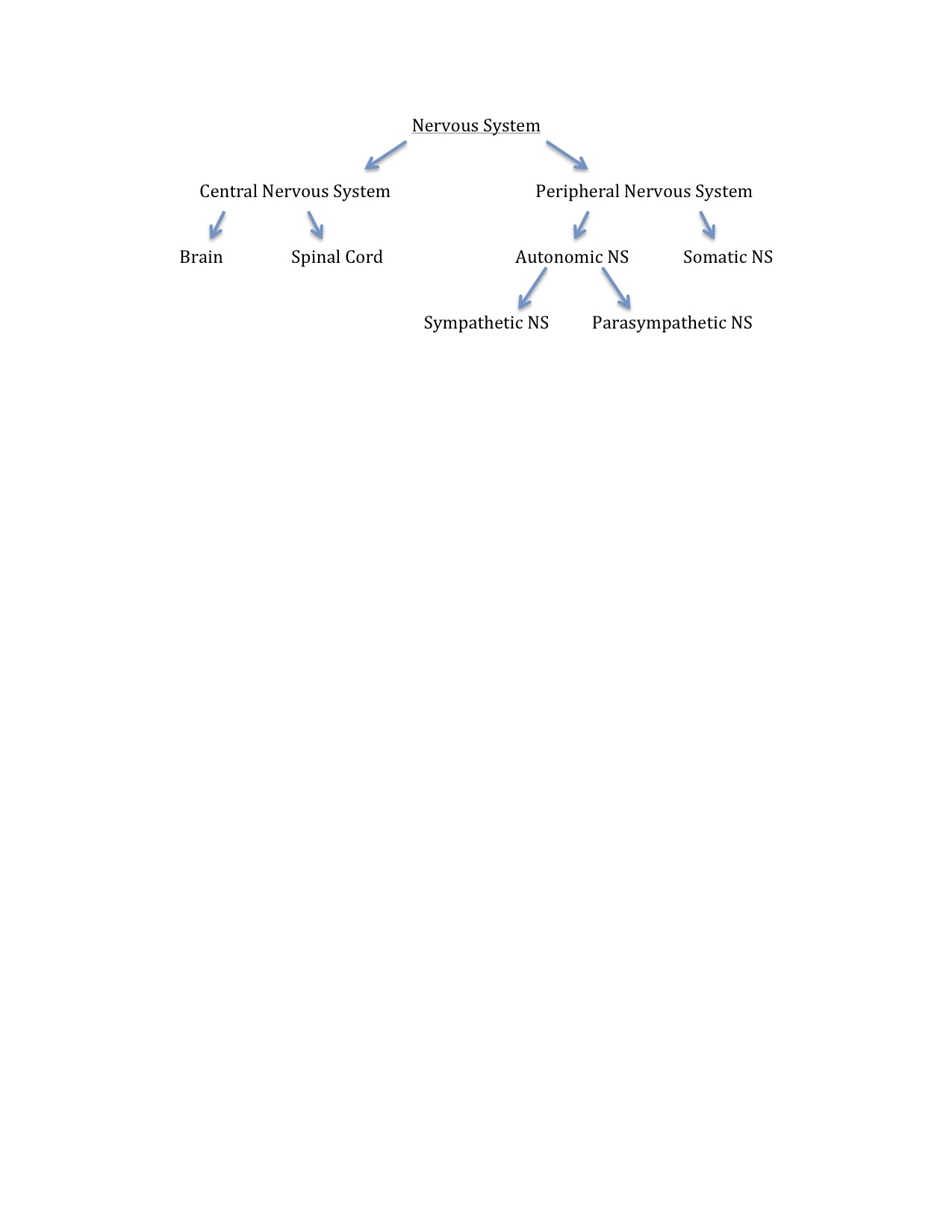
The Nervous System
No description yet. This curated deck is ready for daily study.
Card preview (21)
Central Nervous System
Comprised of the brain and spinal cord. Main processing center of body functions controlling all functions.
Peripheral Nervous System
Comprised of a network of nerve cells which pass sensory signals to the brain & spinal cord and motor signals to the body.
Sensory Nervous Cells
Carry signals to the central nervous system from internal organs or from external stimuli.
Motor nerve cells
Carry signals from the central nervous system to organs muscles and glands. Divided into the somatic nervous system and autonomic systems.
Somatic nervous system
Part of the peripheral nervous system Controls skeletal muscle and sensory organs such as the skin including touch, heat and cold. Voluntary because muscles can be controlled consciously. (exception are reflex reactions)
Autonomic Nervous System
Regulates unconscious processes including heart rate, blood pressure, respiration, etc. Involves control of cardiac muscle, smooth muscle, glands. Divided into the sympathetic and parasympathetic systems.
Parasympathetic Nervous System
Controls functions including inhibiting heart rate, constricting pupils and contracting the bladder. Activities which conserve energy and resources.
Sympathetic System
Speeds up heart rate, dilates pupils, and relaxes the bladder and increases metabolism. Provides the “fight or flight” response. Controls activities that increase energy expenditure.
Neurone
Nerve cells which generate and transmit electrical impulses.
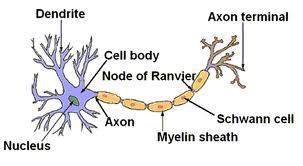
Name the parts that make up a neurone
• Dendrite • Axon • Neucleus • Myelin sheath • Schwann Cell • Axon Terminal • Node of Ranvier
Dendrites
Branchlike projections from the cell body which make connections to other cells or perceive the environment. Can be located on one or both ends of a cell.
Axon
Cablelike projection that carry the action potential along the length of the cell.
Myelin Sheath
Myelin is made of fat and protein which covers the axon, and it helps to speed transmission of a nerve impulse down a long axon. Myelinated neurons found in the peripheral nerves (sensory and motor neurons). Non-myelinated neurons found in the brain and spinal cord.
Node of ranvier
Tiny spaces between the myelin sheath, a micrometer in length, which exposes the axon to the extracellular fluid. Serves to facilitate rapid conduction of nerve impulses.
Action Potential
Reversal of electric polarization of the membrane of a neuron or muscle cell. In the neuron an action potential produces the nerve impulse. In the muscle cell it produces the contraction required for all movement.
The Brain
Cerebrum - largest part of the brain, receives sensory information, initiates muscle contraction for voluntary movement. Carries out processes including processing information, understanding, thinking, memory and personality. Cerebellum - coordinate voluntary movement, posture and balance **Brain Stem **- contains vital function centers, controlsbreathing and heart function. Relay station between the spinal cord and the higher parts of the brain.
Spinal Cord
• Long cylinder of nerve tissue, which passes through channels in vertebrae which protect it. • Contains 31 pairs of spinal nerves relaying nerve impulses between the body area they serve and the spinal cord • These nerves establish the link between the peripheral and central nervous system
Axon Terminal
The end of the neuron where the electrical pulse causes voltage gated calcium channels open causing the synaptic vessicles to bind to the membrane.
Synapse
Gap between nerve cells which neurotransmitters cross to continue signal transmission.
Motor Neurone Disease
Disease which destroys essential nerves transmission causing failure of essential muscle activity such as speaking, walking, breathing, and swallowing. There is no cure for the disease and not much information on how it develops.
The Nervous System Flow Chart