3.5 Alcohols
No description yet. This curated deck is ready for daily study.
Card preview (24)
Key points about alcohols :
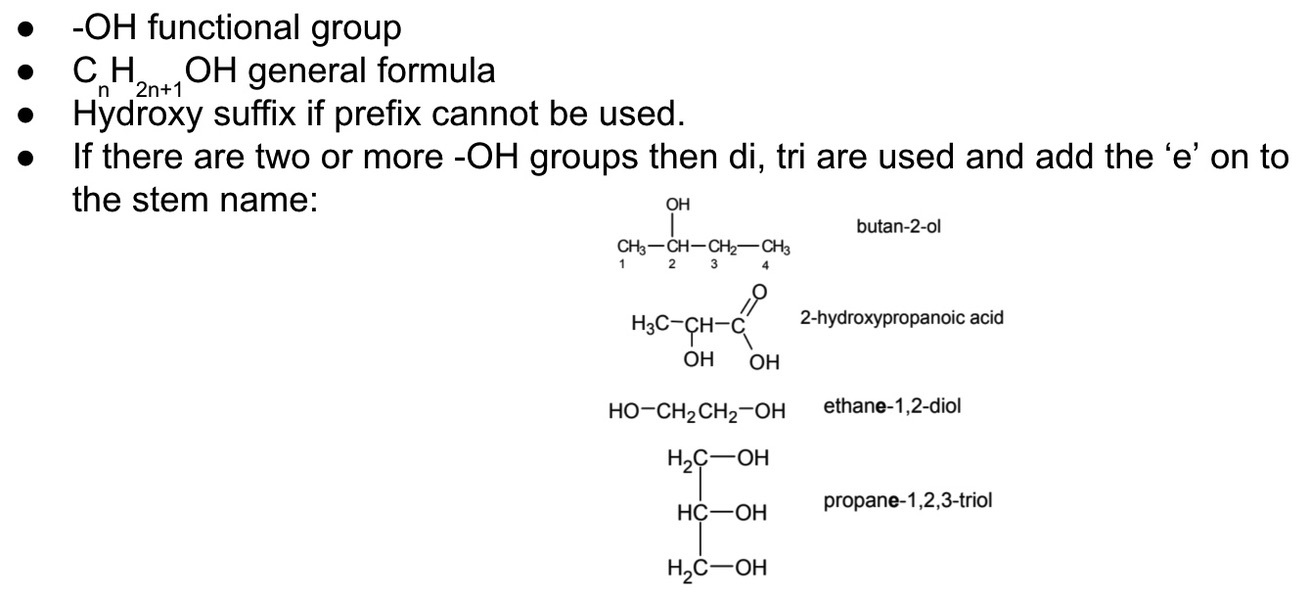
Physical properties of alcohols in water :
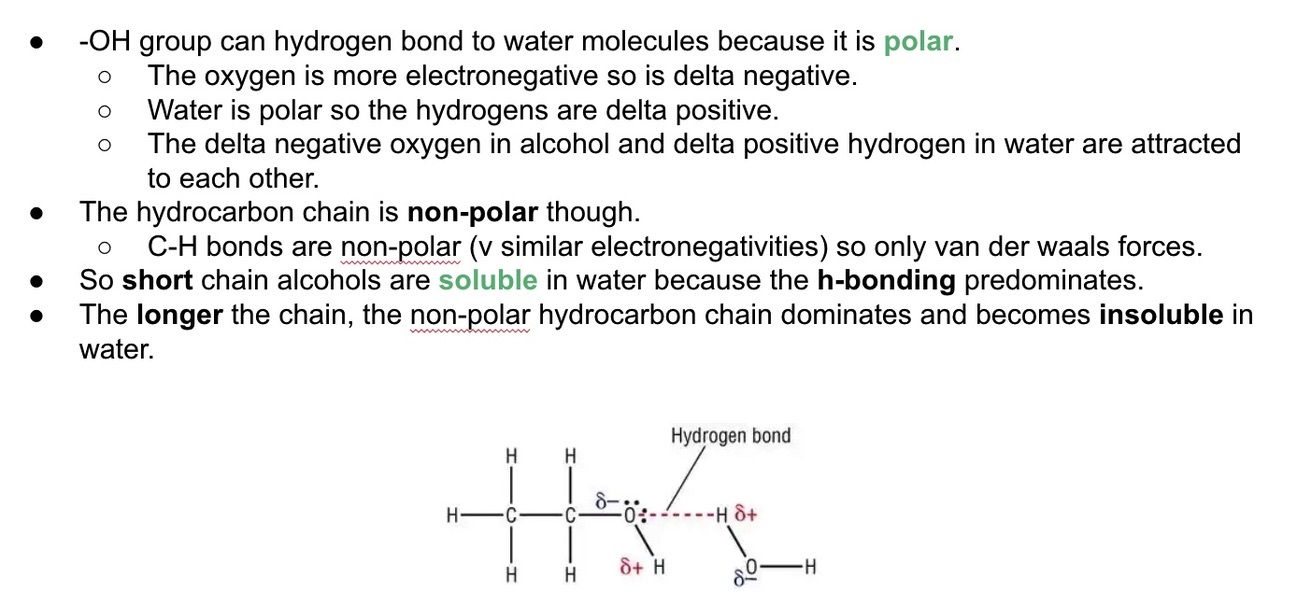
What are the boiling points of alcohols (key points)
• Higher melting and boiling points than alkanes of similar relative molecular mass due to hydrogen bonding • -OH group can hydrogen bond to other alcohol molecules because it is polar • The delta negative oxygen in alcohol and delta positive hydrogen in next alcohol are attracted to each other
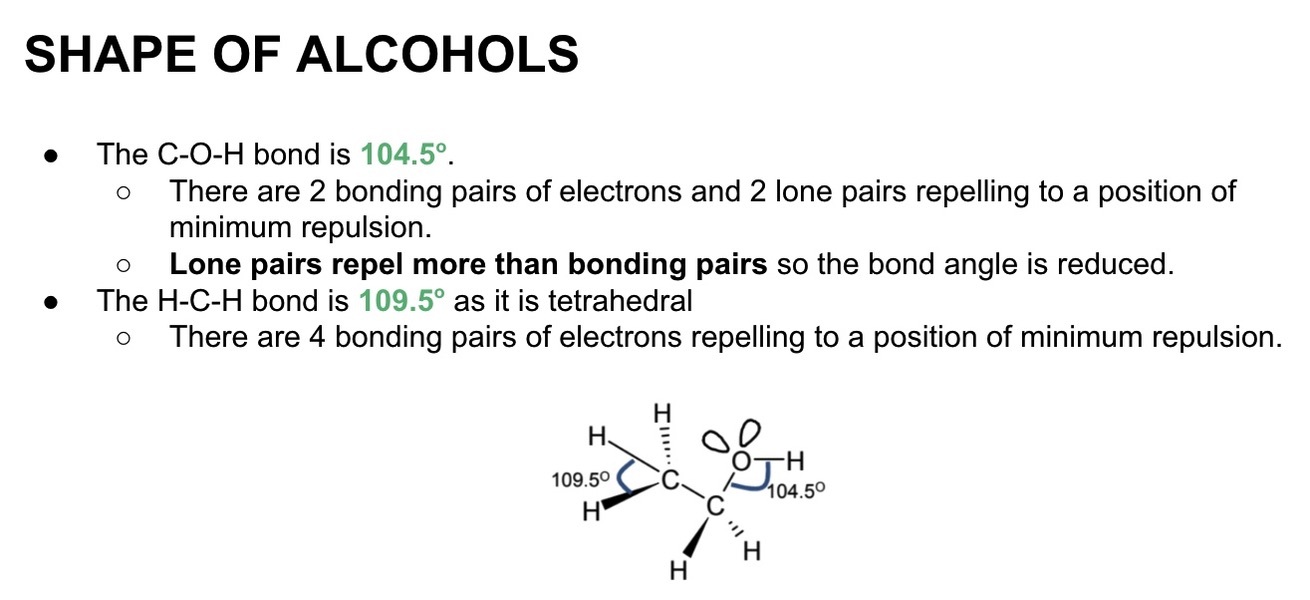
What is the bonding shape of alcohols ?
Uses of ethanol
• Used as a solvent to make substanced like detergents and pharmaceuticals • Can be used as a fuel, a biofuel if made by fermentation Biofuel - A fuel that is made from biological material that has recently died
What are the two methods of production of ethanol ?
• Fermentation • Hydration of Ethene
What is the process of fermentation ?
• Plants photosynthesise and produce glucose • Carbohydrates (glucose) made from plants are converted into ethanol by the action of enzymes from yeast It is an exothermic process called anaerobic respiration

What are the conditions for fermentation ?
• The rate of this chemical reaction is affected by temperature due to the yeast enzymes which denature if the temperature is too high or low and the reaction is too slow, a compromise temperature of about 35C is used • It occurs at atmospheric pressure - 1 atmosphere • Anaerobic - Air is kept out of the fermentation vessel to prevent oxidation of ethanol to ethanoic acid
What are the advantages of fermentation ?
• Fermentation is cheap • Uses low tech equipment • It uses renewable resources
What are the disadvantages of fermentation ?
• Batch process which is slow and gives high production costs • Procuses impure ethanol which requires frac dist • Fractional distillation occurs after to purify it which takes extra time and money • Depletes land used for growing food crops
What is the process of the hydration of ethene ?
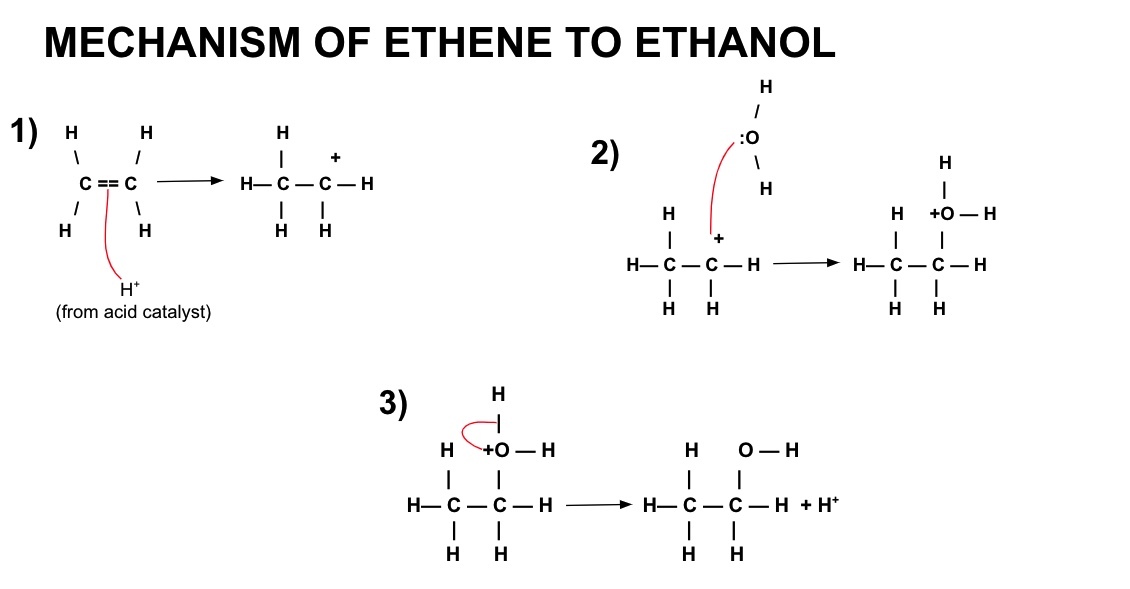
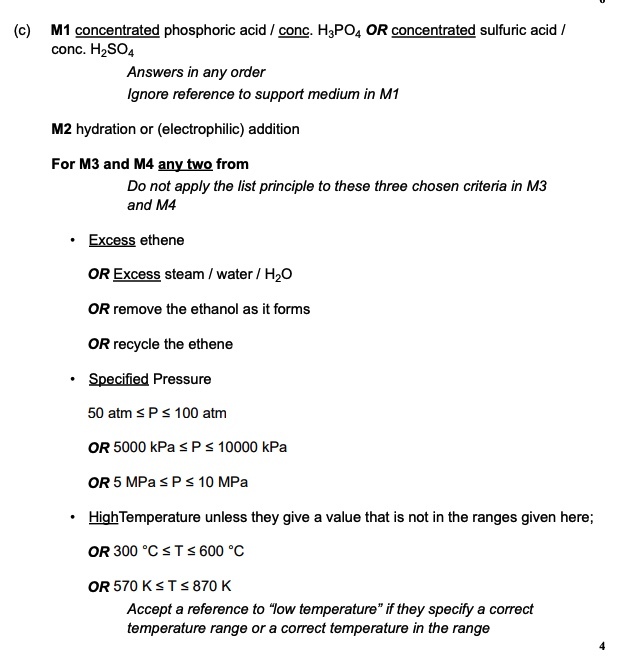
• Ethene is produced when crude oil fractions are obtained and cracked thermally (zeolite catalyst) • Ethene is then hydrated where water is added over the double bond • This reaction required the presence of an acid catalyst (phosphoric acid)

What are the conditions for the hydration of ethene ?
• The temperature is 250-300C, high so that the double bond can break • The pressure needs to be high at 70 atmospheres so water can break the double bond
What are the advantages of hydration of ethene ?
• It is an continuous process • Faster reaction • It makes ethanol that is very pure
What are the disadvantages of hydration of ethene ?
• The raw material is crude oil which is non-renewable (will become more expensive when raw materials run out) • High technology equipment needed (expensive initial costs) • High energy costs for pumping to produce high pressures
What is the mechanism for ethene to ethanol ?
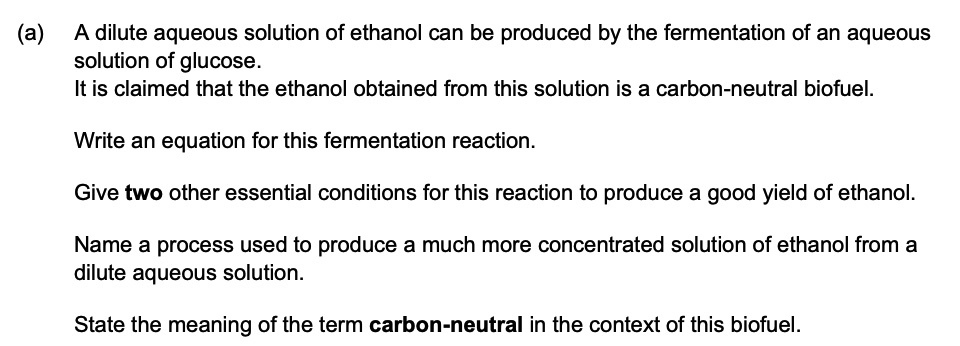
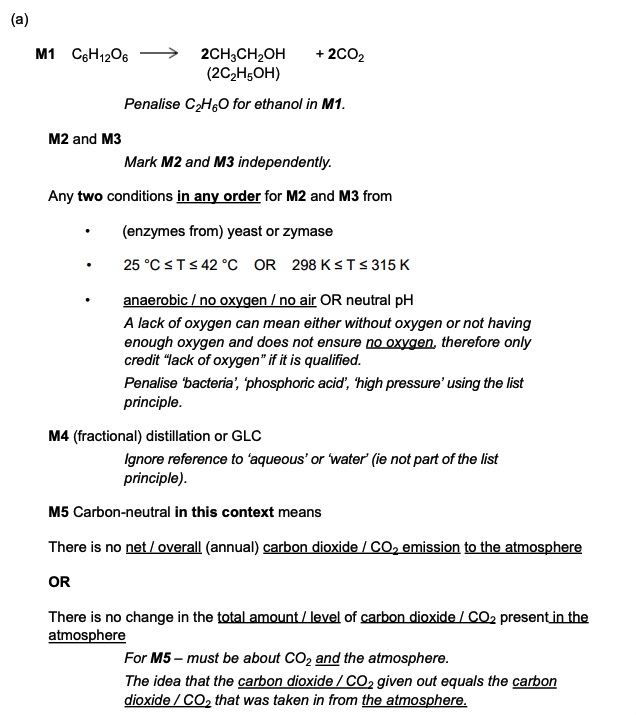
Write an equation for the reaction occurring during fermentation
C6H12O6 > 2C2H5OH + 2CO2
In industry, this fermentation reaction is carried out at 35 °C rather than 25 °C. Suggest one advantage and one disadvantage for industry of carrying out the fermentation at this higher temperature (2)
• Advantage – ethanol is produced at a faster rate • Disadvantage – more energy is used / required in the reaction
The method used by the student in part (b) would result in the ethanol being contaminated by ethanoic acid. How does this contamination occur? (1)
Air gets in / oxidation occurs
(5)
Give the meaning of the term mean bond enthalpy (2)
• enthalpy / heat / energy change (at constant pressure) or enthalpy / heat / energy needed in breaking / dissociating (a) covalent bond(s) • averaged for that type of bond over different / a range of molecules / compounds
Give one reason why the ethanol produced by fermentation may not be carbon neutral (2)
• A specified process e.g. planting / harvesting / transport / extracting sugar / distilling ethanol solution / fertiliser production etc. • The specified process uses / burns (fossil) fuel that releases CO2
Suggest one reason, other than safety, why this method is not used in industry to make ethanol (1)
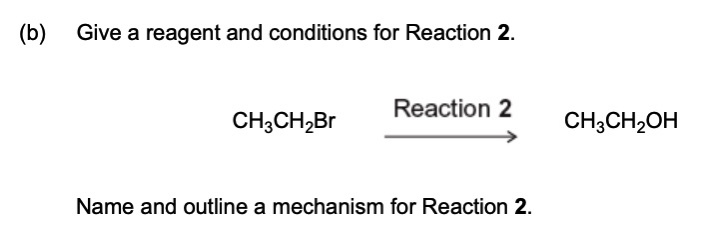
• The yield is (very) low / not a high yield OR elimination occurs / ethene formed • The rate of reaction slow • Bromoethane has to be manufactured / made first • Bromoethane is expensive
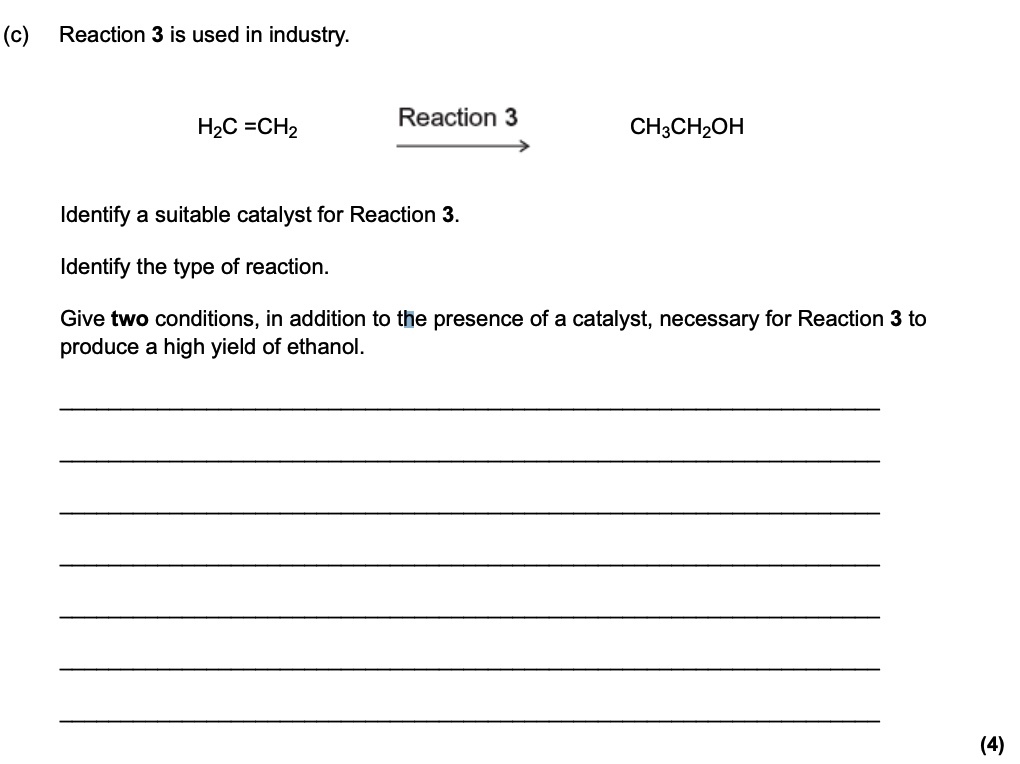
Use the equations for Processes 1, 2 and 3 to show why it can be claimed that there is no net emission of carbon-containing greenhouse gases (3)
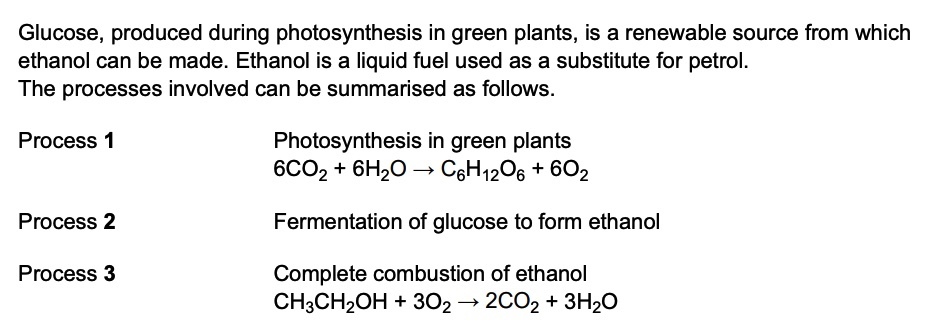
• 6 (mol/molecules) CO2/carbon dioxide taken in/used/used up (to form glucose or in photosynthesis) • 6 (mol/molecules) CO2/carbon dioxide given out due to 2 (mol/molecules) CO2/carbon dioxide from fermentation/ Process 2 and 4 (mol/molecules) CO2/carbon dioxide from combustion/Process 3